Read Real Japanese Essays : Contemporary Writings by Popular Authors edited by Janet Ashby (Kodansha) ~Ernie Hoyt
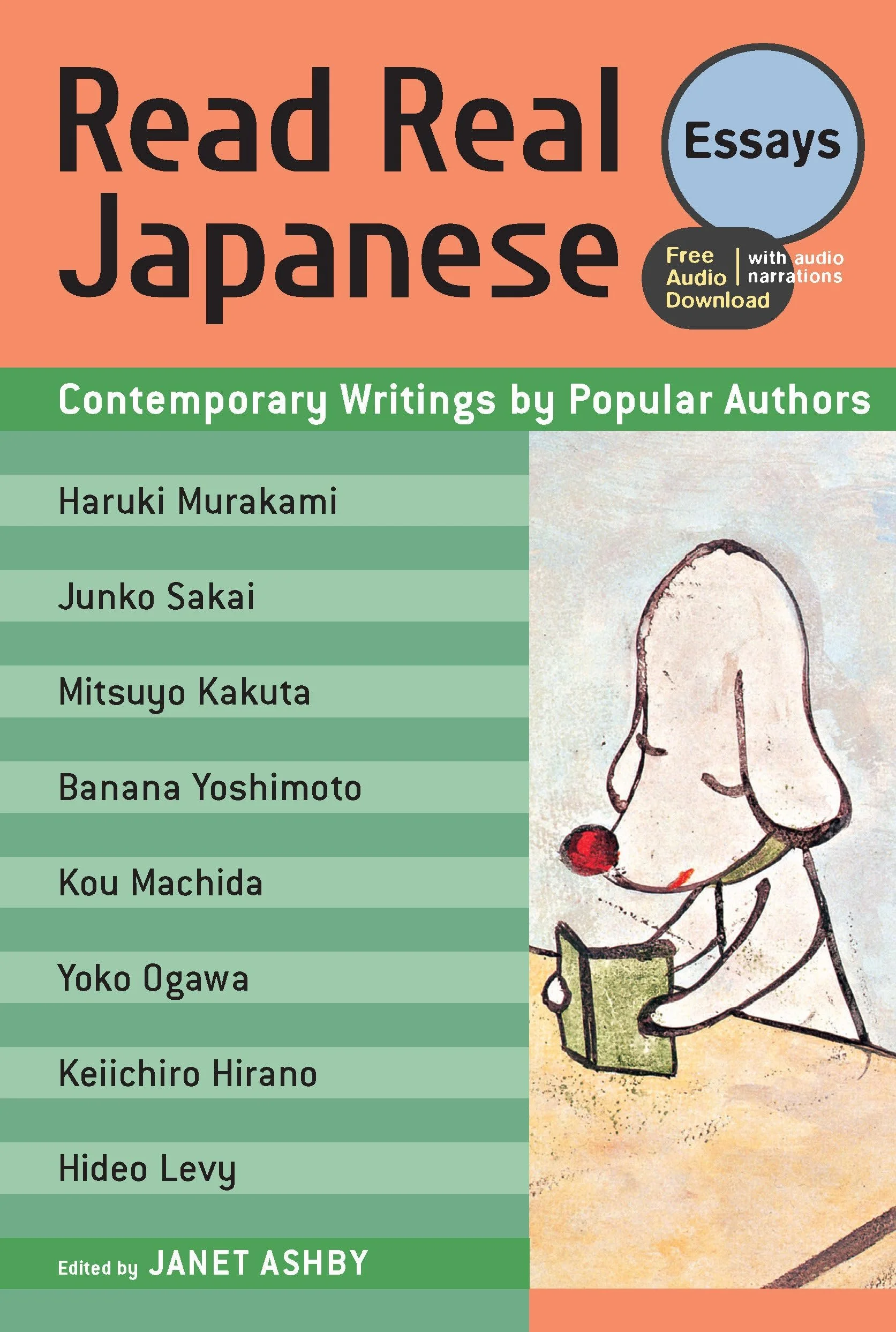
I wasn’t really intending to read another book in Japanese yet. I thought this title included essays by popular writers in Japan such as Haruki Murakami, Banana Yoshimoto, and Yoko Ogawa. I was interested in reading their essays only to open the book and find that their essays were all written in Japanese.
I suppose I shouldn’t have been surprised as this is a book for people studying the Japanese language. The book includes a free CD with audio narrations and Japanese-English dictionary to help you understand the writings better.
The book also provides notes explaining the nuances of certain passages in Japanese, grammar usage and Japanese culture. It includes eight essays written by the likes of Harumi Murakami, Junko Sakai, Mitsuyo Kakutta, Banana Yoshimoto, Kou Machida, Yoko Ogawa, Keiichiro Hirano, and Hido Levy.
The editor, Janet Ashby, is a longtime resident of Japan. She has been living in the country since 1975. She used to write a column for the Japan Times on Japanese books. On the back flap text, Ashby writes, “There is a world of difference between reading Japanese that has been specially contrived for students and reading real Japanese - that is, real-world Japanese written for native speakers”.
As a long time resident of Japan myself and being a self-taught reader of Japanese kanji, I have a general understanding of what she is trying to convey. I have never studied to speak, read or write Japanese - I was brought up bilingual because my mother is Japanese and I lived in Tokyo during my elementary school years.
It was my mother who taught me how to speak Japanese and read and write in hiragana and katanata which are two forms of Japanese writing. Unfortunately, my mother did not teach me any kanji. All the kanji I know, I learned on my own. I really enjoyed reading the essays by Murakami, Ogawa, and Levy.
Haruki Murakami’s essay 真っ白の嘘 (Masshiro no Uso), which translates to “Little White Lies” was originally written for the fashion magazine An-An. Murakami says he’s not a good liar but he doesn’t mind telling little white lies. One of his anecdotes is about being asked to write book reviews. In his mind, he says, “I’m a writer, not a book reviewer”. However, he decided to accept the job. However, Murakami says writing regular book reviews is kind of boring so he would invent an imaginary book and comment in depth about it or he would talk about a biography of a writer that doesn’t exist. His reasoning was, “I could save the time to read a book”.
Yoko Ogawa, author of The Memory Police (Asia by the Book, October 2021) and The Housekeeper and the Professor (Asia by the Book, June 2009) wrote an essay titled 「博士の愛した数式」をめぐって (‘Hakase ga Aishita Sushiki’ wo Megutte) which translates to Concerning [The Professor’s Beloved Equation].
The Professor’s Beloved Equation is the direct literal translation of the Japanese title. The book won the first Bookseller’s Award in 2004. Not only did the book win the first Bookseller’s Award, it also won the first Mathematical Society of Japan (MSJ) Publication Prize in 2005, much to the author's surprise.
Ogawa was also invited to attend the award ceremony at Nihon University, College of Sceince and Technology, Surugadai Campus. As this was a Mathematics Convention and the awards ceremony would be held between lectures and symposiums, she had no idea what to expect.
Ogawa was shown to the reception center and found herself seated next to Professor Yasuo Morita, the chairman of the MSJ. As she was seated, she thought, “what points in common could there possibly be? What on earth would I say to him?”. She also noticed that the Professor seemed to be at a loss as well and “could sense him feverishly searching for an appropriate topic”.
Ogawa breaks the silence by asking the Professor about something she researched and wrote about in her novel but still doesn’t fully understand - the Napierian logarithm (e) which is used in Euler’s formula that the professor loves.
The chairman answers her question by drawing a diagram on a sheet of paper and explains it in simple terms. Simple for him perhaps, but I still didn’t understand it and I still don’t understand logarithms, imaginary numbers, sin and cosine and whatnot. Math is just not my forte.
Hideo Levy’s essays are on words and cencpets that have no equivalents in English. The title of his essay is 「文学者」の国に、ぼくがいる (Living in the Land of the ‘Bungakusha’). It’s this concept of the bungakusha that mystifies Levy. In Japan, bungaku is literarature. A writer is a 作家 (sakka), and a literary critic is a 文芸評論家 (bungei hyoronka).
So, what exactly is a bungakusha? Levy is still uncertain of how to explain this concept in English. Bungakusha is just one of many words and concepts that is very difficult to explain in English. I think native English speakers are still confused by the concept of wabi sabi or the usage of ostukaresama. Even after living in Japan for over thirty years, I am still confused by many of these concepts.
Although the essays are all written in Japanese, they are short and easy to read, especially with the English translations printed on the opposite page. The essays give you an idea of the Japanese mind as you will be reading real Japanese.