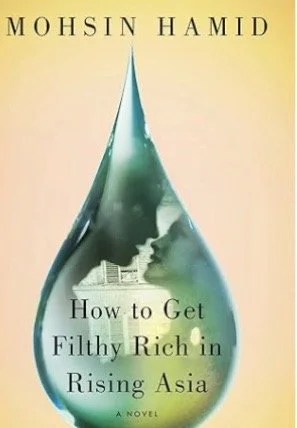
How to Get Filthy Rich in Rising Asia by Mohsin Hamid (Riverhead Books) ~Janet Brown
Ever since Dale Carnegie launched the publishing phenomenon known as self-help by writing How to Win Friends and Influence People, "How To" titles have dominated best-seller lists for the past ninety years. Well aware of this, Mohsin Hamid used this form as a peg from which he's hung this novel, exploring and lampooning self-help books, while exploiting them with his title, How to Get Filthy Rich in Rising Asia.
Hamid begins by addressing "you" the reader, as every self-help book does. "But," he says, "the idea of self in the land of self-help is a slippery one" and "you" swiftly becomes a small boy, "huddled, shivering, on the packed earth under your mother's cot." Confused? Get used to it, as Hamid frequently swerves from You the reader to You the protagonist all throughout the novel.
You the protagonist is a plot device and one that many readers have encountered before. "You" is never given a name, but then no one in his story has one, not the parents nor the master nor the pretty girl. They are all specimens under the lens of a microscope.
You the reader watches You the protagonist move to a city when he's very young. You see him go to school, fall hopelessly in love with the pretty girl, leave the university to go to work after his mother dies. You see him achieve success after working in sales with "the master" who by example teaches him how to maneuver in the business world. You watch him develop a thriving bottled water business that might have become an empire if he weren't felled by a faulty heart and an unscrupulous partner. You observe how his life develops in tandem with that of the pretty girl and you appreciate how both of them find a peaceful old age.
What keeps You the reader from yawning and tossing the book aside is Hamid's sly sense of humor and his bursts of brilliance. When You the protagonist's parents take him and his two siblings from the village to the city, the "few hours on a bus...appear to span millennia," leaving "nature's pantry" and a clan of villagers to enter "layers of marvels and visions," where "now there are five." The family sits in the evening in front of a "sign of urban prosperity," a little black-and-white TV, with only You the protagonist given the ability to understand the credits that roll across the screen. He as the youngest son goes to school up to university level because his father has "recognized that in the city manliness is caught up in education." He learns to work the system in a city that’s “enormous, home to more people than half the countries in the world.”
When he meets the pretty girl, "her jaunty strut sticking out in your neighborhood like a bikini in a seminary," she becomes his beacon, a lantern in a lighthouse, blinking on and off, who disappears and returns. Both of them are propelled by ambition, both achieve what they want, and both of them find satisfaction when they lose what they've spent their lives chasing, in a city that’s become “part of a change-scented urban archipelago, spanning not just rising Asia but the entire planet.”.
Suddenly the self-help story becomes a tender fable with its last sentence giving the final lesson. "So may all of us confront the end."
As You the reader confronts the end, you realize the self that has been helped is the writer’s, taking a threadbare plot, adding discursions into the realm of self-help, and sparking it all with intelligence and perhaps a dash of desperation too. The readers who are writers will understand and sympathize while those who read but don't write will take consolation in Hamid's next novel, The Last White Man (Asia by the Book, August 2022). Although since Hamid claims that all books are self-help manuals, even fiction, maybe this won’t provide them with a huge difference.