The Reluctant Fundamentalist by Mohsin Hamid (Houghton Mifflin Harcourt) ~Janet Brown
Many travelers are familiar with this scenario. In a country where foreigners are easily spotted, someone who knows their language will strike up a conversation. Whether it's with another traveler or a local resident, this encounter can become surprisingly intimate. After all, two strangers in passing are perfect vessels for confidences since they will move on, never to meet again.
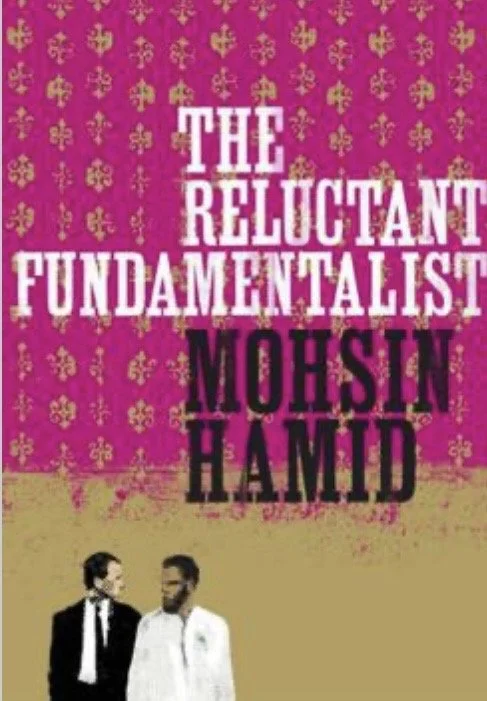
When Changez comes across an American in a Lahore cafe, he's happy to have a chance to use his English, which is flawless, and to tell his American story, which would be incomprehensible to his family and friends in Pakistan. Changez had an enviable grip on the American dream which he has turned his back upon without regret.
He is one of two Pakistani students who have been admitted with full financial aid to Princeton, where he "never received a single B." With the bearing and manners bestowed upon him by his well-bred family and with his impeccable GPA, he's recruited by one of the country’s leading valuation firms, given a job that comes with a hefty salary and that "virtually guaranteed admission to Harvard Business School" after working several years as an analyst. He's fallen in love with a WASP princess, "more to the camp of Paltrow than... Spears," and once he takes up residence in Manhattan, he becomes "Immediately a New Yorker."
But small moments of unease make him realize he isn't seen as one. When he meets the father of the girl he loves, the man announces "I like Pakistan. But you guys have got some serious problems with fundamentalism." When he's sent to Manila with a team of analysts, his American facade is pierced by a jeepney driver who glares at him as he sits in a limousine with his white co-workers. Then as the team prepares to return to New York, the World Trade Center topples and Changez is shocked to find himself smiling as he watches this alone in his hotel room. "I was caught up in the symbolism of it all, that someone had so visibly brought America to its knees."
The cracks in his perfect life widen as war engulfs Afghanistan and imperils Pakistan. Changez begins to marvel that America could "wreak havoc" so thoroughly while suffering "so few apparent consequences at home."
"My blinders were coming off" and while Changez is on a business trip to Brazil, an elderly man tears those blinders away by telling him about the janissaries, the Christians captured by Muslims who then "fought to erase their own civilization."
"I was a modern-day janissary, a servant of the American empire," Changez realizes, a man whose work is based upon "a focus on the fundamentals," and "a pursuit of those fundamentals" with a single-minded obsession on determining value. But after this fateful encounter, he realizes that his "days of focusing on fundamentalism were done."
As he concludes the story that he tells to an American stranger who has no apparent reason to be in Lahore, threats are hinted at without defining against whom those threats might be directed. Changez's monologue takes on a desperate speed and ends with an enigma.
This novel, Mohsin Hamid says, took him seven years to write. Daring and original, it races through history that we all still remember and still are living through, no matter where in the world this novel is read. There are no heroes, no villains, only people trapped in their separate worlds, people who are clearly recognizable, capable of breaking hearts and changing perceptions.