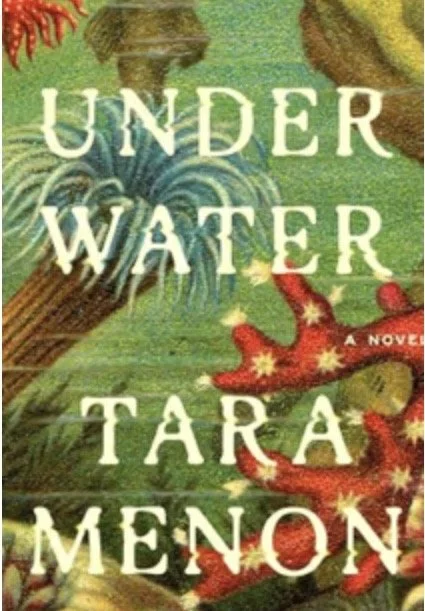
Under Water by Tara Menon (Riverhead Books) ~Janet Brown
Marissa lives on an island in the Andaman Sea. She and Arielle are closer than sisters because theirs is a bond of choice, not of blood. Together they grow up in a world of mangrove trees, a garden of coral reefs, and the constant presence of manta rays, benign sea creatures who must stay in constant motion or die.
Now Marissa lives alone in Manhattan where she's accompanied by a ghost. She's submerged by the peculiar kind of grief that can't be expressed in a single English word. When she tries to describe it, her listeners can't understand the depth of what she feels for someone who was neither a relative nor a lover.
While running from the tsunami of 2004, Marissa turns back and sees her friend vanish, as "the sea swallows her whole." Haunted by Arielle and obsessed with natural cataclysms, she waits for the hurricane that's approaching New York, "wanting to be where the earth convulses again." Alive and filled with survivor's guilt, Marissa is certain that Arielle's death is her fault. Now on a darker, colder island, she welcomes and invites this new disaster to come and sweep her away.
The Boxing Day Tsunami that devastated much of the South East Asian coast has been recorded in histories and memoirs. In Under Water, Tara Menon cloaks it in fiction but with details that evoke the stories of those who survived the wave.
Scorning the usual opening sentence of "It was a beautiful day," Menon tells of a holiday morning when dogs howl, spinning in circles, and an elephant trumpets as it escapes the control of its handler. Nobody understands why the birds go silent and few know what it means when the water recedes, "leaving the bay almost drained," until the "sea on the horizon lifts into the sky and slingshots back toward us as a black wall." Everybody begins to run except for Arielle, who stands still, watching the wave approach.
People, beach lounge chairs, motorcycles, an ice cream truck, twist, turn, and "corkscrew" in onslaughts of darkness and surging water. When the wave recedes at last, it leaves a surreal landscape of "a sofa resting on top of a car," "a back half of a bus sticking out of a shop," broken bodies, and the dead.
Within a day, the hospitals are filled beyond capacity. Dentists come to bring identities to the nameless corpses. Many of those bodies are very small; "estimates suggest that between a third and a half are children."
Earthquakes, hurricanes, floods, tsunamis come with such mythic force and destruction that they take on the power of myth. Menon mingles an earthly paradise that seems mythical with the brutal facts of what happens when humans are erased from it. The tragedies pass. The natural world heals itself and goes on.
Under Water is a cautionary fable, one that’s more essay than novel. Its beauty and its horror are both inescapably haunting. While Marissa and Arielle swiftly fade, the manta rays and the brilliant life of the coral reefs refuse to go away.