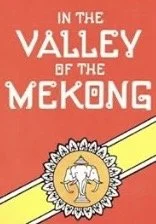
In the Valley of the Mekong by Matt J. Menger (St. Anthony Guild Press, out of print) ~Janet Brown
When I found this book in a New York used bookstore that's primarily devoted to baseball, I was so excited I didn't realize until I got back home to Seattle that it was written by a priest. Not to be bigoted, but I've only met one priest that I liked. Now I've met two.
Before Matt Menger went to Laos in 1957, he knew his education and his stint in the Vatican City had a couple of gaps that needed to be filled. He volunteered at one of America's leading medical centers on a six-month crash course in basic medical tasks like taking blood tests and picking up urine specimens. Then he shocked a surgeon he'd worked with by rolling out from under the doctor's car after completing its tune-up at Wagner's Garage. ("I'll be damned," the surgeon said, unaware of Menger’s primary vocation, "An intern working as a mechanic. Garage business must be good.")
This sets the tone for Menger's account of thirteen years in Laos, in the days before that country was completely racked by war, although hints of that were on the way. He arrives in Vientiane when the capital city still consists of "dirt paths, bamboo huts, and water buffalo" and is almost immediately sent off to a language school in the countryside on a rickety old Army truck that now serves as public transportation for "passengers, screaming babies and snapping ducks."
After two months of struggle with the multitoned Laos language, Menger is deemed ready to go to a nearby mission station and give a sermon in Lao. He gets through his memorized five-minute speech and ends with a request that all able-bodied men in the congregation come to help with "planting posts for the new church." The response is almost overwhelming and Menger feels proud of his language proficiency until he finds that his request actually asked for men to come and help steal the young girls.
Menger is a hands-on prelate whose energy is matched by his sense of humor, his observation skills, and his lack of moralization. When he needs men for a dangerous stint of well-digging, he finds his workers in an opium den. Without flinching, he watches a shaman administer an herbal remedy by expectorating it on a patient that Menger has just treated with a shot of penicillin. On a walk through the Plain of Jars, "a quiet sanctuary of beauty," he meets the denizens of the Bungalow, soldiers of fortune who fly cargos of opium to drop zones near Saigon, Phnom Penh and the Gulf of Siam and then relax over booze and opium. "But," Menger says, "these men were good to me."
He persuades American members of the International Voluntary Service to help him "launch Operation Red Island Red" and with the six roosters from the IVS, Menger's villagers are in the egg business.
"In Laos, he says, "I quickly learned that a priest must also be the village medicine man: general practitioner, pediatrician, surgeon, obstetrician, and dentist." He also needs to keep a rifle handy to dispatch visiting cobras and he learns to live with wild elephants. Human life, he discovers, is quite literally cheap. In a marketplace he watches an old woman assess the value of a new baby at four thousand kip or eight US dollars.
Menger is blessed with the gift of cultural relativism and acceptance, and has more than the usual abundance of courage, even as war advances and bombers smash 110 windows in the newly built but not yet opened orphanage.
His one bit of judgementalism is reserved for spirit houses, which he believes are harbors of witchcraft, saying "The burning of a spirit house is always a victorious moment.” His other flaw is a passion for exclamation marks which appear on almost every page of his book. However if readers exercise the same forbearance that Matt Menger displays throughout In The Valley of The Mekong, they're in for an adventure that few books will provide and they're going to have a rollicking good time.