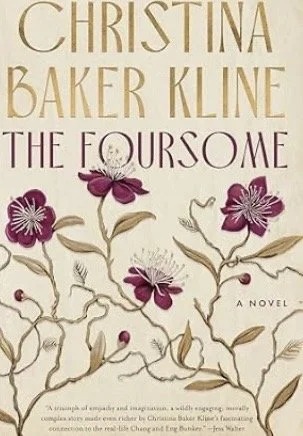
The Foursome by Christina Baker Kline (HarperCollins) ~Janet Brown
It would be easy to mistake The Foursome as a romance novel or even as a retelling of Beauty and the Beast. Two daughters of a wealthy plantation in rural North Carolina have been touched by scandal. Despite the beauty of the youngest and the ample charms of her sister, they remain unmarried until two gentlemen come to town. One of them is attracted to the youngest but he can't marry unless his brother does too.
The prospective suitors are the richest men in the county and they intend to stay. They've opened a general store, purchased 150 acres of farmland and have furnished their newly built house with a taste for luxury. They are "uncommonly elegant," well-traveled, and cultured. They have only one drawback. They are Chang and Eng, the world-famous Siamese twins, joined at the breastbone by a four-inch piece of cartilage. They've been together since birth and they will never be apart.
Once exhibited by showmen, they were able to break their contract when they turned twenty-one and are now U.S. citizens with all the rights that this confers. But they will always be seen as curiosities or, worse yet, freaks. Their existence provokes gossip and vulgar rumors about how two men in one body can conduct basic physical actions.
The youngest sister, Adelaide, swiftly makes her decision. She will never have a better offer than the one she's received from Chang and she's pragmatic enough to accept it. But she can only marry him if her older sister accepts Eng. One woman in a bed with two men will incite charges of polygamy.
Sarah agrees to a double wedding and the sisters and brothers enter into a marriage that will last for over thirty years, until the deaths of Eng and Chang. The brothers build a second house when their wives begin to have children and long for homes of their own. Eventually they have large families, Sarah with eleven children and Adelaide with ten.
In this account of two unconventional marriages, Christina Baker Kline delves into the lives of the two sisters, concentrating mainly upon Sarah, who was inexplicably buried far from the graves of Eng, Chang, and Adelaide. Kline has reason for this focus. Sarah and Adelaide, she says, were "distant cousins of mine,” and she is one of 1500 descendants of the family the two women formed with these two men from Siam.
Her research has been thorough. Even the most incredible details in her book are corroborated by a scholarly examination of Chang and Eng's lives, Inseparable by Yunte Huang. (in fact Kline took the name of her book from a chapter in Huang's that describes the two marriages and is entitled The Foursome.)
The solution that the twins find to the dilemma of sharing a body as described by Kline is corroborated by Huang. Every three days, a husband lives with his wife. During that time, his brother remains as detached as possible, silent and emotionally removed. This was the way they led their lives, Huang says, "with an understanding of 'alternate mastery. Each in turn controlled all actions, while the other practiced a "mental withdrawal," "blanking out."
The twins die within hours of each other. Sarah and Adelaide reluctantly agree to an autopsy in which it was found that the two men could never have been separated, nor could one live without the other. The brothers shared a liver and were connected by its tissue.
This organ is now exhibited at the Mutter Museum in Philadelphia, ensuring that two men who did their best to live normal lives are still gawked at by hordes of intrusive strangers.