Untangling My Chopsticks by Victoria Abbott Riccardi (Broadway Books/Random House)

"I have always believed you can learn as much about a culture by the ingredients that they put in their mouths, as by the buildings they erect", says Victoria Abbott Riccardi. She's a woman who has definitely put her money where her mouth is, having abandoned her high-powered Manhattan advertising job where "stress poisoned the air" to live in Kyoto and study the art of preparing kaiseki meals, the elaborate food that is served at a tea ceremony.

untangling.jpg

A veteran of a year at Le Cordon Bleu and a former sous-chef at a Parisian restaurant, Victoria was more than a casual cook. She had already been immersed in the discipline and techniques of haute cuisine and possessed a culinary confidence that would serve her well while she studied at one of Kyoto's leading tea schools.

The art of tea originated in Kyoto's 12th century Zen monasteries, spread to the imperial court, and became an artistic and spiritual influence throughout Japan. Making tea in a formal ceremony is a "spiritual ballet" and the food served with the tea is "a set series of tiny exquisite dishes that change with the seasons." When accepted at a school where her teacher was a direct descendant of the man who refined the tea ceremony in the 16th century, Victoria became steeped in the highly detailed history of a complex ritual.

Balancing the extreme formality of tea kaiseki was Stephen, the American fellow-student who became Victoria's mentor, and Tomiko, the woman who opened her household and the art of Japanese home-cooking to a stranger. Living and cooking with Tomiko's family, while preparing kaiseki with Stephen for tea ceremonies that took place away from their classroom, Victoria traveled beyond the world of a foreigner's guesthouse to a place that visitors seldom see.

From exploring supermarkets to learning the symbolism of her tea school's "paradise garden," from making delicate cherry-sized orbs from sea-urchin eggs and lily bulbs to pounding rice with a mallet for mochi cakes at New Year's, learning from painful experience the waist-choking discomfort of an obi-bound kimono and the humiliation of "feeling like a big, fat Alice in Wonderland" when wearing a baby-doll dress and a frilly pinafore in a short-lived modeling assignment, Victoria reveals the contrasts of her year in Kyoto in vivid and candid stories.

With an artist's eye, she gives precise descriptions of the city's seasonal beauty, of streets that lead back into time, of the visual abundance and glory of a fresh food market. She recreates the sheer terror of standing before a class of Japanese five-year-olds, the difficulties of being a "lounge lady" at an English conversation club, and the special problems of introducing her visiting New Yorker boyfriend to the pleasures of the public bath and a holiday at "the Jersey shore of Japan." She explains why a sushi chef has good reason to hate anyone who adds wasabi to the soy sauce that accompanies sushi, and perhaps best of all, at the end of almost every chapter she provides recipes for the food that she has enticingly described.

Although not a travel guide, this is undoubtedly a book that will launch a thousand trips. It should be tucked into the luggage of any first-time visitor to Kyoto.~Janet Brown

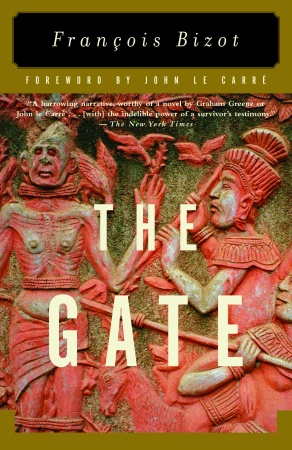
The Gate by Francois Bizot (Vintage Books/Random House)

gatepaper.jpg

Francois Bizot was a Khmer-speaking Frenchman, an ethnologist who searched for old manuscripts and art that would illuminate the religion and customs of ancient Cambodia. A man whose only gods were Saul Steinberg and Charlie Parker, Bizot lived in a village near Angkor Wat with his Cambodian wife and their little daughter. His world was “enameled with paddy fields, dotted with temples, a country of peace and simplicity.” Then the war in Vietnam spilled over the border into Cambodia and Bizot and his family moved to the urban safety of Phnom Penh.

While working thirty miles from Phnom Penh with two of his Cambodian colleagues, Bizot and his companions were captured by a group of Khmer Rouge. They marched at gunpoint for three days to a remote village, where they were confined on their backs, their ankles shackled within two wooden beams. As they lay there alone and in pain, they could hear the sound of bare feet approaching and a group of young girls, “pretty,” Bizot noted, “ just like those from my own village,” surrounded them and spat on their faces.

The man who was in charge of this Khmer Rouge outpost was young, thin and suffering from malaria. “His authority was total. His silences were mightier than words.” Repeatedly he came to Bizot with pen and paper to receive written declarations of innocence. Bizot's statements were written in French but the conversations that he began to have with his jailer were in Khmer. “The bonds gradually forming between us depended entirely on our capacity to understand each other on common ground and this could be done only in his language.”

It was Bizot's ability to communicate in Cambodia’s language that convinced his captor of his innocence and prompted this man to persuade the Khmer Rouge leadership that the Frenchman should be freed. After three months of imprisonment, living in shackles, witnessing death, and experiencing humiliation and torment, Bizot was released. No other prisoner left that camp alive; his Cambodian colleagues were executed after his departure, despite assurances from the leader of the camp that they would be safe.

Four years later, the Khmer Rouge took Phnom Penh. The Americans had fled, Bizot had sent his daughter to France, and his wife joined the crowd of Cambodians who were ordered to evacuate the city.

Sent to the French embassy with all other foreign residents of Phnom Penh, Bizot used his Khmer language skills once more to advantage, becoming the link between the Khmer Rouge leadership and the foreign community, and the only foreigner authorized to leave the embassy walls. His descriptions of a city emptied of its inhabitants and of the Cambodian people who were denied the safety that lay behind the gate of the embassy are haunting and soul-wrenching.

Long after the Pol Pot years had passed, Bizot returned to visit Cambodia. The camp where he was held has become famously known as Anlong Veng and is now a tourist attraction. The man who held him prisoner and was responsible for his release is known to the world as Douch, the infamous leader at Tuol Sleng, the Phnom Penh high school that was turned into a center of torture and death. Bizot’s history, lived in Khmer, written in French, and translated into English, provides stunning testimony to whatever International Tribunal may someday stand in belated judgment.~Janet Brown

The Lizard Cage by Karen Connelly (Nan A. Talese/Doubleday)

Teza, known as “The Songbird,” lives in a cage, sentenced to twenty years of solitary confinement in a Burmese prison. He’s a twenty-five-year-old man who had wanted to be a rock star but his Twelve Songs of Protest fed Burma’s rebellion instead. Locked away in a “teak coffin,” he is starving for food, for the touch of the woman who, after the first seven years of his imprisonment, had married someone else, and for the freedom “to speak and be spoken to.”

lizard.png

Teza’s name means the fire of power and glory, and this fire lives in his voice. He sings his songs almost silently because to send them out for others to hear would add years to his prison sentence. He talks to the insects that live in his cell, to a jailer who becomes his friend and ally, and to the man who brings him meals and will betray him.

Within the walls of this prison lives a child, the son of a man who had worked there until his death turned the seven-year-old boy into an orphan. Searching for a safe place, the child builds himself a shelter from bits of scrap and becomes an errand boy, carrying meals and messages and contraband to the prisoners. The prison is his world; he dreams of leaving to see Rangoon’s splendor but his fear holds him back. At twelve, he is a boy without a name, known as Nyi Lay, Little Brother, who hoards old books given to him by prisoners but who cannot read, who never eats enough food to subdue the pain of his growing legs, and who has learned that to be silent is to be unharmed.

A cheap ball-point pen is the instrument of Teza’s betrayal and a treasure that inexplicably lands in Nyi Lay’s path. Soon after this new possession comes his way, the boy begins serving meals to a prisoner whose jaw is so badly broken that he cannot speak or eat without tearing pain, a man who pushes his food tray back to Nyi Lay and manages to utter one agonizing syllable, “Eat.”

Teza, brutally beaten and pulled back from death by a political system who values him as a symbol of imprisoned rebellion, is diverted from his morphine-fueled dreams only by the boy who brings him food, a nameless, silent child who resembles Teza’s younger brother. He feeds Nyi Lay, speaks to the boy through the jagged pain of his broken jaw, and slowly, in a place of brutality and impotence and filth, Teza hatches a plan filled with hope and power.

Karen Connelly has recreated this prison world and its inhabitants with careful research and the piercing language of a poet. The Lizard Cage is not an easy book to read nor is it easy to forget once finished. It is a book that will haunt imaginations, inhabit minds, and perhaps change lives.~Janet Brown

More books on Myanmar at ThingsAsian Books

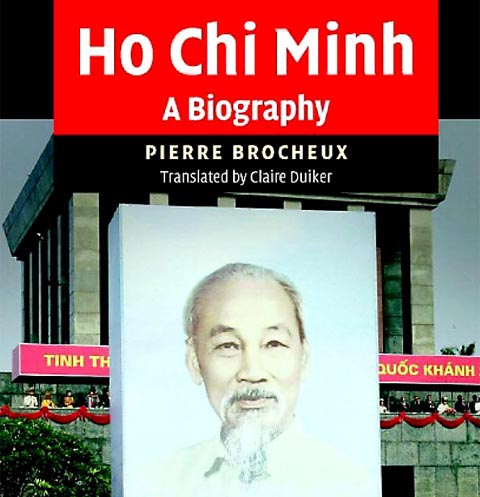
Ho Chi Minh: A Biography by Pierre Brocheux/translated by Claire Duiker (Cambridge)

Ho Chi Minh

Ho Chi Minh

It was an internationally acknowledged fact, when World War II was over, that Vietnam needed "protection". The French were eager to repossess their former colony. Chiang Kai-shek's government wanted to welcome Vietnam into "the great Chinese family." Franklin Roosevelt claimed that Vietnam would flourish under American stewardship. The only dissenter to these magnanimous offers was Vietnam.

On September 2, 1945, a declaration of independence announcing the birth of the Democratic Republic of Vietnam was read aloud by Ho Chi Minh. Middle-aged and physically frail, this was a man who had been so sick with malaria that he had been, only months before, “ a bunch of bones, staring with glazed eyes,” a man of many names who had been away from his country for thirty years and was now its figurehead.

Nguyen Tat Thanh was decades away from being Ho Chi Minh in 1911, when he arrived in France from Vietnam, an easily scandalized twenty-one-year-old who immediately asked “Why don’t the French civilize their own people instead of trying to civilize us?” Changing his name to Nguyen Ai Quoc, Nguyen the Patriot, he became a political activist, petitioning the Allies at Versailles in 1919 for Vietnam’s equality, autonomy and political freedom.

Lenin’s writing persuaded Quoc that revolution would end colonial oppression This led him to Communism and to Moscow, where he attended Lenin’s funeral, standing for hours in the frigid cold that left scars on his hands from frostbite.

Quoc traveled, studied and forged political ties in Russia, China, Southeast Asia and Europe. Delightful, diplomatic and blessed with a gift for languages, he was described by the poet Osip Mandelstam as “a man of culture…the culture of the future.”

Arrested and imprisoned in Hong Kong as a Communist criminal, Quoc faced extradition to Vietnam where he was faced with execution for “plots and assassinations.” His charm saved him. A British solicitor, Frank Loseby, visited Quoc and later wrote, “After thirty minutes, I was entirely won over.” Quoc’s death from tuberculosis was announced, and, with Loseby’s help, he was disguised as a Chinese scholar and escaped to Russia. Years later he reappeared in Vietnam as the resurrected Nguyen Ai Quoc, after having established himself as Ho Chi Minh, Well of Light, leader of the Viet Minh resistance movement and the man who would spearhead his country’s battle for freedom.

Ho’s life was defined by politics and his passion for Vietnam’s liberation; this biography is dense with historical and political background. Yet the man shines through the thicket of facts, with his wit and his poetry making Ho alive on the page: a Confucianist who adapted to Stalin and Mao, a man who fought France but loved the French, a poet who, while living in a cave for a year, wrote “Really, the life of the revolutionary is not lacking in charm.” Pierre Brocheux brings out a concise but skillful portrait from history’s obscuring layers of sainthood and demonization, allowing Ho to declare once more, “I am a normal man.”~Janet Brown