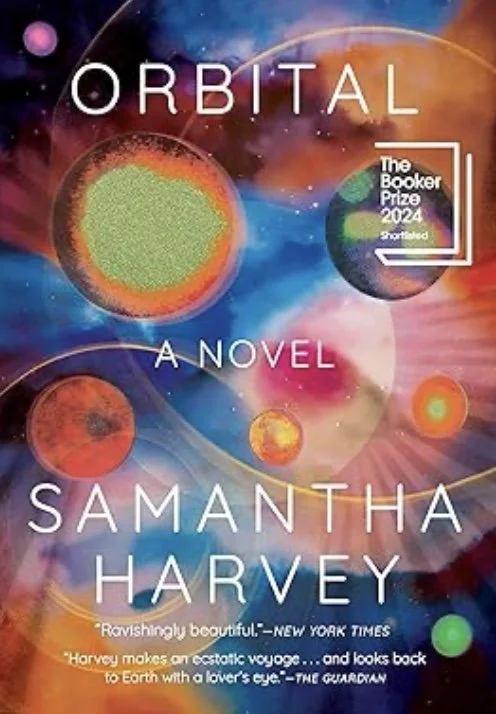
Orbital by Samantha Harvey (Grove Press) ~Janet Brown
There are truths that are acknowledged but remain difficult to comprehend fully: birth, death, and people living in outer space. Although the International Space Station has been crewed by humans since 2020, orbiting 250 miles above the earth, they remained largely unnoticed until 2025, when two astronauts were there for 286 days instead of the 10 days they had been slated for. From June until March, they lived in the Space Station, insisting after their return to earth that they had never felt stuck or stranded, as news headlines had proclaimed.
For that politicized, media-fueled time, they did what they had been trained to do, with their only worry being that they hadn't brought enough changes of clothes. Clothing was sent to them on the supply ships that regularly replenish food, medicine, and scientific material provided by the United State and Russia.
Because humans in orbit are still unexplained curiosities, seen mostly in science fiction novels and movies, nobody could imagine an unanticipated nine-month stint in outer space being anything other than horrific, that is nobody but Samantha Harvey. Two years earlier, her novel, Orbital, told the earthbound world what it was like to exist outside of our confined limits.
With minor deviations from facts, Harvey gives a poetic and careful description of life on the International Space Station. Her crew numbers six instead of seven and they orbit the earth sixteen times instead of the 15.5 that actually take place. These tiny quibbles are incidental ones. What matters is the way these six astronauts come into vivid life, along with what they see.
The earth becomes "a wild, tilting world," where no borders exist. Although there are two Russians, an American, one woman from England and one from Japan, they've become almost a single unit, a symbiotic, intertwined community. No matter that the two toilets on the station are clearly designated as Russian and US, and exercise bikes and food stores remain separated by those two divisions. The astronauts ignore this. They know they live on "a nationless borderless outpost," in a spacecraft that travels an orbit of "tender indifference."
The six of them together have learned to "hang like bats" as they sleep in suspended cocoons, to eat every packaged meal with a spoon, to transform their initial space sickness into effortless flotation and playful somersaults, to track the weather while occasionally yearning for its wild deviations, "a cold stiff wind, blustery rain, autumn leaves." All of them surrender to the beauty of what surrounds them, 16 different predawn moments in one day, when the moon looks like "a buckled bicycle wheel" and "the stars explode." They grow silent before "a glorious coppering of disbanded light" and rolling waves of the aurora with its "shimmering hum" and its "snaking blades of neon." They know the "music of the spheres," the "fumbled harmony" held in the sounds of unique vibrations that are emitted by every planet.
Although they will eventually descend in a "blazing ball" that will bring them to the "grasses and wild horses of the Kazakh plains," for now they all feel divorced from the world that they left behind. Then Chie receives news from Japan. Her mother is dead and she won't be back in time to go to the funeral.
Steeped in memories of her family's home on an island, Chie brings the earth into the confines of the "earthstuck orbit." The crew talk about their childhoods, remembering going to candy stores, arguing about the virtues of condensed milk, surprised by floating droplets of tears which they catch in their fingers.
Some books aren't read; they're inhabited. Orbital is one of those novels that shows another world, one that beckons, entices, and carries change, to be read and reread, given and kept.