Very Bangkok (Updated Second Edition) by Philip Cornwel-Smith (River Books} ~Janet Brown
Bangkok, according to Travel + Leisure at the beginning of this year, is the most visited in the world. It's also the least understood, by design and intention. A city where all wishes can be granted, for as much or as little money as a traveler wants to spend, it has carefully extended attractive boundaries that few vacationers care to cross. Different circuits appeal to different tastes, from the sophisticated and affluent to the wide-eyed budgeteer. Both might leave without ever deviating from the coherent pathways of the Skytrain, feeling certain that they've "done Bangkok."
For foreigners who have decided to live and work in this city, things become more puzzling, a situation that's made more difficult by the idiosyncratic, multi-toned Thai language. Within a couple of months, unanswered questions abound and become a galling source of frustration, in a place that constantly changes like a hyperactive kaleidoscope.
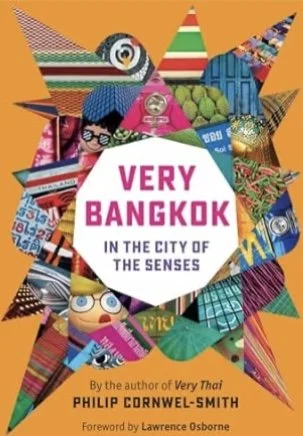
Back in the distant past, Philip Cornwel-Smith provided a compendium of answers in a book called Very Thai. That was several coup d'etats ago and both Cornwel-Smith and Bangkok have changed since 2005. In 2020 he followed up what was essentially a dictionary of Thai customs and behavior with an encyclopedia to the place he's inhabited for over thirty years. Now he's come out with an updated second edition of over three hundred pages. (This would be much longer if it hadn't been printed in a font that just barely goes beyond miniscule, with photographs that are predominately thumbnails, an unfortunate decision.)
However Cornwel-Smith found a way to pin Bangkok to accessible proportions. Accurately terming it a "city of the senses," he explains it in a collection of essays that reveal Thailand's capitol and primate city as it's experienced through the senses. He goes well beyond the usual five, venturing into the sense of space, direction, motion, and the one known as "the sixth sense." He concludes with the very Thai concepts of "heart" and "face," venturing into local perspectives in a way that could only be done by a writer who's made Bangkok his home since 1994.
Cornwel-Smith immediately targets this city's sense of impermanence, one that has probably rendered many of his observations inaccurate. He anchors them with a sense of history, from ancient to the beginning of this century. This provides background that's usually unknown or overlooked (or obscured by the city government), expanding the perspective of foreign explorers and residents in a way they aren't going to find anywhere else, unless they tackle the imposing bibliography that's provided at the back of Very Bangkok.
This isn't a book that will be read from start to finish in a linear fashion. Much like the magazine that Cornwel-Smith launched and presided over for years, Bangkok Metro, it consists of discrete bursts of information that can be browsed at random. Unlike a magazine, it provides insights that are far from superficial and are frequently deeply sad. Cornwel-Smith quotes many Thai writers and journalists who have seen their city change and don't applaud the changes. (In a burst of candid schadenfreude, one of them who goes unidentified says that "Brexit and Trump are direct karma for Western criticism of Thailand.”)
Delving into the spiritual underpinnings of a city that flaunts its materialism and carnality, giving urban history that illuminates areas that have been brutally modernized, providing a guide to the art that flourishes in a place that elevates financial profit, Very Bangkok accomplishes an impossible task. It provides as full an examination of this city as one book is able to capture. Although its readership will be a narrow one, its readers will keep it as an essential historical record of an enigmatic metropolis.