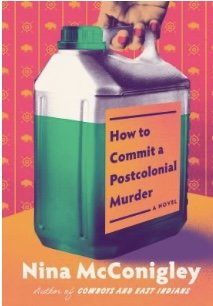
How to Commit a Postcolonial Murder by Nina McConigley (Pantheon Books) ~Janet Brown
Amma is lonely. She had never planned to leave India and America hadn't been a place she yearned to see. Her life as a well-educated girl at the end of the Raj had been shaped by England and that's where she travels after she becomes a lawyer in Madras. That's where she meets a Texas geologist, where she falls in love with a man who marries her and takes her to Wyoming. Not only does she end up in one of the most Western of all the fifty states, she's the first person from India to live in Marley, "a town for passing through, firmly oil and gas land."
Her husband's job with an oil company turns Amma into a single parent. Her life centers around her two daughters, whom she names after her two favorite authors, Agatha Christy and Georgette Heyer. She raises Agatha Krishna and Georgie Ayer on a diet of Indian folktales and British manners but as the girls become immersed in their own lives, Amma, isolated and homesick, sends for her family. When her brother, sister-in-law, and nephew arrive, they're the first Indians Amma has seen in fourteen years and she happily lapses into a life with domestic squabbles and shared memories, in a house that now shelters an extended family.
But for Agatha Krishna and Georgie Ayer, what's an idyll of companionship for their mother becomes a secret nightmare for them. Their uncle turns out to be a sexual predator who teaches both girls "the art of freezing." Disassociation of their minds from their bodies is the only defense they have against Vinny Uncle, who tells them if they go to their mother about what he does to them, he and his family will have to return to India. "You know how lonely Amma was before," he warns them.
When a neighbor's cat dies from drinking antifreeze that drips from the family car, the girls find their solution to the horrors posed by Vinny Uncle. They begin to put spoonfuls of Prestone into his glasses of soda, gradually increasing the dose, with the goal of having him dead by the summer's end. A story that begins with the sweetness of To Kill a Mockingbird, narrated by Georgie Ayer, ends with the same ambiguity found in that American classic. What does their plan cost the two girls and who was Vinny Uncle's killer? And who is ultimately to blame?
Daughters of a woman who was shaped by colonialism, Agatha Krishna and Georgie Ayer blame the British. "Everything went back to the British...It was the British who taught us to keep our upper lips stiff at all times." The British were the ones who divided India and Pakistan and taught Amma to embrace English culture, making her a double foreigner living in a provincial little American town.
Agatha and Georgie, "half-and-half," born in America, enter adolescence guided by magazine quizzes and articles that promise popularity. They become astute observers of why they are different and what they hope to become. Cataloging what white Americans expect from them as their appearances promise exotic differences, the girls list every stereotype associated with being Indian and show how little these categories figure into their daily lives. Divisions are what they live with every day and they use satire and wit to cope, until Vinny Uncle shows up. The division he brings is insurmountable and they know he is ultimately the one to blame for what transpires.
Nina McConigley, biracial herself, was born in Singapore and grew up in Wyoming. She knows what she's talking about and what she has to say raises questions. What's the difference between an immigrant and an expat? What's it like to be a Third Culture Kid who grows up in a white monoculture? How does life in a small town in the American West make it easy to consider thoughts of violence? Who's to blame when powerless children find a means to achieve protection?
This is a book to handle with care. It may look like a cozy little murder mystery but instead it gives a perspective that's badly needed and has been a long time coming.