Never Say Die by Ke Huy Quan (Grand Central Publishing) ~Janet Brown
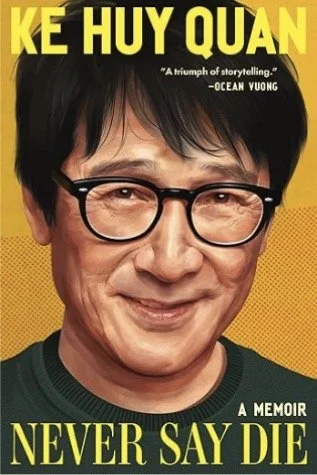
I'd rather read the back of a cereal box than a celebrity bio so it surprised me when I came home from the library with a copy of Never Say Die. Was it the face on the cover, smiling and unrecognizable? Was it the blurb that appeared above the face, written by Ocean Vuong? Was it the subtitle that simply said "A Memoir" instead of something like "My Life in Hollywood"? In fact there was nothing on that cover to tell me who Ke Huy Quan was and that's probably why the book came home with me.
When I took it out of my book bag and gave it closer scrutiny, I was fairly certain that I'd be taking this back to the library, unread. But one evening last week I had nothing else to read and when I saw the quote that opened the first chapter, I kept reading.
"you have to understand
that no one puts their children in a boat
unless the water is safer than the land."
"Home," Warsan Shire
I didn't stop reading until I came to the end of the book, and a portion of another poem,"Refuge" by JJ Bola "...a refugee is simply someone who is trying to make a home." When I turned the last page, I had tears in my eyes.
This is the story of a family, from 1977 to 2023, from Saigon to Geneva,and how one small boy kept their hopes alive.
Ke Huy Quan begins his story with his first night in a jail cell. He was seven years old. When he, his brothers, and his father came home the next day, half of their family was gone. Quan wouldn't see his mother or three of his siblings again until 1979 when he, his father, and the rest of the family got off a plane in Los Angeles.
Quan's mother made it out of Vietnam when the family divided into two groups and launched their escape. His father had to make two more attempts before he and his remaining children were crammed on a ship that carried more than 3000 people out of Vietnam and into a refugee camp in Hong Kong. Because they had family waiting for them in Los Angeles, they were in the camp for only eleven interminably long months.
In three more years, their lives were transformed by a chance encounter, a film crew scouting for a small boy to be in a movie. They went to an ESL class and the boy they found was Ke Huy Quan, who would become famous as Short Round. The movie was Indiana Jones and the Temple of Doom, starring Harrison Ford, directed by Steven Spielberg, and created by George Lucas. To Quan these names meant nothing more than that they belonged to men who encouraged him and took care of him.
With his mother Quan traveled to film locations all over the world. With the rest of his family he walked down the red carpet to the premiere of the movie at Mann's Chinese Theater. He met Princess Diana in London and Michael Jackson in Los Angeles. He worked with Sean Astin and Josh Brolin in Goonies. And by the time he was a teenager he received an unexpected check from Lucasfilm for almost $100,000 dollars. Lucas and Spielberg had done something unprecedented in Hollywood. The contract Quan had signed as a small child included profit-sharing, in one of the most popular movies of its time. The checks kept coming and Quan took care of his family. He bought a house, he insisted that he bankroll his father's dream of beginning a factory to replace the one lost in Vietnam.
And then the work dried up. Quan's father had a debilitating stroke. The checks dwindled and life changed by the time Quan turned eighteen.
That's where his story begins, with an adulthood of struggle, working toward a life as an actor, buoyed by the love and support of his family. It's a story of courage, persistence, and failures that eventually lead Quan to stand on a stage, saying, "Mom, I just won an Oscar."
Yes. I cried. Be warned. You just might do that too.