The Guest Cat by Takashi Hiraide (New Directions Books) ~Janet Brown
Even though all of humanity begins its time on earth with birth and faces e common fate, most of us would fiercely contest that our lives are the same. Yet how many of us retrace the threads that our lives are made of, to discover where our differences are formed? Robert Frost chalks these up to roads not taken, while Machiavelli terms them acts of "fate," or "fortuna" an inexorable river that is counteracted only by "virtu," or "skill displayed in times of emergency."
The narrator of The Guest Cat subscribes to Machiavelli's theory, with a slight variation. He believes our daily movements create a current, a little river, that eventually flows into the larger one. But what happens when a small deviation deflects an established current?
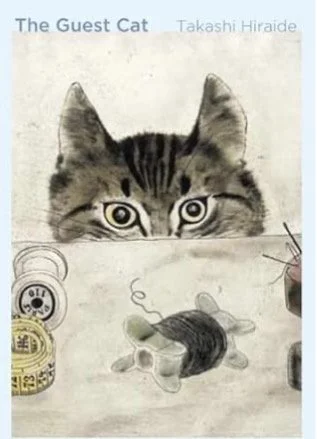
The narrator and his wife have their currents deflected by a single knothole. Both of them work at home and in their confined space they have found amusement in a tiny circular opening that gives a minute view through a fence. When they take a break and wander into their kitchen, their attention fastens upon what they can see through that knothole. Because it looks out onto an alley, that minute view always changes, regardless of weather or time of day.
But one day that view doesn't change. For hours all that is shows are what look like "ribbons of clouds," motionless.
They ignore the small sounds that seem to come from the opposite side of the fence but the little boy next door is attracted by them, discovers a cat, and bears it off to his house in an act of rescue.
The man and his wife are tenants of a little guesthouse that's on the grounds of an old estate. They live next door to a mansion that's owned by an elderly couple who pride themselves on their extensive garden. The landscape is tended by hired workers and nothing is allowed to tarnish its perfection. When the husband and wife are accepted as tenants of the guesthouse, they're told quite sternly by their landlady, "No children or pets allowed." Since neither of them want the intrusions of offspring or animals, they agree and the little river of their daily movements goes undisturbed.
But then the cat next door comes visiting, not in a friendly fashion but in the way an invading army slowly conquers forbidden territory. In gradual increments she inches closer and closer to the guesthouse, providing an unexpected note of interest to the carefully nurtured garden. Even the landlady is charmed, since the cat is only a very pretty little guest who always returns home.
As is in the nature of any self-respecting cat, an open window becomes an irresistible invitation and Chibi, as the boy next door has named her, slowly infiltrates the household of the husband and wife.
Without making any sudden moves, Chibi becomes a diversion and a fact of life to both the man and his wife. They look forward to her visits and when they see her living her other life out in the garden they watch with fascination, until the day that she doesn't return. When they learn that she has died, both of them feel an absence that is surprising and life-changing.
Takashi Hiraide is a poet and an essayist who has become best known for his only novel, The Guest Cat. Since the biographical blurb on the back cover of this book says he lives with his wife (a poet herself) and a cat in Tokyo's suburbs, it's easy to wonder if this is fiction or a meditation on Hiraide's domestic life, "a raw open space covered by a sheet of pure white." But as Chibi causes two lives to become "an invisible body of water about to overflow its banks and inundate the surrounding area," her story makes us wonder what idiosyncrasies may have caused the currents of our own lives to go off course and take a different direction?