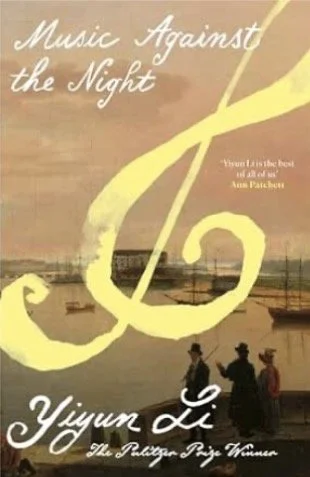
Music Against the Night by Yiyun Li (Farrar, Straus and Giroux) ~Janet Brown
John Field is born with "music in his blood," or so he’s told by the mediocre musicians who are his father and his grandfather. John himself believes this is true; he hears music in his head, sounds he'd never heard before, each time he walks past crosses in a graveyard. He’s six.
From that time on, this boy loses his childhood. Groomed to be a prodigy, he measures himself against Mozart and knows he's already lost valuable time. Mozart had published his first opus by the time he was eight, while John, at that same age, has only composed a single piece of music.
But John is small for his age and is presented to the world as a younger child, a musical genius who can write music as skillfully as he performs it on a stage. Apprenticed to a master musician in London when he’s not yet ten, John turns his back on his family and never returns. And yet the magic that he conjured up in a graveyard has gone. Music becomes a form of "muscular dexterity and intellectual prowess, and beyond that, fortune and fame."
Although he creates the nocturne, the one who becomes famous from that creation is Chopin, not John Field. Taken to Russia by his musical mentor, Field achieves a measure of fame in Moscow, under the patronage of a princess who became the mother of Leo Tolstoy. But when he dies, few remember him.
In Pondicherry, a little orphan named Adelaide Percheron is trained by her grandmother to use her intelligence under a heavy veil of charm. Percherette, as a cousin nicknames her, is pretty, clever, and quick and when she is presented with piano lessons, she finds a fascination that becomes an obsession. Without a pianoforte at home, she practices on a keyboard made of paper and soon she becomes known for her musical talent. But Percherette wants more than what she's been given musically in Pondicherry. France is the beacon that brightens her ambition and when she discovers that her grandmother plans to marry her off, Percherette, at the age of twelve, finds a way to achieve her goal. She voyages to Paris under the protection of two older gentlemen. One of them presents her with her heart's desire, a pianoforte.
For Percherette feelings and music are intertwined. When she plays, she discovers her emotions and learns to understand them through the instrument she loves. But John Field's ambition will never be hers. Percherette was born too early to become a prodigy.
Although both of these characters share a passion in common, their goals are different. Field wants "idolatry." Percherette longs to be recognized as his musical equal. Neither get what they want.
Music Against the Night juxtaposes these two lives, bringing them together only in its final chapter to achieve "their contrapuntal fate." As in musical counterpoint, they attempt to "establish a harmonious relationship while retaining their linear individuality." As a novel, this attempt fails.
Yiyun Li, author of The Vagrants (Asia by the Book, March 2009) and Things in Nature Merely Grow (Asia by the Book, July 2025), took refuge in music when both of her two sons died by suicide. Striving to overcome her feelings, she used music as a way of marking time, an activity that demanded "the discipline of order and logic." When she was halfway through the writing of Music Against the Night, her second son died, and this novel became a testament to that discipline, devoid of emotion.
Music without feeling is dead. A novel without feeling is a failure. Neither Field nor Percherette, both living people born in the 18th century and making their way through the world in the 19th, soar higher than figures in an incomplete biography.
Although online sources claim this is the first of a trilogy, nowhere is that made clear in an introduction or an afterword. Would knowing that make a difference? Probably not. This odd hybrid of fiction and historical fact, sprinkled with parenthetical observations made by an omniscient narrator and trite sentences that give nuggets of wisdom ("One person's valley might still be higher than another's mountain"), does nothing to whet an appetite for more.