Floodlines by Salem Haddad (Europa Editions) ~Janet Brown
"To love an artist, you must have an even stronger belief in the power of art." Bridget, an English artist, is told this by her Iranian mother-in-law, wife of a man who launched an artistic dynasty. His son, Bridget's husband is consumed by the dangerous marriage of art and politics, but before it eats him alive, he fathers three children, all of them daughters and each one an artist.
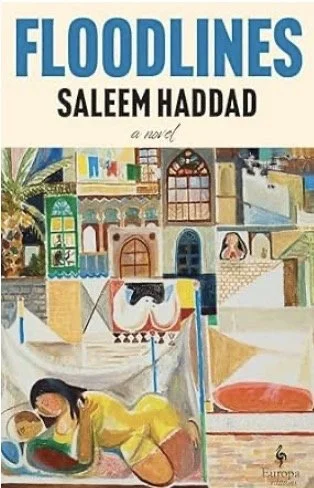
Three sisters is a grouping that echoes through time in mythology and literature, only surpassed by the power of the mother. Floodlines makes a daring choice by combining both tropes with equal force, and makes them soar beyond the usual pigeonholes.
True to life, each sister has her own designated slot. Ishtar has never been taught "to muzzle" her fierce and creative spirit. Zainab has been "taught to beautify, to make pretty all manner of ugliness." Mediha "believes in the plight of Arab women," with her life as the sacrificial daughter convincing her that this is true.
She's the one who has taken on the task of caring for Bridget as the mother ages, while Ishtar lives alone on a Thames houseboat and Zainab in Dubai becomes heir to a fortune when her husband dies. Her wealth is the catalyst for two separate dreams. Ishtar longs to build a new ark that will sail down the Tigris river, reviving ancient history and culture by using the forms of three traditional Iranian boats. Zainab yearns to collect their father's art which has been scattered by war and acquisitions, to reveal it all in a dazzling exhibition that will revive his legacy. Mediha is tepid to both of these ambitions, while Bridget veers between the past and the present with no thought of the future.
It's the only child that came from the three sisters, Zainab's son Nizar who is tossed into the middle of a family cauldron of desires, emotions, and memories. A war correspondent who's suffering from battle fatigue, the last thing he wants is to fall into his family's drama, one that a boyfriend accurately describes as "a war zone." But Nizar has inherited the artistic sense and he's possessed by the need to understand where this sense has taken his family. He agrees to help his mother realize her dream and as he does this, he becomes part of Ishtar's.
Saleem Haddad has drawn upon the life of an ancestor for "wells of artistic inquiry," not, he insists, "as blueprints for biography." Haddad's great-uncle, Jewad Selim, a sculptor whose wife Lorna Selim was a British artist is the creative seed that led Haddad to Floodlines. From that he has shaped new lives, along with "questions around memory, grief, and...creative hope."
In this novel, Haddid evokes Iraq in a way that only happens when a writer has been claimed by a place. "The smell of mud...the color of soil..memories bleeding into the present like shades of sienna," with Baghdad "shedding its skin in endless cycles..'this chaos of color and sounds."
"This soil under our feet," he concludes, "is where the whole world began," a truth we need to hold close in the world we have today.