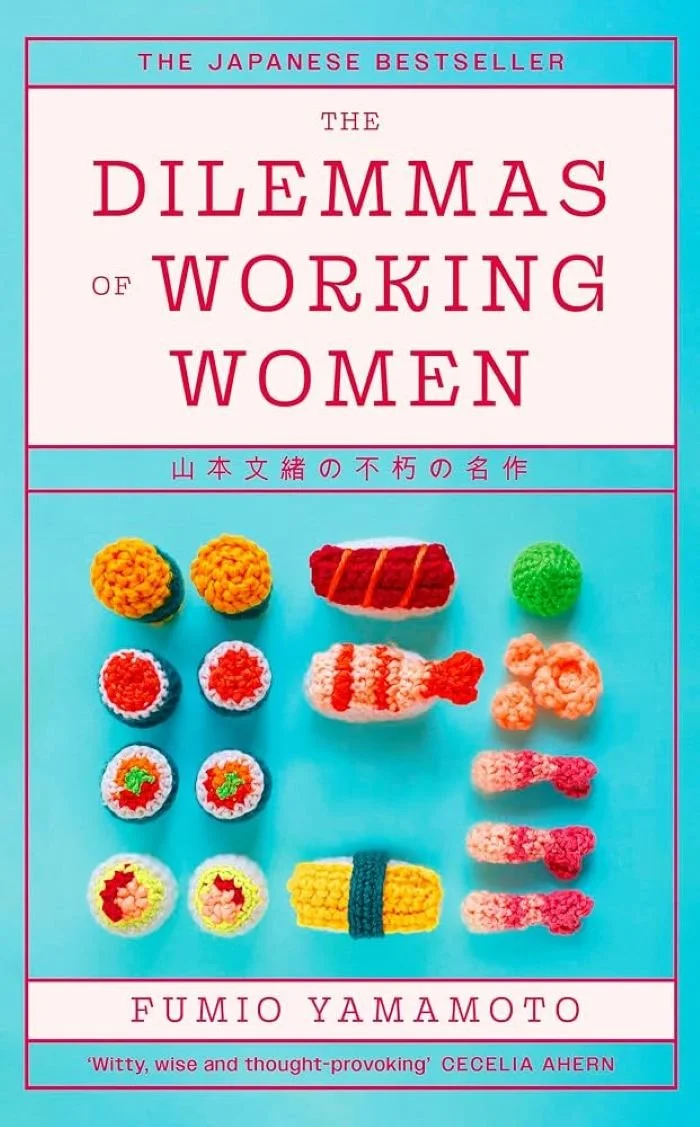
The Dilemmas of Working Women by Fumio Yamamoto, translated by Brian Bergstrom (Virago) ~Ernie Hoyt
Fumio Yamamoto was a Japanese author from Yokohama City in Kanagawa Prefecture. Her 1988 novel, 恋愛中毒 (Renai Chudoku) won the Eiji Yoshikawa Prize for New Authors in 1999. She died in the year 2021 of pancreatic cancer. She was only fifty-eight.
The Dilemmas of Working Women which was first published in the Japanese language by Bungeishunju Ltd. in 2000. The book’s original title is プラナリア (Planaria). It won the Naoki Prize in 2001 along with Kiyoshi Sugematsu’s Vitamin F.
This 2025 English translation by Brian Bergstrom, who has also translated works by Kotaro Isaka, Erika Kobayashi, and Koji Suzuki, turns Yamamoto’s prose into an easy to read and understand collection of short stories.
The Dilemmas of Working Women focus on the lives and struggles of ordinary Japanese women in contemporary society. Yamamoto’s co-winner for the Naoki Prize, Sugematsu’s Vitamin F focuses on the lives and struggles of men.
The book is a collection of five novellas. Planaria was the lead story in the Japanese book. In this English translation, the book opens with the story titled Naked. In this story, the main character, Izumi, is in need of a new job. She spends most of her days making stuffed animals. Her friends are worried about her and believe she needs a little push to get her motivated in going back to work. However, her friends don’t realize that Izumi has twenty-million yen in the bank. It’s not as if she really needs to go back to work but Izumi can’t decide for herself what she really wants to do.
Planarian is an even more interesting story. It is about a woman named Haruka who can’t seem to stop talking about having had cancer and then getting a mastectomy. Her boyfriend has even told her, “You need to stop”. She was out drinking with her boyfriend and friends when she said to them, “In my next life, I want to come back as a planarian.” She explained to her friends that if you cut one planarian in half, it would become two.
Her friends asked, “Why would you be something like that?”. Haruka replies, “I don’t really know the technical details, I just think it would be really cool, you know, to have a body you could cut up all you want and it would grow back!” She further elaborates, “Like I had breast cancer right? If I’d been born a planarian, I could have just cut off my breast and it would have grown back, no fuss, no surgery, no bother!”
She thought she was being funny but nobody laughed. After they left the restaurant her boyfriend turned to her and said, “You need to stop.” He told her that if she kept bringing up her cancer, even though she is cured, she will lose friends. Unfortunately, a woman like Haruka just doesn’t want to face her own fears.
In the title story, The Dilemmas of Working Women, Mito needs to make a major decision - to break up with her boyfriend or to marry him. What spawned her to give this serious thought was the way in which her boyfriend proposed to her on her twenty-fifth birthday. He didn’t say, “Marry me” or “Let’s get married”. What he said was, “Well, I guess it’s about time. We can get married”.
Her long-time boyfriend, who was still a student, said he had money. Mito knew that when he was talking about money, it was the allowance that was given to him by his parents. She was a little appalled at his idea of marriage. In Mito’s mind, she thought, “Don’t go around proposing to people when you don’t even earn your own money.” What will Mito do?
All the stories are related to what these women must face. Although the book was published nearly twenty-five years ago, the trouble these women went through are still relevant today. The women of Japan today are no longer meek or submissive. They make their own decisions and they choose their own lifestyles and no one should question their choices.