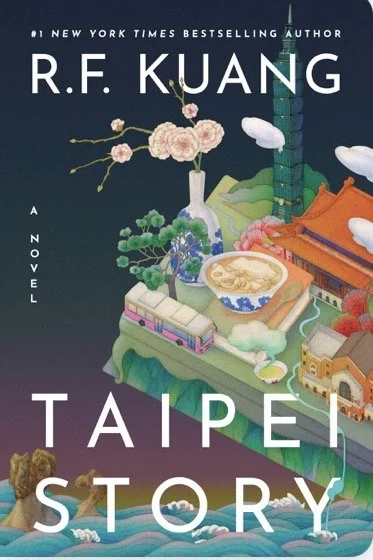
Taipei Story by R.F. Kuang (HarperCollins) ~Janet Brown
Lily Chen is nineteen with a year at Yale behind her, along with a lifelong habit of being a good student. She comes to a ten-week intensive course in Chinese at Taipei's National Taiwan University with complete confidence. Chinese is her mother tongue, after all and her first view of Taiwan gives her a feeling of having been homesick for a place she's never seen before. Her goal is the same as all the other students in the program, to leave "with perfect tones spilling out of our mouths, no longer so bad at being Chinese." How hard could that be? She's "a heritage speaker," after all.
But she's also unmistakably one of the Chinese American group of students, distinguished by "the summer tans, the ruddy cheeks, the sun-browned hair," "like Chinese people put under a broiler."
Culture shock settles in with the first glimpse of the apartment she will share with a roommate, a single room with a bed concealed behind a lattice frame, a couch that's a loveseat, and a kitchenette out on a miniscule terrace. A tiny bathroom with an unshielded showerhead comes with a fervent directive to never flush toilet paper and the washer-dryer combo is too tiny to launder their bed sheets. "It all seemed too much," and that was before the mosquitoes showed up.
Taking the "language pledge" to speak only Chinese within the confines of the program, Lily and her roommate Anna extend that to their time at home, making an uncomfortable living situation even more stressful. "After an hour of this," Lily says of her conversation with Anna, "I wanted to smack her...In Chinese, Anna was a pouty baby."
Even eating becomes a linguistic minefield, with the local restaurants places "where Chinese Americans went to feel shame." "None of us were Taiwanese" and Lily realizes she's come to this place "to become Chinese here, on my own terms."
When a dating mistake becomes a source of scandal, Lily goes to her default mode as a refuge. She buries herself in studying and accepts that she's not involved in any sort of homecoming, but doesn't have the comfort of being a tourist. As she wrestles with the language that she's heard all her life, she becomes "jealous of all the people who studied a foreign language just because it was foreign...in a place where no one you to even know the word for bread...What would that be like?"
Lily's goal is to become fluent enough to have a true conversation with her grandparents, a goal that vanishes midway through her course, when her grandfather dies and her grandmother sinks into dementia. Then her mother detonates a family bombshell. Her grandfather wasn't from mainland China at all.
What seems to be a rite of passage narrative is actually a meditation on language and its acquisition, how it shapes and limits the way its speakers live. Lily, expert at learning in a classroom, begins to espouse "the exposure theory of language," where "language was primarily absorbed through daily interaction...exposure, endless exposure." Instead, at the end of their program when she and the other students go out for a celebratory meal, they're "unable to stop speaking in chenyus," the idioms and classical allusions that have been drilled into them for ten weeks. They've learned the form of the language, but not the vocabulary that makes up daily life,
When Lily tells a teacher that her grandfather has died, she's immediately corrected. "Passing away is much more dignified. Dying is for animals." When this is followed up with appropriate forms of condolence, they all contain the words "Restrain your grief." "It's actually very comforting. It shows your concern," her teacher tells her.But Lily, Chinese American, can't stop crying. When she combs her dictionary app to find the Chinese word for "catharsis," it doesn't seem to recognize the English word.
Linguistic determinism, "how some cultures had richer vocabularies for describing color or taste than others" with its shaping of cultural perception, and “how different languages map space differently onto time" are the ideas Lily comes away with. "Speaking different languages altered not only our perceptions of the world but also our understanding of ourselves." she concludes and her narrative takes on a different slant as it shows the way that Lily has been transformed by the language she’s struggled to acquire.
R.F. Kuang, author of the scathing satire Yellowface and the fantasy series known as The Poppy War Trilogy, brings a tender sensibility and an intellectual lens to Taipei Story that sets her apart as one of the more versatile writers of our time.