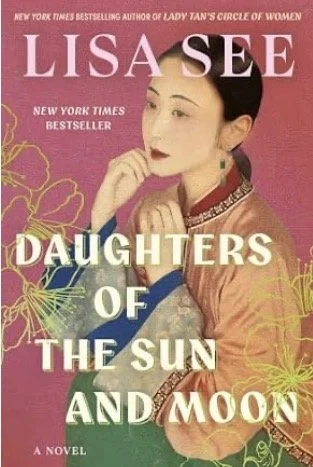
Daughters of the Sun and Moon by Lisa See (Simon & Schuster) ~Janet Brown
Three Chinese women walk into a novel. Two are beautiful. One is smart. One is sold into prostitution for forty pieces of Mexican silver, paid to her father. One is persuaded to leave home and marry a man she's never seen before. One knows how to heal with herbs. All three are propelled by different ambitions. Moon, the herbalist, wants justice. Dove, the reluctant bride, wants love. Petal, the prostitute, wants freedom. Converging together in Lo Sang, or Los Angeles, when it's still a frontier town, these women might as well yearn for a place in the stars.
It's 1871, a time when the 180 Chinese residents of Lo Sang are compelled to live on a single street, Calle de Los Negros, housed in buildings that once were imposing but now crumble. A year earlier, the Los Angeles Gazette, inveighed against the "waves of heathen Chinese," and issued "the rallying cry...The Chinese must go."
Laws in this town are tenuous. Of its 285 businesses, 110 are saloons. Colt revolvers are sought-after purchases. With a population of six thousand, there are only six policemen, so "one out of every eight people" belong to the Home Guard Vigilance Committee. Poundcake Hill (now known as Bunker Hill) turns into a staging ground for public lynchings.
Women are scarce. With the arrival of Petal and Dove, there are now 34 women in the Chinese enclave, and only a single child. A handful of these are wives. The rest are prostitutes. Beauty is both an asset and a danger, while both Petal and Dove are beauties.
Moon has a privileged position. She's married to a doctor whose skills make him essential to the white community as well as the Chinese. Both she and her husband are Hong Kong born with a command of British English. With her herbal skills, her married status, and her lack of beauty, Moon seems unassailable.
Neither Petal nor Dove have that protection. Their looks ignite a feud between the leaders of the Chinese community that leads to the hire of "tong fighters," hired assassins and this threat of violence breeds a massacre.
White vigilantes take their cue from inflammatory newspaper articles and a mob of more than 500 men, almost a tenth of Los Angeles' total population, run riot through Calle d Los Negros looting, burning, and killing. No Chinese man is safe. Moon watches a woman offer her clothesline to lynch the doctor whose patient she once had been.
When the massacre ends, the official death count stands at 18. Out of a population of 180, ten percent of the Chinese residents are killed in what's called "one of the largest mass lynchings in U.S history. Over $40,000 in money and jewelry are looted. Calle de los Negroes is destroyed. The Irish and Mexicans are blamed for the violence and eight men are charged and jailed. Eventually all charges are dropped.
Moon, Petal, and Dove survive. Banding together they make a home in an outbuilding on the property of a prominent Mexican rancher who offers refuge to them and other Chinese who have chosen not to leave Los Angeles.
This man isn't fictional. Neither are Moon and her husband, nor Dove, although they are given names other than their own. Petal is a blending of two women who were forced into prostitution. This is history, unveiled and retold under a scrim of fictional narrative.
Los Angeles will soon have a memorial to keep this history alive. On the site of Calle de Los Negroes (now North Los Angeles Street) there will be 18 granite sculptures, shaped into the trunks of banyan trees. A fallen trunk represents the unrecorded victims of the massacre. Poems and the names of the dead are engraved on sculpted tree roots.
Pico House, close to where "Moon" and her husband healed with herbs and traditional Chinese medicine is one of the only surviving remnants of what was the first Chinese community in Los Angeles. Both Dr. Tong and a man who worked and died at the Pico House Hotel are commemorated onsite, in stone.
Daughters of the Sun and Moon begins with all the trappings of a romance novel. Lisa See knows how to grab the attention of her readers and then immerse them in the true details of an overlooked history. Her research, told through the stories of three women who (in different forms) witnessed true horror, makes this book an essential spotlight on what's been ignored for much too long.