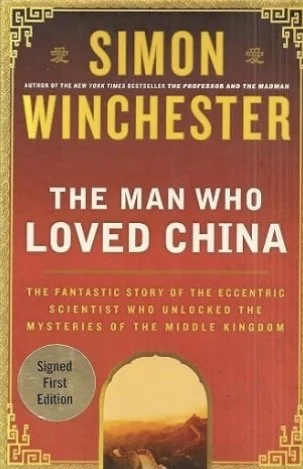
The Man who Loved China by Simon Winchester (HarperCollins) ~Janet Brown
"He who goes would have to be ready for anything." In 1943, Joseph Needham was ready. Chosen by the British government to go on a mission to China, at a time when Chinese universities were being targeted and destroyed by the Japanese, Needham's job was to assess whether Great Britain should intervene to "help the cause of China's intellectual survival."
But Needham had his own quest in mind. A scientist who was in love with a biochemist from Shanghai, his avocation had been the acquisition of the Chinese language and his obsession was "Why didn't science develop in China?" The woman who had become his mistress and, much later in life, his wife, Lu Gwei-djen, insisted that was the wrong question. She asserted that China had a long history of scientific achievements and discoveries that had been usurped by the West. Needham's goal, as she saw it, was to find out what Chinese scientists had developed over the course of its long history.
Needham was a prodigy and a rebel, a Cambridge scientist who had gained his degree in chemistry in only three years and had written an acclaimed three-volume work called Chemical Embryology by the time he was 31. He also had "socialist leanings," was "an avid nudist," and by the time he was 24, was happily embroiled in an open marriage that would only end when his wife died at the age of 92.
He was a man who raised eyebrows among the conservative members of academia but his brain and his charisma were more than a match for conventional outrage. Those attributes, coupled with his knowledge of written and spoken Chinese, were why he was chosen to board a ship that would take him to India after ten weeks at sea. From there, he flew on a US military plane to China, but only after following official instructions. As a British diplomat traveling to a country that was at war with Japan, Needham was told to buy a gun.
He hit the ground running. In his first thirty-six hours in China, Needham turned a walk in a garden into an observation of the grafting of plum trees, unlike any that he, the son of a devoted botanist, had ever seen before. As he watched an elderly gardener's "elaborate grafting techniques," he had an immediate epiphany: "In China they did things differently." This was followed by wondering how long this different grafting had been in practice. Was it possibly being done before Europe had "done anything like it," a question that Needham was able to pursue because he had the ability to conduct research by reading "ancient texts" written in Chinese.
This was his goal for the next three years and he pursued it with a spirit of adventure and scientific inquiry. When he returned to England in 1946, he came back with a stunning catalog of Chinese inventions that predated its Western counterpoints, ranging from arched bridges to smallpox vaccinations, from seismoscopes to toilet paper. The library he had assembled in China, thousands of books and cartons of papers, had been carried back to England over the years by the Royal Air Force. This collection was augmented by a man he had met in passing, the president of Zhejiang University, who sent Needham "a large number of tea chests, and still more crates and cartons," all of them containing books, including "a complete copy of an edition of 1888 of ...what was perhaps the largest book in the world...the imperial Chinese encyclopedia.., the sum of all Chinese knowledge."
From all of this came a work that's still in print today, Science and Civilization in China. By 1995, the year of Needham's death, this consisted of eighteen volumes. It has grown to twenty-four since then, with 15,000 pages and 3 million words.
Simon Winchester doesn't only concentrate on Needham's life's work. He gives a riveting account of this man's life, his journey from Chongqing to Dunhuang in what was then known as "Chinese Turkestan;" his eastern train trip to Fuzhou which at that time was surrounded by Japanese forces; his attempt to reach the Burmese frontier. He tells the story of Needham's friendship with Zhou Enlai that almost scuttled his academic career during the Korean War. And he always maintains a detailed portrait of this eccentric genius at every stage of Needham's truly amazing life, one that began at the beginning of the 20th Century and ended in its final decade.