Julie Chan is Dead by Liann Zhang (Simon & Schuster) ~Janet Brown
Maybe Shakespeare's the one to blame. When he announced "A sad tale's best for winter," he issued a pronouncement that publishing houses have taken to heart. For centuries, all the ponderous biographies, the academic elucidations, the gloomiest literary novels show up in bookstores during the darkest, coldest time of year. Anything light, diverting, and frivolous is dumped into the category of beach books. As soon daylight returns, so do entertaining bits of fluff, as bright and evanescent as daffodils, ready to toss into a bag along with sunscreen and an oversized towel.
The truth is those puffy bits of fictional candy are wasted on the beach. They can't go into the water, they're hard to see in blazing sunlight, and they're easily smeared with suntan lotion. When they're needed is during the cavernous black hole that stretches from New Year's Eve to St. Patrick's Day to combat Seasonal Affective Disorder. Wallowing in depression, readers need books that settle lightly upon the brain and might even make them laugh.
They need Julie Chan is Dead. In spite of its grim title, this is a book to brighten winter's gloom, written by a woman who divides her life between Northwestern Canada and Northeastern Canada. Well acquainted with what's needed when daylight is scanty and temperatures plummet, Chinese Canadian Liann Zhang provides the perfect antidote.
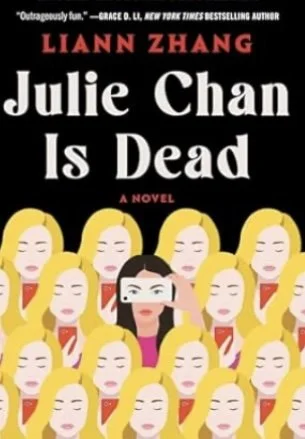
Julie Chan is one of a matched pair, an identical twin who has the same looks but none of the luck enjoyed by her sister. When their parents died, Julie was taken in by an aunt while her sibling was adopted by the Van Huusens, a wealthy couple in New York. As Julie toils behind a supermarket counter, her sister Chloe becomes the darling of the Internet, an influencer with over a million followers on Instagram and six hundred thousand Youtube subscribers.
She sees her sister only once after their separation, when Chloe descends upon her, followed by a camera crew, and presents Julie with a house. "A beautiful angel plucking me out of the gutter," Chloe embraces her twin while giving a loving speech, "so eloquent it must have been prepared." It all stops when a camera man announces "That's a wrap." Chloe vanishes. The reunion gets ten million views in ten days.
That's the last Julie sees of her sister for years until she receives a brief and ominous phone call that makes her worry. Going to Manhattan in an effort to be certain her sister is all right, Julie finds Chloe lying on the floor of her luxurious apartment, dead.
Physically the sisters are carbon copies and when Julie is mistaken for Chloe, she steps into another life. Chloe's body is accepted as the result of a drug overdose, taken by her less fortunate sister. Julie instantly has everything she's always wanted, burdened only by an identity that she hasn't been trained for. Almost immediately she meets her sister's PR manager and is given a full calendar of social events, ones that Chloe thrived upon and has Julie floundering. But not for long.
What began as a Shakespearean comedy of errors becomes a social satire, as Julie takes on the trappings of an Internet goddess. This is where Liann Zhang shines, with phrases as sharp and as piercing as a tattoo needle. Julie describes her aunt as the sort of Cantonese woman "who uses old Cheeto bags as folders for her tax returns." A fellow influencer "runs a pet account for her white Yorkie who looks like she'd bite your ankle for sport." Chloe's parents had adopted "a Chinese kid to prove they weren't actually racist." One of Chloe's friends gained over almost two million followers and a spot on the New York Times bestseller list when she wrote a book called Healing Through Dessert. Another achieves fame by writing poetry that’s "less profound than the back of a shampoo bottle."
Zhang's biting observations pervade her novel, right up to the bittersweet end. Her modern day version of Cinderella is the perfect way to spend a long evening after the winter solstice has set in. It's neither profound nor thought-provoking, just a snarky, funny helping of gleeful schadenfreude that's "best for winter," no matter what Shakespeare had to say.