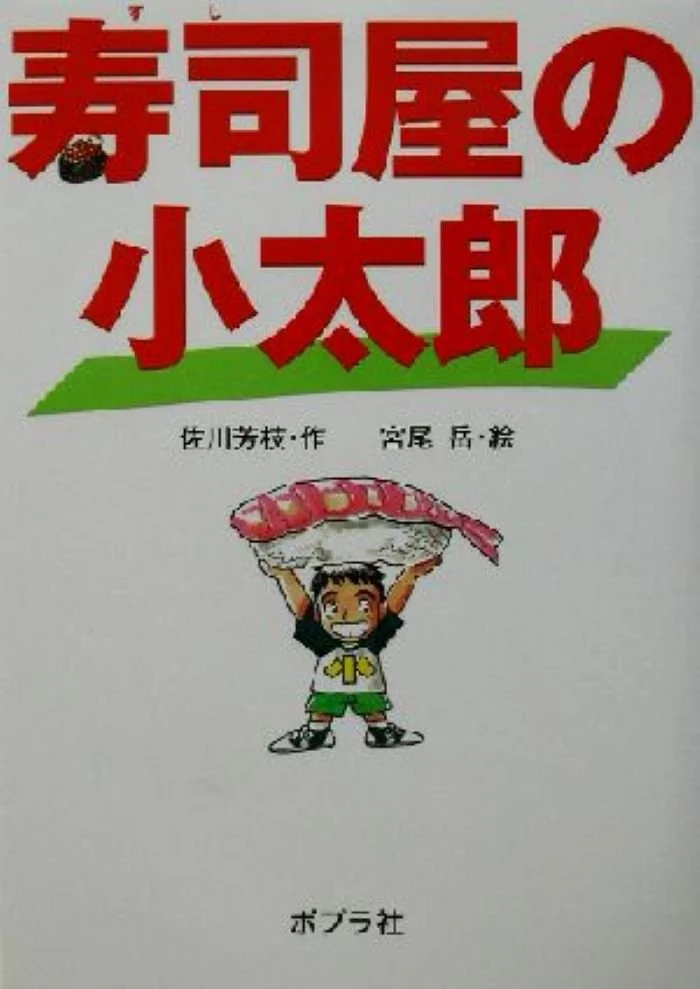
寿司屋の小太郎 (Sushi-ya no Kotaro) by 佐川芳恵 (Yoshie Sagawa) (Poplarsha) ~Ernie Hoyt *Japanese Text only
Yoshie Saga is a Japanese essayist and children’s book writer. She got married in 1975 to a man who was the owner of a sushi shop called Natori Sushi in Higashi Nakano in Tokyo’s Nakano Ward. In 1978, she became a professional cook and spent the next thirty years working with her husband at the shop.
She wrote about her experiences and her first book, 寿司屋のかみさん うちあげ話 (Sushi-ya no Kamisan : Uchiagebanashi) which roughly translates in English to Confessions of a Sushi Restaurant Owner’s Wife. The essay was later adapted into an irregular drama series and was aired between 1996 and 1997.
Her experiences became the basis for the Wife of a Sushi Restaurant Owner series which includes a total of eight books. In 2011, she wrote her first children’s book, 寿司屋の小太郎 (Sushi-ya no Kotaro) which roughly translates to Sushi Restaurant’s Kotaro. This book would also develop into a series which consists of five volumes.
The main character of this book is twelve-year old Kotaro. His father, Tsuyoshi Yamamoto, is a forty-year old sushi chef who has his own shop called [Masa Sushi]. His mother, Harumi is thirty-seven. Kotaro also has a younger sister named Mayuko who is only two years younger.
Kotaro loves sushi. He thinks he may one day take over the shop from his father. Their shop, which is also their home, is located in the middle of Keyakidai Shotengai. Kotaro often helps his father in the shop and likes to brag that he knows how to make natto maki or natto roll. Natto is a traditional food item in Japan and is made by fermenting soybeans. It has a very strong smell and a slimy texture. Natto rolls consist of vinegared rice and natto and is wrapped in a sheet of toasted seaweed.
Kotaro has many adventures. In his first adventure, a man claiming to be from Keiyakidai Elementary School came to the sushi shop and said he was talking to people working along the street to contribute to a safety poster for the community. However, one of Kotaro’s assignments, along with the rest of the sixth-graders was to draw a safety poster first and the best one would later be chosen and distributed to various places around town. Also, Kotaro did not recognize the man’s voice and had never seen him at school.
The man was trying to swindle people out of 10,000 yen (approximately $80USD at the time the book was published). It was the shotengai’s tofu shop auntie who really got angry at the conman telling him, “Do you know how much tofu I have to make and sell to make a profit of 10,000yen?”. She gave the conman an earful. The adults were all proud of Kotaro for his actions.
Kotaro has more adventures with his most dangerous and yet most intriguing was going to the large fish market with his father. As his father was busy talking with various fishermen and fish-sellers, Kotaro became bored and found himself walking around the pier where many boats were anchored. As he didn’t see anybody around, he boarded one. He found a nice spot to sit and became so relaxed he fell asleep. When he woke up, he was no longer at the pier. In fact, he was nowhere near any land.
Poor Kotaro. What will become of him? Will he be lost at sea? Will the owners of the boat toss him overboard? Or will they say they will sell him in Hong Kong, when they get there. Of course, the boatowners were not evil men but they thought they would teach Kotaro a lesson for boarding a boat without permission.
If you love sushi, then you will love 寿司屋の小太郎 (Sushi-ya no Kotaro). Unfortunately, there currenlty isn’t any English translations of any of the books in the series so you will have to learn how to read Japanese. Sagawa also provides simple recipes in the book and says you should be able to hold the book in one hand and make the dishes. She also mentions that the main character was based on the son of a couple of the shop’s regular customers. He would sit at the counter and ask for kohada (gizzard shad, a small herring-like fish) and aji (horse mackerel). The boy’s name was Kotaro!
Sagawa also hopes that by reading this series, people will want to eat more fish and tell others that fish is not only healthy, but it’s delicious as well. I could go for some sushi right now!