The Devil Takes Bitcoin by Jake Adelstein (Scribe) ~Janet Brown
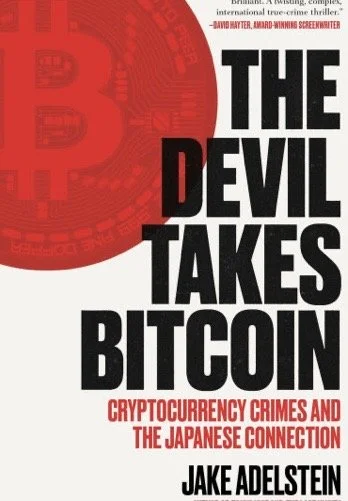
If ever a book needed a diagram, it's The Devil Takes Bitcoin because Jake Adelstein (author of Tokyo Vice, Asia by the Book, January 2010) has never met a detail he doesn't like. Admittedly I read this with no idea of what a Bitcoin is but after hours of reading and taking pages of notes, I now know how to dress if I'm faced with a Japanese arrest, where to find Tokyo's cafes where waitresses wear maid costumes while calling their customers "Master," and that Adelstein has liver cancer. However I still have only a vague idea of what a Bitcoin is and I have absolutely no idea of what the theme of this book is meant to be.
For anyone as ignorant as I am, Bitcoin was first mentioned in 2008 when it was registered by anonymousspeech.com as www.Bitcoin.org. Two months later a white paper appeared under the title Bitcoin: a Peer-to-Peer Electronic Cash System, written by an elusive and untraceable person who called himself Satoshi Nakamoto.
Bitcoin, as explained by Nakamoto, would be an "unregulated, decentralized currency unshackled from the clutches of the state,” a monetary system operating over the internet as electronic money that was unconnected to banks. Every transaction would be logged in a public ledger and production would be capped at 21 million Bitcoins, protecting this against forgeries and inflation and increasing value as demand outstripped the supply.
This 9-page proposal was only a theory because Bitcoin needed to be generated through computer software which at this point didn't exist. Three months later in 2009, Satoshi had found the necessary software developers and created (or mined) the first Bitcoin, at a time when the financial debacle of 2008 made this new currency an enticing possibility. Distribution was handled by a man who had created an exchange for gamesters (often teenage boys) who were obsessed with Magic cards. He added Bitcoins as another commodity to exchange on this site which was then discovered and purchased by a French computer geek based in Tokyo.
Mark Karpeles turned mtgox.com into Mt. Gox, the world's leading Bitcoin exchange. It sold Bitcoin to purchasers who used "fiat currency" (money that's government-issued). It purchased Bitcoin through wire transfers or ACH (bank-to-bank payments). Purchases were sent to the buyer's Bitcoin address, which functioned like a bank account number.
Buyers received the Bitcoins by using a "public key" and withdrew them with a "private key" that they were given through their Bitcoin address. All of this was recorded in the blockchain (ledger) that was updated six times an hour with the Bitcoin addresses used in each exchange.
"Little to no personal identity was disclosed in Bitcoin transactions," which attracted the attention of a website that was launched in the same month as the first Bitcoin. Silk Road was the brainchild of a libertarian surfer and physicist who presented it as "an anonymous Amazon.com." Although Ross Albricht believed people were essentially good and that the more laws, the worse society became, his initial Silk Road offering of mushrooms was rapidly overrun by less benign products. And what better way to make illegal purchases than Bitcoin? Mt. Gox and Silk Road became intertwined and disaster was right around the corner as publicity became focused on the Dark Web.
At first the attention was welcome but it all came too fast and things got sloppy. Paper wallets were created, printed documents with the data needed to generate private keys. If the document was lost, so were the Bitcoins. Other Bitcoins were stored in safety deposit boxes where they could be withdrawn without being logged on the blockchain. The U.S. government went after Silk Road and hackers targeted Mt. Gox.
By 2015, 850,000 Bitcoins (about $500 million) had gone missing and Mt. Gox went bankrupt. The founder of Silk Road was sentenced to life with no parole. Mark Karpeles was under arrest in Japan. Satoshi Nakamoto vanished from the internet.
Perhaps because Adelstein was given custody of Karpeles' two cats and wasn’t a lover of felines, he had a vested interest in finding the true culprit who got away with the fortune in Bitcoins. At this point, his book becomes even more convoluted, as impossible as that may seem.
Who did it? Who was Satoshi Nakamoto? Who was the Dark Lord of the Dark Web, Dread Pirate Roberts? Can it all be traced back to the Russians? Do we care?
At the time when The Devil Takes Bitcoin was published, a single Bitcoin was worth around $100,000. (Adelstein used his meager supply of twelve to finance his daughter's first year of college.) Apparently other exchanges are profiting from the dire example set by Mt. Gox and the game goes on. Perhaps we'll all be using cryptocurrency soon and paper money will be as dead as the Danish Postal Service.