Discontent and Its Civilizations by Mohsin Hamid (Riverhead Books) ~Janet Brown
When he was two years old, Mohsin Hamid often entertained his family by standing on a table and repeating the words of a prominent Pakistani politician. A year later he was silent, surrounded by American children who asked "Why can't he talk?" "He can," his mother told them, "He just doesn't know English." Six years later when Hamid''s family returned to Pakistan, he no longer remembered how to speak Urdu.
Now Urdu is his second language while his English reflects his personal history, "fractured," he says, "coming in distinct California and Pakistani varieties, with Mid-Atlantic and British English "added to the mix."
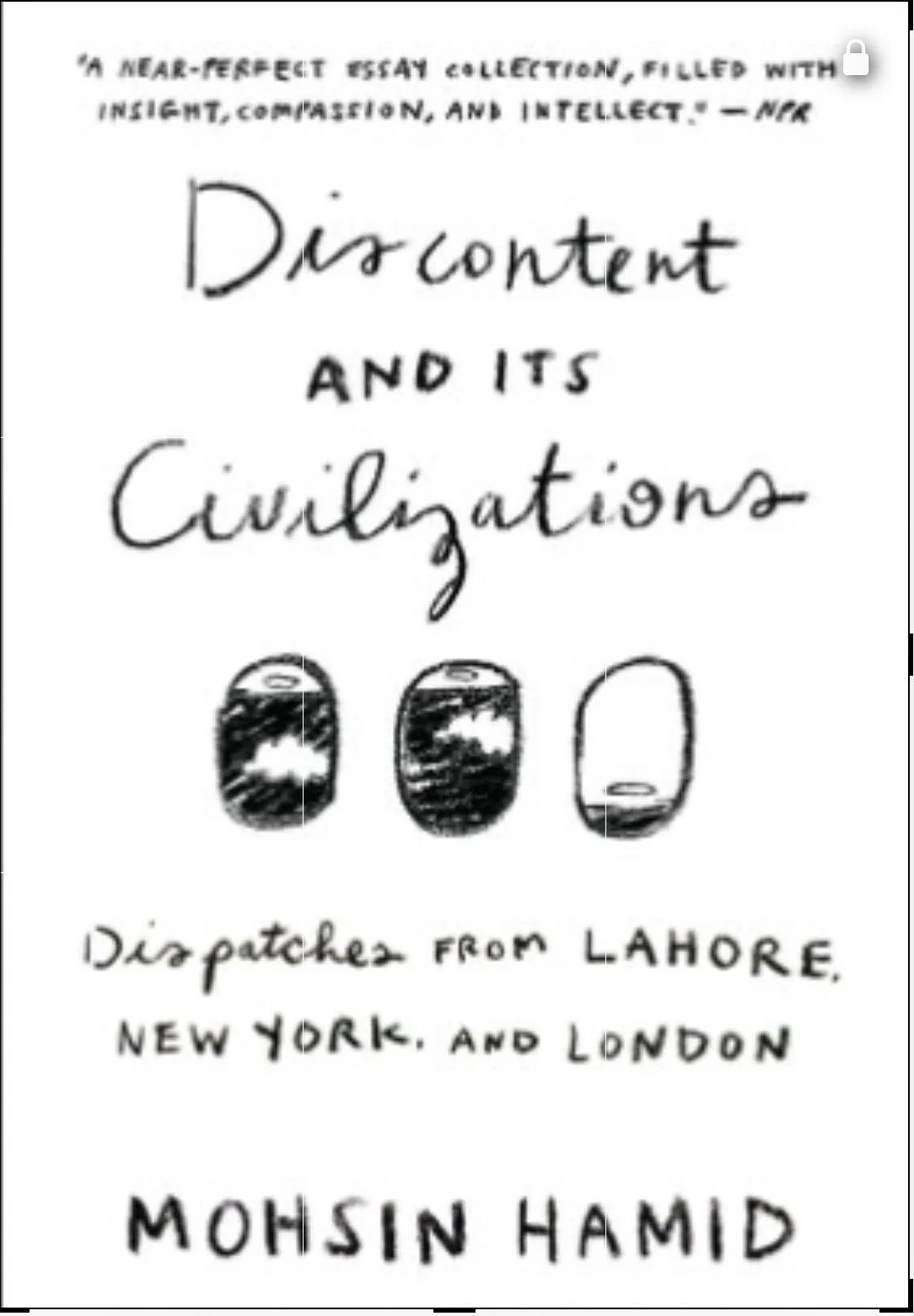
His novels, each shatteringly different from each other, might be, he says, "a divided man's conversation with himself." His essays, collected under the rather snarky title of Discontent and Its Civilizations, are a divided man's view of the contemporary world, written with a perspective that comes from a life spent on three continents.
Hamid came to Princeton when he was nineteen and lived in America for seventeen years. At thirty he moved to London. After eight years there he and his wife chose to come back to Pakistan where he lives with the perspective of "two notional civilizations," one that he terms "Muslim" and the other that's shaped by "Westerners."
From there he dissects just what these notions actually contain, while concentrating on Pakistan and the political realities that have beset the United States since 2001. While America struggles with the "war on terror" and immigration policies, Pakistan, he claims, "is a test bed for pluralism on a globalizing planet." Predominantly Muslim, its citizens are also Christians, Hindus, Amadis, secularists, and those of no religion."
"The self we create is fiction," Hamid states, and then proves this is perhaps most true when applied to how nations are perceived. Pakistan is a Muslim country but "Islam is not a monolith." Barack Obama may have understood this crucial truth when he spoke in Cairo, asserting that "Muslims and Americans overlap in seven million Muslim Americans." But is the same value placed on a Muslim life as it is on an American one?
This question echoes when Hamid writes about the killing of Osama Bin Laden, a man responsible for nearly 3000 American deaths. Americans celebrated when they heard Bin Laden was dead. Pakistanis shut their country down for fear of paying "a blood price," since the death took place within their borders. They had good reason for this. In the years since 2001, terrorism and acts of war have killed Pakistanis because their country became a staging ground for America's war in Afghanistan. "America's 9/11 has given way to Pakistan's 24/7/365."
And yet this is where Hamid has chosen to bring up his children in "a multi-generational daily existence...three generations at one address." In Pakistan "the personal and the political intertwined," as they do in this essay collection.
An autobiography, an examination of a writer's life, a stern and clear-eyed look at geopolitical realities in the two countries that Hamid calls home, this is a book that can easily induce mental vertigo. Don't read it in a linear fashion. Pick and choose and contemplate. Watch your own perspective change and be grateful.