The Deer King ~Returners~ by Nahoko Uehashi, translated by Cathy Hirano (Yen On) ~Ernie Hoyt
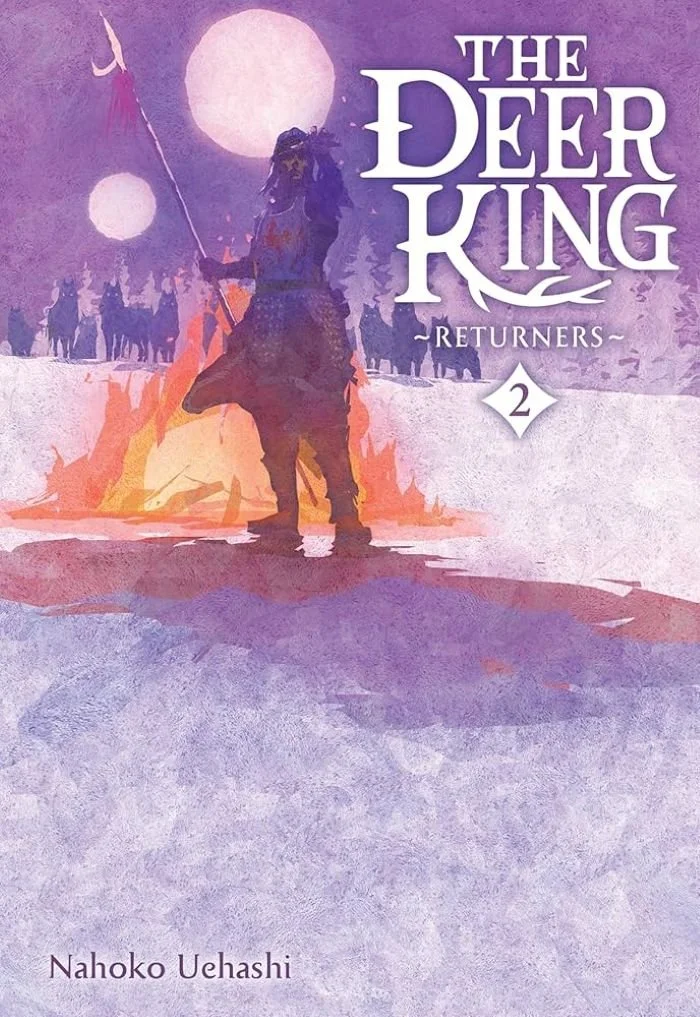
The Deer King ~Returners~ is the sequel to The Deer King ~Survivors~ by Japanese fantasy and science fiction writer Nahoko Uehashi. The plot thickens as the story picks up where the previous book ends. The main character, Van of the Gansa, the leader and sole survivor of the Lone Antlers, a band of warriors who fought against the Zolians, was captured and enslaved in a salt mine by the conquering army. He is also the only survivor of the attack at the mine by wild dogs called ossams which are a cross between a dog and a wolf.
The follow up to the first novel is just as exciting as its predecessor. Van had saved a small child who was also at the mine when during the ossam attack. Her mother protected her by placing her in the oven and defended her only daughter with her life. Van used to be a family man so he could not in good conscience leave the little girl on her own and let her die, so he decides to take her with him and they both travel to a big trading city called Kazan.
On their way to the city, they encounter an injured young boy named Tohma. Tohma is from the Oki region, a land north of Aquafa where Van is from. Tohma’s mother is a Zolian who emigrated to Oki so Van does not trust the boy at first. However, they become good friends and Tohma guides Van to Kazan.
Before I continue, I must confess that I only focused on the going ons of Van and his adopted daughter. However, in the first book, there was a secondary character whose actions would intertwine with Van’s as the story progresses. The character is a man named Hohsalle.
Hohsalle is a physician and a descendant of the Ancient Kingdom of Otawalle, which fell to ruin over two hundred years ago. He has been studying the people who died after being bitten by the ossam at the salt mines. The wild dogs did not only attack the slaves, they attacked everyone and almost everyone, except for Van, did not survive.
Hohsalle believes the ossam are carriers of Black Wolf Fever, an invisible disease that is fatal and contagious. In order to stop a pandemic, he is studying the corpses of those who died from the disease. He also believes that people are dying from an enemy they can’t see.
In order to truly appreciate this epic, I would recommend to the reader to study the cast of characters, the map of the land, and the people who inhabit this world. There are three main domains - the Empire of Zol, the former Kingdom of Aquafa, and the Kingdom of Mukonia.
The Aquafaese were driven from their own lands or were forced to live as subjects of the Zolian Empire with Zolian immigrants. Another land the Zolians had taken over and whose people were forced to leave their land were the Ahfal Oma, the People of the Fire Horse, on the Yukata Plains, which is located in southern Aquafa.
Kenoi, the former leader of the Ahfal Oma, is currently known as the Dog King. He has trained wild dogs to attack people with precision. He has never forgiven the Zolians for taking over their land and making them exiles. It is Kenoi who plans to use the dog to spread Black Wolf Fever among the Zolians as the disease does not seem to affect either the Ahfal Oma or Aquafaese.
It is Van’s quest to save his adopted daughter and to stop Kenoi and his followers. He is of the same thinking as Hohsalle - diseases cannot be controlled by man. Will Van be able to stop Kenoi and his followers? Will Kenoi’s plot wipe out the Zolians? And will Hohsalle find a vaccination to stop the pandemic before it’s too late?
In the current state of the real world, contagious diseases are no laughing matter. We already saw the effects of the coronavirus and now the world is fighting against an outbreak of the hantavirus virus. People may have laughed at Laurie Garrett after she published her book The Coming Plague in 2005, but her warnings had come to fruition. Uehashi’s world in The Deer King deals with this subject in an entertaining but informative way. Who knows what other “coming plagues” there may be but we must be prepared to detail with them when they appear.