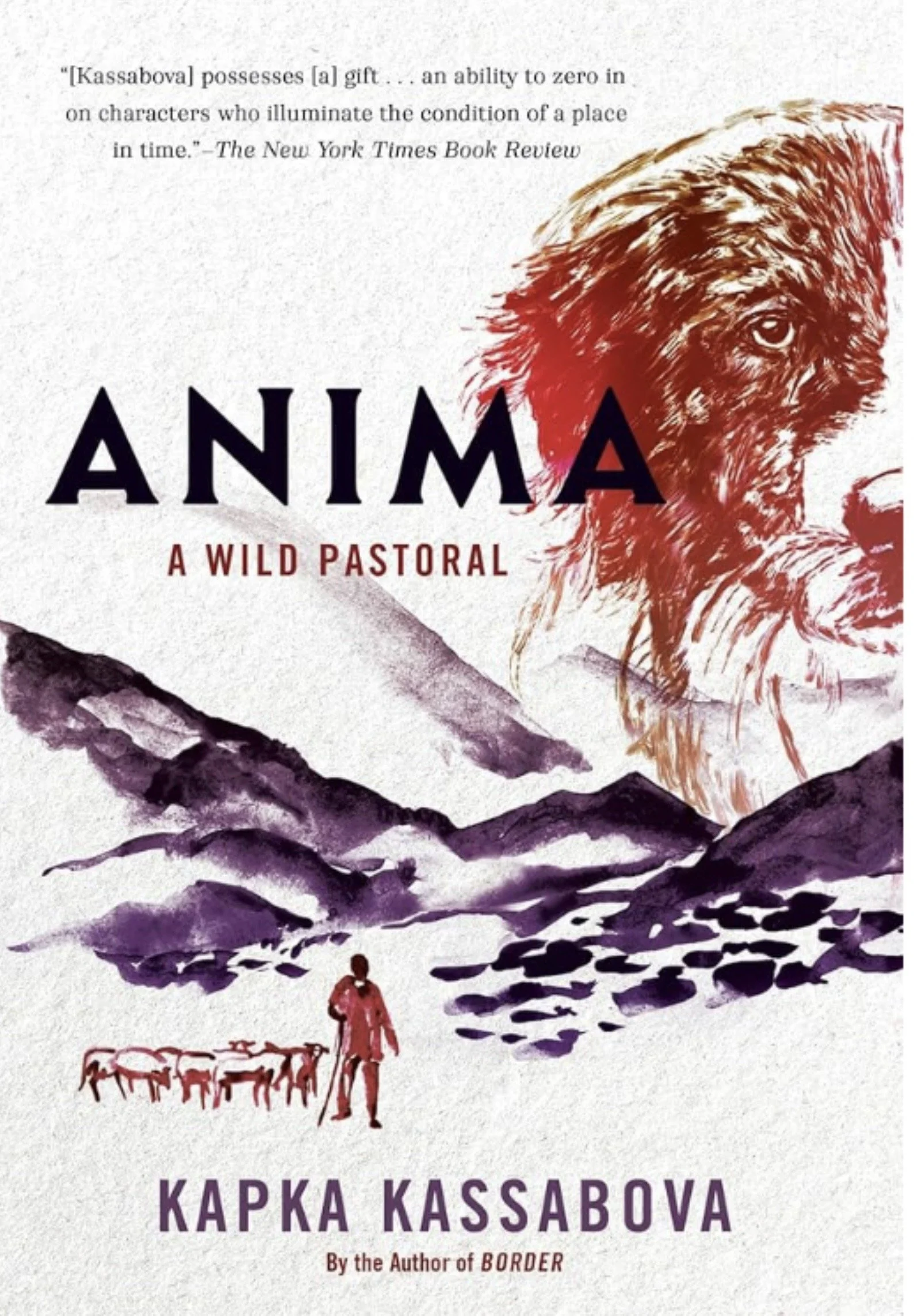
Anima by Kapka Kassabova (Greywolf Press) ~Janet Brown
There are things and places and states of being that are neither this nor that, the space between sleep and wakefulness, the passage between birth and life, the moments between life and death, the gender that exists between male and female, the indefinable territory that lies along borders. Academics define these states of being as liminal spaces. Kapka Kassabova offers no definitions. Instead she inhabits them.
In Border (Asia by the book, January 2024) Kassabova explored the region where "Bulgaria, Greece, and Turkey converge...where something like Europe begins and something else that is not quite Asia."
"We are not Europe and we are not Asia," an Eastern Orthodox priest said in Border.
"This is not even Europe," Kassabova is told by the man who will give her entry to the world of pastoralism that she lives in and describes in Anima, "this is the Balkans." However what Kassabova discovers goes deep into history and moves far beyond manmade labels.
She is allowed to experience the life of the Balkan Karakachan herders, "the oldest nomads to have entered modernity with their animals." Their roots go back several millennia into Central Asia, when "a moving human-animal rug" brought a pastoral world into the Balkans and the Mediterranean. Almost stamped out by Communism and the Iron Curtain, it was revived by a couple of Karakachan boys who fell in love with a dog, one that was interrelated with their own history. Kitan was one of the last purebred Karachakan dogs who have the gait of wolves and "human eyes," who have one mission in life. They are guards, with a yearning for mountains and an appetite for predators.
The boys searched for more of Kitan's kind and became dog breeders, custodians of "an animal army" that had almost died out. But the dogs needed sheep, and raising sheep required the use of horses. The boys, now men with an obsession, found the sheep and horses that had been bred for moving across mountains, preserving the original Karakachan strain for both. They transform an abandoned village into "a metropolis of lost animals," bringing a strain that had almost been extinguished back to life and with it the pastoralism that the animals demanded.
"Pastoralism is the movement and grazing animals in search of pasture," and as the brothers practice this, it becomes "transhumance," a seasonal journey to high places with tender grass. This requires a particular kind of person who can withstand long periods of isolation and extreme weather, who can live without comfort, and who has not just an ability to work with the sheep and the dogs, but knows that everything is "connected by a living breath," that there "is no evil in animals." A shepherd is a man "walking through a beautiful world devoid of humans with just the clothes on his back."
In a time that "has no place for free-moving people and animals," the shepherds and the sheep, the dogs and the horses, continue to move, while knowing that "Everything has a beginning and an end. And we're toward the end."
Spending a summer with eight dogs, five hundred sheep, "animals that would survive the apocalypse and not even notice," and their shepherd, Kassabova enters a life of poetry, beauty, and sadness. Alone with a man with whom she finds a surprising connection, she begins to "smell of sheep and smoke," she learns to "inhabit the round clock of the mountain," and begins to think of the world as a place divided between "above and below," where time and distance are circular,not linear. When she goes into the "lower world,"walking along the flat road doesn't feel like walking." She's gripped by "shepherd's syndrome" when "your body feels like cement" without slopes to climb.
The dark side of pastoralism emerges with the alcohol that the owners of the sheep provide as a way of keeping their shepherds under control. Darkness breeds darkness and the only act of violence is committed by Kassabova as a rebellion against her comrade's persistent bouts of drunkenness."Life here is a game of roulette," she tells him, "I can't take it anymore." Yet when she leaves, the life in the mountains follows her. Remembering its wind, she recognizes it as "the world's soul. Anima."