Retrograde by Osamu Dazai, translated by Leo Elizabeth Takada (One Peace Books) ~Ernie Hoyt
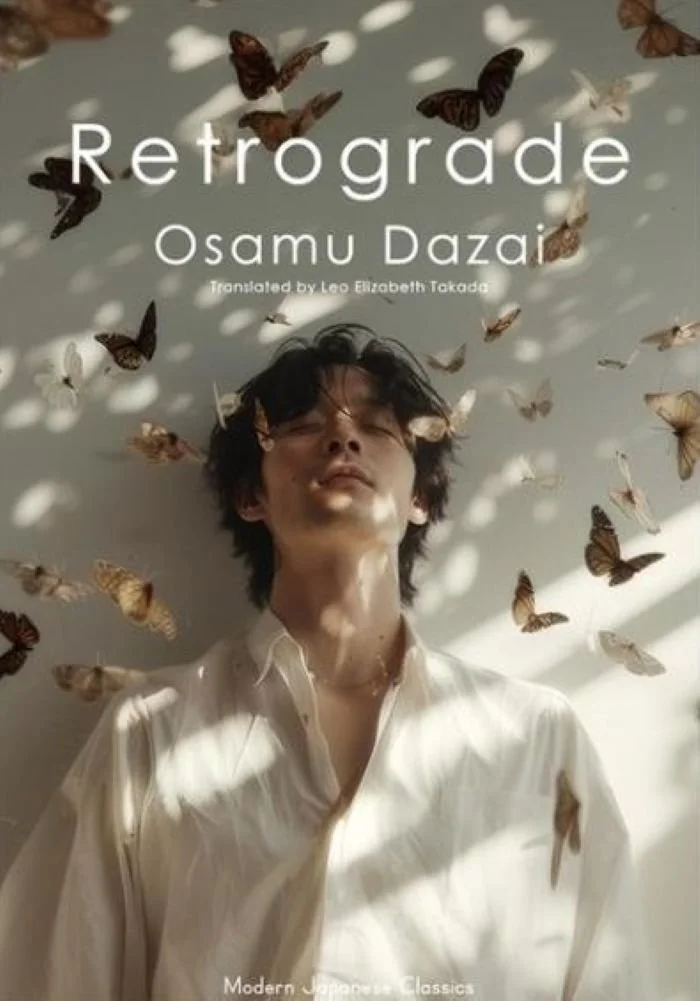
Retrograde is a collection of three early stories written by one of Japan’s literary legends, Osamu Dazai. Although he never won Japan’s most prestigious literary award, the Akutagawa Prize, and he ended his own life at an early age, he left behind a legacy of written works. His most famous being No Longer Human (Asia by the Book, August 2022).
Osamu Dazai was born in Kanagi in Aomori Prefecture. He wrote 逆行(Gyakko) in 1936 after moving to Tokyo. Although Dazai was a nominee for the Akutagawa Prize for his story, he was disheartened when we didn’t win.
Dazai’s literary ambitions almost ended before it even began when he learned about the death of his favorite writer and idol Ryunosuke Akutagawa, who took his own life in 1927. After that Dazai’s life would be”marked by alcohol, prostitutes, and Marxism”.
Author and translator and Japanese native Leo Elizabeth Takada “received the honor of translating Osamu Dazai into English”. Before proceeding with her translations, Takada decided to read Retrograde in its original language. However, she had a hard time deciding what edition to buy. She was also confused by her friend’s response when she told her, “I’m looking for 逆行 (Gyakko) to which her friend responded, “Ah, from his final years?”
Takada corrected her friend saying, “No, it’s one of his early short stories”. Her friend was aware of that and told her, “Yeah, from The Final Years.” Takada was at a bookstore when she ran into one of her writer friends, Akutagawa Prize nominee Megumi Kawano, who immediately pulled a book from the shelf and handed it to her.
Takada said to Kuwano, “I thought you said it’s from his final years?”. Kawano explained that the story was part of his collection of short stories in a book titled The Final Years. He was “intending it as a subtitle for his own suicide note”.
In the same year that Dazai wrote 逆行 (Gyakko), he also wrote two other short stories - ダス・ゲマイネ (Das Gemeine) and 葉桜と魔笛 (Hazakura to Mateki) which are both included in this collection as well. In the English translation, Das Gemeine retains its original title. It is German for “common”. The final story is translated into English as Blossom-Leaves and the Spirit Whistle.
As with Dazai’s later writings all three of these short stories are filled with torment and anguish. They are told in the first-person and you feel if Dazai is speaking to you personally. Dazai also inserts his own characters in the stories. In Das Gemeine, he introduces a character named…”Osamu Dazai”. The character who meets “Dazai” says he is “terribly annoying” and “he’s adorned with bad taste, head to toe”. It’s hard to tell if Dazai is mocking himself or if he truly despises his life.
If you are interested in classical Japanese literature but are not sure where to start, Leo Elizabeth Takada’s translation of Osamu Dazai’s Gyakko is a good place to start. His stories may seem dark and dreary but his writing will keep you interested in his characters. There is not a dull moment in any of the stories that are collected in Retrograde and as Takada says in her Afterword, “It’s my humble hope that this collection will serve as nourishment for fans of Japanese literature in the English-speaking world”, I share those same sentiments.