Grand Canal, Great River by Lu You, translated with annotations by Philip Watson (Frances Lincoln Ltd, Publishers) ~Janet Brown
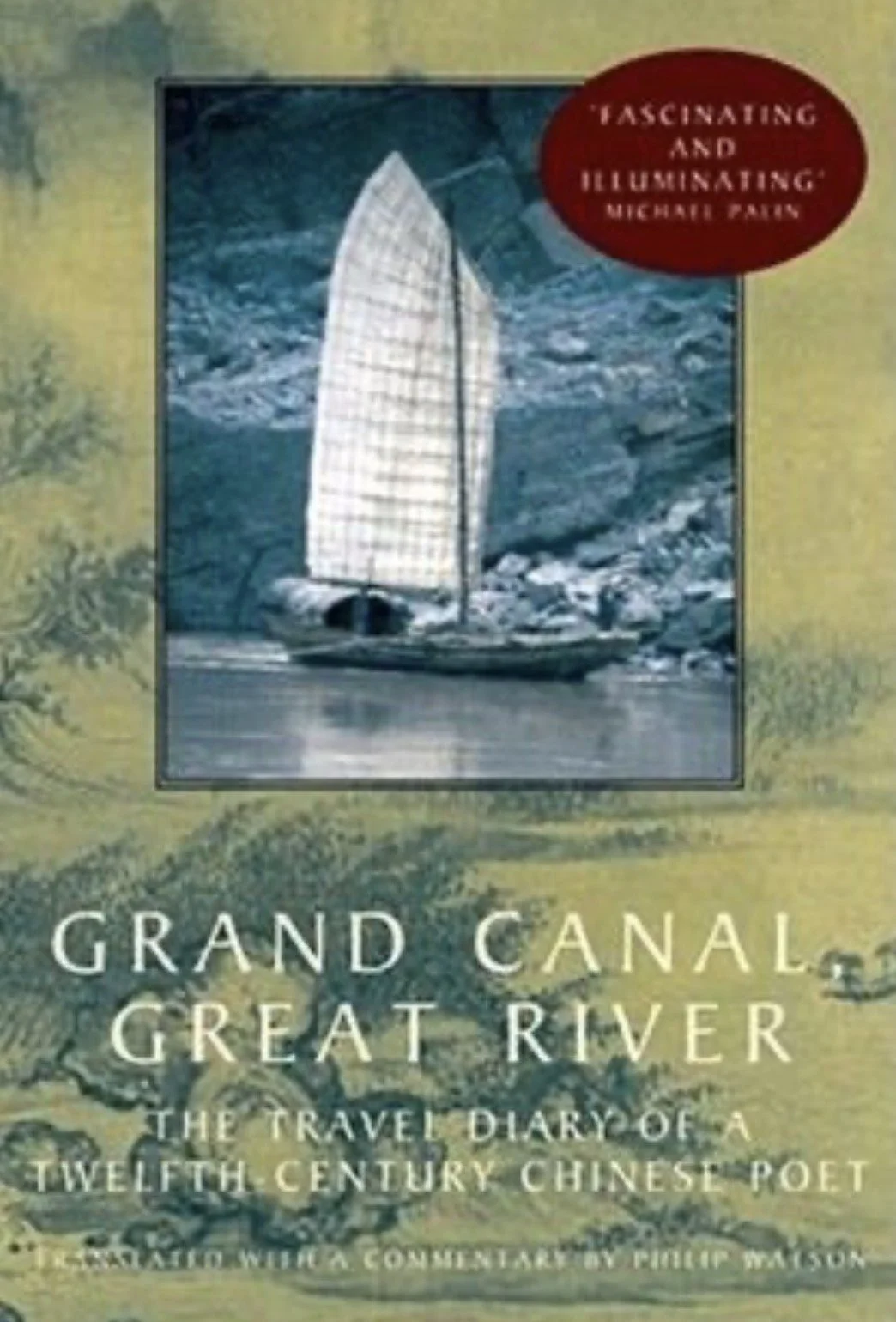
Almost all travel literature in English that’s about China have been written by people "looking from the outside in," translator Philip Watson points out in his introduction to Grand Canal, Great River. From Marco Polo to Paul Theroux, readers are presented with accounts that skirt the boundaries between what's real and what's imagined. Without linguistic, historical, or cultural knowledge, how can writers understand what passes before their eyes?
This is far from the case in this diary that whisks its readers on a 157-day, 18,000 mile journey across China in 1170, 100 years before Marco Polo ever set foot in this country. Lu You was one of the most famous poets of his time and a highly educated government official who was politically astute and well-versed in Chinese history. When he was given a post in a small Sichuan town, this resident of Hangzhou had no choice but to take to the riverine highway that connected Southern China from east to west.
It was a journey that began along the Grand Canal that stretched from Beijing to Hangzhou. This led to the Yangtse River which would take Lu You to Kui, a walled town in the hinterlands of Sichuan, traveling through gorges so perilous that Lu and his party left the boat and traveled overland on sedan chairs until the dangers were behind them. It involved switching from boats powered by oars to a ship propelled by wind in its sails, a vessel that weighed “150 tons,” yet "yawed and sheered under mountainous river waves like a leaf."
There may have been more than a few of these moments but Lu doesn't dwell on them. He's a poet after all, traveling in the wakes of poets who came before him, Li Bo and Su Shi. He pays homage to them while making poetic observations of his own. "Reed flowers...like snow" blanket the river banks, the river with ripples ""as smooth as a mat," "thousands of acres of empty river, and the moon, like a dish of purple gold, welling forth from within the waters." Yes, this man could write.
As a prominent dignitary, Lu travels from meal to meal hosted by other officials but he gives no culinary details. He's obsessed by potable water and assesses what he drinks throughout his journey. The "pure green" water of Gushu Creek he extolls for its "sweet smoothness" while in Huang he dismisses the spring water as "not very sweet," blaming it for the foul taste of that area's wine. In the wonderfully named Jade Void Grotto he praises the water from a "fragrant stream," saying it "tastes delightful.""Unless you're a connoisseur, it's not easy to detect the quality of poor tea," he sniffs dismissively at one point. Clearly he sees himself a connoisseur of water, not surprising in a culture that produced lists of the Classification of Waters in the ninth-century work, Record of Waters for Boiling Tea.
There are remarkably few complaints, with most of them concerning the plagues of mosquitoes encountered along the way. Toward the end of the trip a rare mention of food surfaces when Lu is served a meal of "delicious venison and wine of a fine vintage." At around the same time, this Southern sophisticate begins to greet any sign of urbanity with enthusiasm.
"There are shops, " he notes at one point and his relief is palpable. Later he views a settled town with a cry of joy, calling it "an enchanted land." Girls with hairdos that soar as high as two feet, anchored with silver hairpins and ivory combs as large as a hand also claim his delighted attention. Unfortunately his translator tells us at the end of his trip, Lu begins a "disconsolate” year, in a place that vanished beneath the floodwaters of the Three Gorges Dam, referring to one of the highlights of his new home as “the so-called Palace of Eternal Peace” that’s become “the prefectural graineries.”
But before he reaches the journey's end, he describes the sight of a "wooden raft, 100 feet wide and 500 feet long that holds 30-40 households, complete with pathways, alleys, livestock and a shrine to a deity. "This is still one of the smaller ones" of the raft communities found only on the Yangtse. One night he witnesses 500 lantern-bowls, "like a multitude of stars," released as an offering to the river in hopes that it will provide blessings and avert disaster. He's surprised by the belltower in the Hall of the Heartless that soars 100 feet or more, made of three storeys of brick "without a single piece of wood." He marvels at herds of wild water buffalo and schools of black and yellow dolphins, while feeling a stab of terror at the sight of a bright red creature that's several feet long,and swims against the current, churning the water into spouts a couple of feet high.
Philip Watson charitably converts Lu's ancient measurements into feet and miles and provides ample annotations that give insight into this 12th Century odyssey. Lavish use of photographs, showing the art and riverscapes of the time, make even the most ignorant reader an informed and enthralled part of Lu You's life and world.