Etna by Paul Yoon (Simon & Schuster) ~Janet Brown
Etna is born into a world of water, "sand floating in daylight" past "trembling grass." Within a year he's taken away to become a dog of war, trained to help troops from other countries who have come to fight in a place they've never seen before. He's given his name by the woman who drives him away from his family and his world, a human who can communicate in the silent language used by dogs. She tells him she's named him after a volcano and tells him what that is. Only years later does he learn that Etna, in its original form, means "to burn," and is asked by another dog, "Were you named after a war?'"
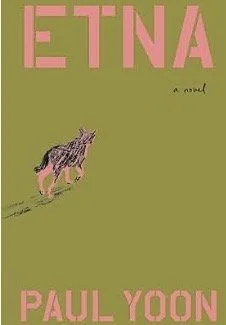
Etna is taught how to move, what to smell, and when to kill, fighting in a world of gunfire and shouting, for four years. When the war ends, he's covered with "scars like old worms" and no longer looks at his own shadow. He has one memory that gives him a reason to live. He remembers the ocean and he wants to go home.
He moves along "bombed-out roads" that lead to craters and woods that are filled with charred stumps. There are no birds and "living fields" carry death under their soil. When he finds another dog who becomes his comrade, that dog tells Etna how "the mountains burned" and cities were obliterated. "Just when you thought there was nothing left to destroy, it just went on."
In fact, he informs Etna, it continues to go on. Up in the desolate destruction of the mountains, men "got so used to fighting" that they can't stop. "Maybe," he concludes, "there was never a place for us here."
Like Odysseus, Etna finds his way home to "the wind, the tide, the sand." Hearing waves on his first morning, he's lost in "the deepness of it...like first snow." Near the ocean, in a devastated landscape, there's life, a solitary human, a group of dogs playing in the surf, and a bird who knows the language of dogs and has lived through untold measures of time,
When Etna asks it how it survived the war, the bird answers with a question.
"Which war?"
That's a question that could be asked by anyone born in the last half of the 20th Century and into the beginning of the 21st. All of us came to life in the shadow of a war that was immediately succeeded by the next. Our visual vocabulary is filled with bodies lying in different parts of the world, but most of us have never seen that ourselves, other than on a screen or in a photograph. Most of us have never learned what life becomes in the aftermath of a war.
Paul Yoon is one of us, a person who has never gone through a war, but war is a central part of his family history. His Korean grandparents and parents had direct knowledge of what this does and Yoon has explored it in every book he's written, including Snow Hunters (Asia by the Book, November 2020), Run Me to Earth (Asia by the Book, December 2020), Once the Shore (Asia by the Book, November 2023], and The Hive and the Honey (Asia by the Book, April 2025). Each of these, through different voices, echo Etna when he says "There's no other place. This is the only world we have."
Poems, the ancient bird tells Etna, are the way humans really sing. Etna, through the voice of Paul Yoon, sings, not of "arms and the man," but of how to live in "the only world we have."