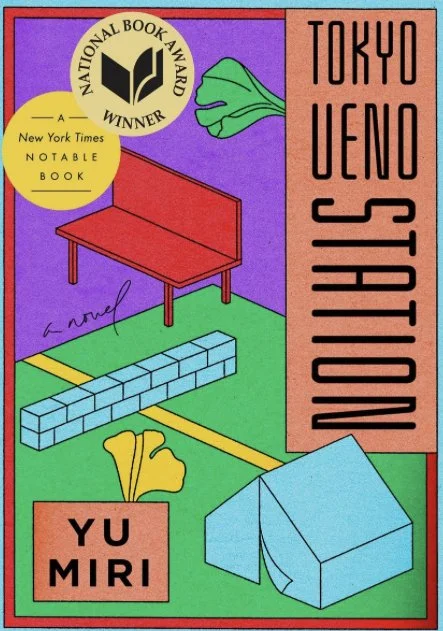
Tokyo Ueno Station by Yu Miri, translated by Morgan Giles (Riverhead Books) ~Janet Brown
Kazu is one of the homeless whose improvised shelters cover the grass in Tokyo's parks and who face constant eviction when members of Japan's royal family are in the vicinity. Otherwise they're ignored, even when they are in full view, and as they grow old and sick, they have no place to die.
Kazu knows he's dead but he has no memory of how this happened. Only an eerie sound emerges when he tries to recall the moment of his death, one that he says "ripped me to shreds but the sound wouldn't die." It's an inescapable and unexplained feature in the world he inhabits now.
He's perpetually tired, perpetually in motion, surrounded by people whose faces are like "a small pool of water," their individuality shown through fragments of conversation that Kazu hears as the speakers pass by. Some he recognizes from his homeless existence, some talk about comfort that he rarely knew when he existed. Kazu lived a life of labor, working on construction sites far from home. Everything he made went to his family, with no room for incidental pleasures and he writhes when he relives a moment when his children ask for a pleasure that Kazu is unable to provide.
Trapped in a "never-ending anguish" of memories, Kazu relives the death of his only son, a young man whose future was a bright testimony to his father's constant labor. He realizes that in 37 years of marriage, he has spent less than a single year in the company of his wife. When she dies, he walks away from everything that he's worked for, including a granddaughter who has come to live with him. "She's only twenty-one," Kazu tells himself, "She shouldn't be tied down here with her granddad," and he leaves for Tokyo and a life without solace.
Suddenly he reaches his final memories, the moment when he realizes "exactly what I was going to do next, like a moment of enlightenment." The world around him takes on an unexpected beauty, colors "pouring into my eyes like paint dissolving into water." Looking at the golden swirl of gingkos leaves in the wind, he sees them as "a messenger of light." Walking onto a station platform, he leans into the path of the approaching train.
"There may be an ending but there is no end." Without the capacity to exist, time doesn't pass. It spirals and loops.
One of my favorite pieces of Hong Kong film-making, the three-part masterpiece, Internal Affairs, is based upon the Buddhist concept of Continuous Hell. For the most evil of the dead, there is no escape from what they've done. They're forced to live their lives over and over again, without respite or escape.
Kazu, now dead, was never evil and the Pure Land school of Buddhism is a forgiving system of belief. However it teaches that life is a gift which shouldn't be tossed aside.. "How lamentable it would be to cast it away in vain," said Ippen Shonin, a founder of this sect.
Kazu knows the truth of this. Although we readers don't know when this loop will release him, while he relives and recognizes the nature of his life, he shows us the gift of our own.