Breakneck by Dan Wang (W. W. Norton) ~Janet Brown

What would have happened if the iPhone had been built in the United States? When Apple chose Shenzhen as its manufacturing point, it made that city a breeding ground for increased technological innovation, “the hardware capital of the world.” Dan Wang says this came about for a simple reason. China is a nation of engineers while the U.S. is a nation of lawyers. The first brings about rapid changes in infrastructure while the second breeds regulation and restriction. One builds while the other blocks.

The People’s Republic of China came into being under the leadership of a poet. Succeeding leaders have been trained engineers, beginning with Deng Xiaoping who “promoted engineers to the top ranks of China’s government throughout the 1980s and 1990s.” Under their guidance China began racing toward modernity and has never slackened pace.

In 2008, both the U.S. and China realized the importance of high-speed rail. By 2011 this was a reality in China while the U.S. claims it might be a functioning transit option by 2033.  The development of AI with its need for massive amounts of electrical power flourishes in China while in the U.S. the essential data centers that gobble electricity are blocked by widespread public opposition. 

Wang traces the history of modern China in seven chapters, each narrated in the same breakneck pace with which this transformation took place. Engineering, he claims, is responsible for China’s greatest successes as well as its most grievous failures. In factories engineers are in their element. When they turn to social engineering, as in the one child policy that was conceived by an engineer, they breed disaster. When they turned their talents to the Zero-Covid plan, their draconian policies caused an unprecedented number of nationwide protests.

Engineers have built not only a high-speed rail network, they have given Chinese cities subway systems that rival any in the world. They enabled Chinese citizens to leap directly past laptops and tablets to smartphones that have made cash obsolete with the use of QR codes. They have turned isolated villages into pocket-sized manufacturing centers, concentrating on a single product. They have made solar and wind power a reality, while pragmatically continuing to use their bounteous resource of coal. They made manufacturing a high priority during Covid, keeping factories running at full speed, producing consumer goods sold online to customers who had no other way to shop.

Xi Jinping, a chemical engineer himself, uses his political power to keep his engineering state intact. When the Chinese tech oligarchs began to exert their influence in threatening ways, Xi swiftly reined them in. His primary focus is directed toward energy security with the development of solar, wind, nuclear, and coal; toward food security, with farmers producing rice, grain, and vegetables across the country and grocery markets readily available to local residents; building manufacturing capabilities while increasing China’s technological power. Few of these goals, Wang claims, are being pursued in the United States.  

A Canadian, Wang has the benefit of being an outside observer in both China and the United States. He’s an engaging writer, as well as an analytical one, with the ability to create a vivid description  in a single concise sentence. “Beijing,” he says, “enthralls not because it is nice, but because it isn’t,” while Shanghai’s “streets have remained human-scaled rather than being built for cars.” “With its Blade Runner aesthetic, Chongqing is the embodiment of cyberpunk,” in contrast to Yunnan where “tea hills and rubber plantations rise above the Mekong River, carrying snowmelt from Tibetan highlands.” 

Because he spent the Covid years in Shanghai, his chapter gives a different perspective to this wellworn topic, and his Canadian passport lets him explore the places where young Chinese artists and entrepreneurs have emigrated and are making their homes, from Vancouver to Chiang Mai.

Although you may disagree with some of Wang’s points of view, you will never be bored. Breakneck is a book for our time, resonant and prescient.


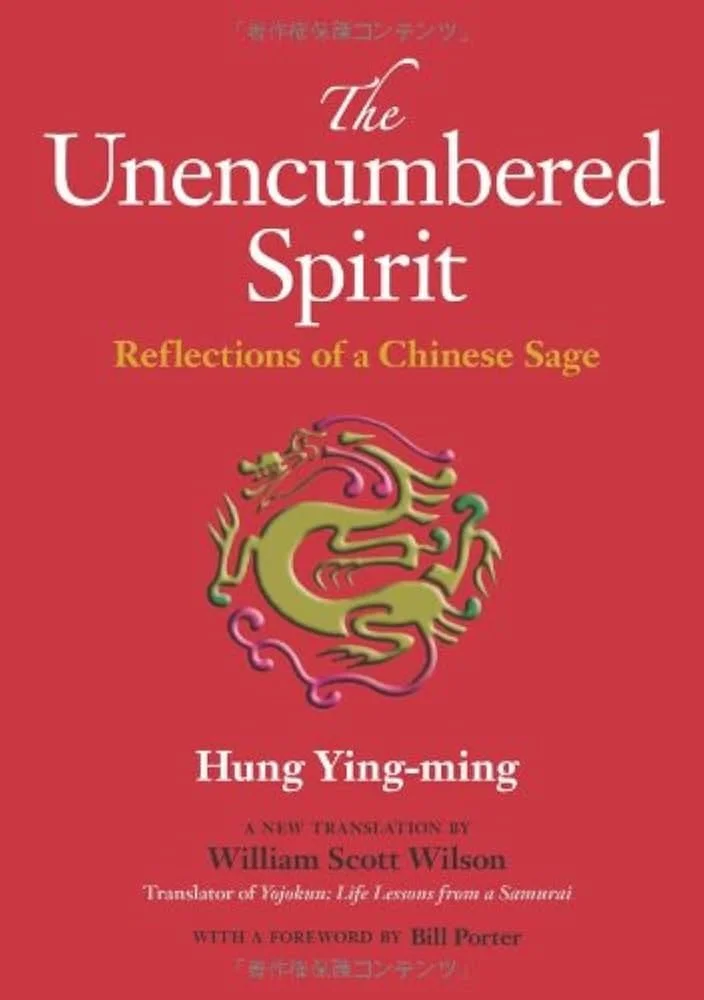
The Unencumbered Spirit : Reflections of a Chinese Sage by Hung Ying-ming, translated by William Scott Wilson (Kodansha International) ~Ernie Hoyt

Not much is known about Hung Ying-ming. What is known is that he was a Chinese sage who lived near the end of the Ming Dynasty (1368-1644). From his writing, most scholars agree that he was well-read and cultured. He was a follower of the Unity of Three Creeds - Taoism, Confucianism, and Buddhism. 

Taosism, founded by Lao Tzu, emphasizes harmony with the Tao, often translated into English as the “way” or “path”. The belief focuses on the relationship between the natural world and the body. 

Confucianisism, founded by Confucious around 500 B.C.E., isn’t concerned with the natural world and the human body but is a philosophy on society and human relationships. Its main focus being virtue, social harmony, and familial responsibility. 

Buddhism was not about the natural world and the human body, nor was it about society and human relationships. This belief focused on the mind and the suffering that arises from its misuse. 

The Chinese did not see these three beliefs as conflicting traditions but as complementary. Even if a person chose to emphasize one over the other, they hardly ever dismissed the other beliefs. The Chinese believe that each belief focuses on a different aspect of the human condition. 

“Taoism seeks the harmony of the body, Confucianism seeks the harmony of society, and Buddhism seeks the harmony of the mind”. If only Christianity or Islam could follow the Chinese way of thinking, perhaps the world would be a better and safer place. 

Hung Ying-ming was believed to be a member of the Chinese literati who enjoyed a simple life, “a type of man who found fulfillment in simple pleasures: reading classic literature, contemplating the Three Creeds, strolling through nature, laughing and drinking with friends, and practicing various accomplishments from calligraphy to the martial arts”. 

The Unencumbered Spirit is a collection of Hung Ying-ming’s writings on how to live a simple and satisfying life. He talks about “good and evil, honesty and deception, wisdom and foolishness, heaven and hell” and more. Although he lived hundreds of years ago, many of his writings still hold true today. 

One of the sayings seems directly related to the current leader of the United States of America. “If a man of high rank uselessly indulges in his power or markets his position, he becomes in the end, only a titled beggar”. Unfortunately, the man in power still holds his position and there are many who blindly follow him. 

Another one of Ying-ming’s sayings rings true in the current state of American politics - “A person brought up closely surrounded by wealth and rank will have appetites like raging fires and wield power like violent flames”. We can only hope that the rest of the saying will come true as well - “If he cannot become cool and clear, if his flames do not actually burn someone else, they will surely scorch the man himself”. 

One final saying I thought related to those who thirst for power is, “Title and rank should not be elevated too high. Once a high elevation is reached, there is danger”. We’ve already seen the dangers set by the current President of the United States as he tries to become more like a dictator than a leader of a democracy. 

I would like to highlight those passages and send it to the man in the Oval Office at the White House. However, if I were to do that, I may become a target of his repressive administration.


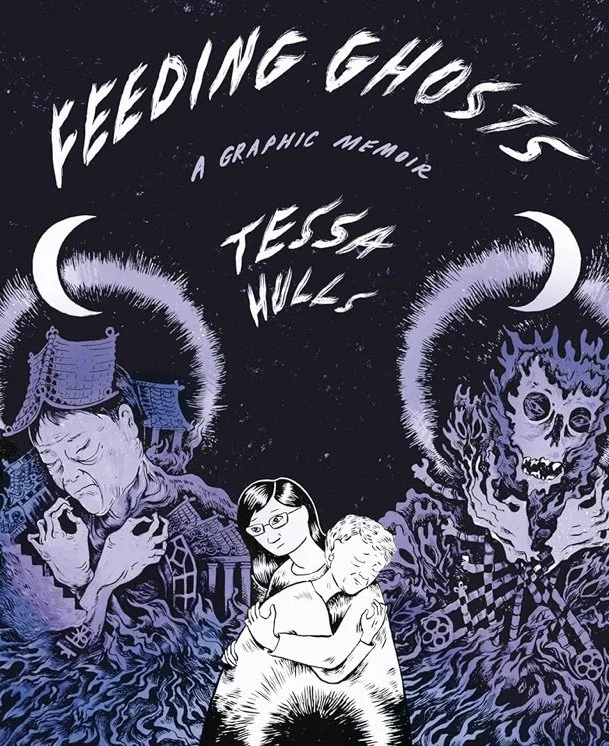
Feeding Ghosts: A Graphic Memoir by Tessa Hulls (Picador) ~Janet Brown

When Tessa Hulls was a child, in her mind, she “became a cowboy.” She dreamed of riding through landscapes “where space, silence, and independence were limitless” and where being an outsider is a heroic existence. 

She has been an outsider all her life. With a British father and a Eurasian mother in a small California town, in a house dominated by the presence of a Chinese grandmother who’s trapped in a morass of memories, Tessa lives far outside of any conception of normal. As soon as she can she runs away, bicycling across the US, deejaying in Antarctica, working in Alaska. Then her grandmother dies and Tessa returns home, facing her inheritance of ghosts.

With her mother, she travels to China, piecing together the turbulent history of her grandmother and the loneliness that engulfed her mother within the safety of an elite Hong Kong boarding school. 

Retracing her grandmother’s life, Tessa comes to know her as Sun Yi, a young journalist who was viciously targeted by the dictates of Chairman Mao. Sun Yi finds protection and betrayal in men who are ensnared by her beauty. She has a daughter with a Swiss diplomat who leaves her with a baby and never contacts her again. Managing to escape to Hong Kong,  she places her daughter in one of the city’s best boarding schools before she falls into a gulf of mental illness that will claim her forever.

Tessa’s mother is saved by her brilliance but that survival is based upon jettisoning her feelings. When confronted by Tessa’s emotions, she interprets them as signs of the illness that erased Sun Yi. As Tessa struggles to gain her independence, her mother turns her over to therapists and medication. Parental love morphs into fear and rage that Tessa combats with her cowboy dreams.

Tessa Hulls has written a family history that sweeps over three generations, blending this into the cultural and political history that shaped Sun Yi, her daughter and her granddaughter. Drawing upon the bestselling memoir that Sun Yi wrote before she lost her mind, from fragments of letters and news articles, and from the accounts of Chinese relatives, Hulls gives her book a broad and chilling dimension as she unfolds the narrative in clear, crisp sentences.

It’s what she evokes in her drawings that conveys the darkness that destroyed her grandmother, crippled her mother, and sent her on journeys into the corners of the earth and the corners of her own being. Every sentence appears in its own frame with a picture. Every picture augments the words into something that comes close to being unbearable.

No matter how much history you have learned or how many books you have read, I’m certain you’ve never read anything like Feeding Ghosts. History, memoir, adventure all create a vast panorama that narrows into danger within its final pages. As Hulls fearlessly confronts her ghosts, she takes her readers into their own dark regions, places they may have always avoided. This isn’t an easy book to read. While it shows lives that few of us have known, it lures us into universal truths that have touched us, leaving their scars.

Winner of the Pulitzer Prize for Memoir and other awards, Feeding Ghosts is a masterpiece.

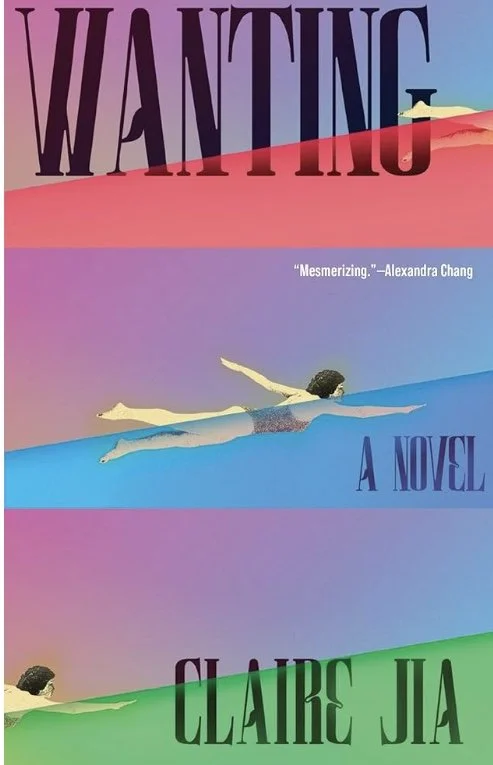
Wanting by Claire Jia (Tin House) ~Janet Brown

Lian and Wenyu are unlikely friends. When they first met, Lian was the good girl, carefully dressed and diligently scholastic. Wenyu was the rebel, the one who shoplifted for kicks, rarely wore the school uniform, and chose the most dangerous guy in her class as her boyfriend. Lian read the Harry Potter books in English. Wenyu cut class and was frequently suspended from school. Lian’s goal was Harvard. Wenyu had no goals but her father had a friend in California whose guest room would soon be hers. When she left Beijing, the two girls lost touch. 

Now Wenyu is coming home, a glamorous social media influencer with a rich American fiance. Lian, who never made it to her dream schools in America, has a promising career that’s the result of going to one of Beijing’s top universities. She and her boyfriend are looking at high-rise apartments in the capitol’s finest neighborhoods. Her life is good. Wenyu’s is fabulous. 

As the women rekindle their friendship, Lian finds Wenyu is still the same predatory thrill-seeker she was as a teenager, with her wealth giving her the freedom to do whatever she likes. When she begins a clandestine flirtation with her old high school boyfriend, Lian develops an illicit diversion of her own. 

But this isn’t a Beijing version of Gossip Girl. Claire Jia changes her focus mid-novel by introducing the architect who’s supervising the building of Wenyu’s mansion. Song Chen lives a universe away from the Beijing that Lian and Wenyu have made their own. He and his wife are successful but their standard of living reflects the frugality of 20th Century China. Educated in the U.S., they never succumbed to its culture. Now their primary goal is to buy a luxurious apartment for their only child and his prospective bride.

The contrast between the life led by Chen and his wife as it’s juxtaposed against those of Lian and Wenyu is shocking. One of Lian’s friends, who returned to Beijing with her American degree and a Power Point presentation for the start-up that’s launched her wealth, recently purchased an apartment for 9 million renminbi (over a million U.S. dollars). Another friend stands at a party with her husband, who holds “her Chanel purse like it was a crying baby.” At Wenyu’s engagement party in a Beijing speakeasy, the banquet tables are brimming with hors d’oeuvres that are as chic and decadent as any in the most fashionable restaurants in Manhattan. “Romance was dead and replaced with a BMW and a lifetime membership to Space Cycle.”

Meanwhile Chen curries favor with a low-level bureaucrat by bringing a bottle of whiskey and a bag of dates to the man’s office. He drives a Mazda that’s far from new and his apartment is filled with cooking odors and traffic noises. His marriage is on the rocks and when his wife leaves on a trip to see old college friends in America, he falls into a guilt-ridden affair with a woman who works in the low-level bureaucrat’s office. 

The contrasts turn sharp and cruel as Wanting reaches its conclusion. While lies are pretty little soap bubbles to Wenyu and Lian, to Chen and his wife, they’re butcher knives, brutal and destructive. 

Claire Jia’s first book takes on the form of an old-fashioned novel, one that mingles a comedy of modern manners, a domestic tragedy, the perils of online fame, and more than a few almost improbable coincidences that come together in ways that evoke Dickens, if not Shakespeare. She’s cleverly and concisely revealed Beijing, with all of its glittering wealth and dark anomalies, and sets a high standard for future debut fiction.

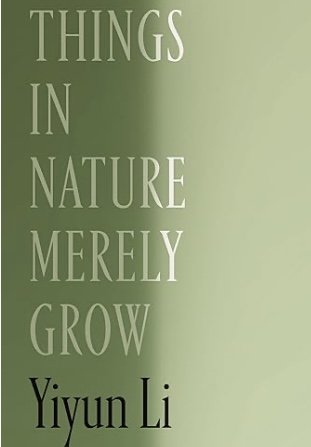
Things In Nature Merely Grow by Yiyun Li (Farrar, Straus and Giroux) ~Janet Brown

When Yiyun Li’s first son committed suicide while he was still in high school, Li didn’t have the luxury of succumbing to her feelings. Her youngest son needed her strength. Six years later he killed himself. 

Immediately Li “began to feel that sensation for which there is no name.” Her life became an abyss. This state of being was a concrete fact, against which her feelings were useless. Trained in science before she became a novelist who wrote eleven books that preceded this one, among them The Vagrants (Asia by the Book, March 2009) and A Thousand Years of Good Prayers (Asia by the Book, April 2020), Li turned to facts, “the harshest and hardest part of life.”

Facts bring “order and logic,” while feelings encourage “the inexplicable and the illogical”where “words take on a flabbiness and staleness.” “I have only this abyss, which is my life,” a state that is permanent. It can slip into Greek tragedy or it can find a different form of existence, one that is stripped of narrative.

Li chooses Radical Acceptance, living with unchangeable facts without bringing judgement  to them, recognizing distress without excessive feelings but with keen attention. 

The death of her children is a fact. Suppositions, intuitions, and searches for reasons why offer nothing that will change this. Instead Li follows a path that she was taught by Marsha Linehan, author of Building a Life Worth Living and the creator of dialectical behavior therapy with its tools of acceptance, mindfulness and shaping. “Do things that work,” is a tenet of Linehan’s and Li adapts this to “Do things that make sense to me.” 

How to survive in the dark hole of an abyss with its threat of timelessness is to “mark time..by doing anything that keeps the body moving and the mind focused.” Marking time is done only by those who are “in the realm of the living,” and provides a structure for a life.

Cooking and gardening are activities that require the discipline of “order and logic” and “keen attention” upon facts. Writing draws upon a practice in which “everything is relevant and noticed” and facts are never ignored. 

Li learned as an abused child to “keep my body still and my mind clear.” Born in Beijing near the close of the Cultural Revolution, with a mother who was badly scarred by modern Chinese history, Li had an aversion to emotional indulgence from her earliest years. As a student of science, she abhors sloppiness of thought. “Cliches,” she believes, “corrode the mind” and “any adjective is an irrelevance.” She repudiates the Western idea of grief with its progression toward an end point and is equally dismissive of the criticism that comes from readers in China, who revile her for using the words “death” and “die” instead of softened euphemisms. 

Refusing to evade or soften facts and unflinchingly observing emotions while letting them pass seem to echo the Chinese practice of “eating bitterness.” Certainly Marsha Linehan was deeply influenced by Buddhist thought, which she has freely acknowledged. Li, who was hospitalized for mental illness when she was younger, lives with the knowledge that “reality and unreality remain permeable.” To remain within the borders of reality, her sense of time is focused upon “now and now and now.” The verb ‘to be” is “undyable” and her sons are now and forever her children.

“Things in nature merely grow, until it’s time for them to die,” she says, “There is no shared abyss. We each dwell in our own.” Although nobody can be with Yiyun Li within hers, she has reached out from it to give signposts for how this state can be survived.

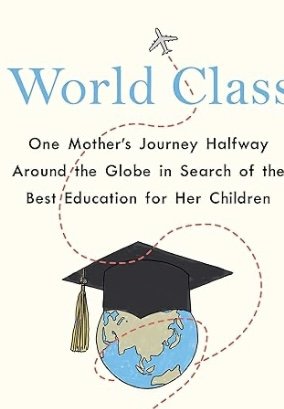
World Class by Teru Clavel (Simon & Schuster) ~Janet Brown

When Teru Clavel’s husband is transferred from New York to Hong Kong in 2006, she’s relieved. The oldest of her two young sons is approaching the age where preschool is in his future and in Manhattan, this is no trivial landmark. The right preschool will determine his future education, right up to his choice of university, and the application process is almost a blood sport. Parents begin this rigorous journey even before the future student emerges on a delivery table, moving to the right neighborhood, joining the right church, and finding the right consultants in tandem with “preschool prep” classes. 

The Clavel family falls into the category of “moderately to extremely wealthy” and both parents were educated at all the right schools but Teru had an additional advantage. Her Japanese mother sent her to public school in Japan every summer. With that background, she’s eager to give that same sort of opportunity to her children--and for the next ten years, she does.

At first her two-year-old son James is enrolled in a prestigious, private preschool but his mother begins to chafe against the affluent bubble that Hong Kong provides to wealthy expatriates. With her Japanese public school experience, she finds the same thing for James by the time he’s three and is delighted that by the time he’s four, he’s given homework and is a confident speaker of Chinese--or Mandarin as Teru terms it throughout her book.

When her husband is transferred to Shanghai, they all leave any form of expat lifestyle behind in Hong Kong and enter what Teru calls “family detox.” Their apartment is inhabited by rats, roaches, and termites and James, at six, becomes his mother’ s interpreter when they go to stores and markets. But Teru’s determination gets her sons into public schools, where James is the sole foreigner in his class and Charles is only one of several  in his preschool. There the family discovers that Shanghai invests in teachers’ salaries and continuing professional development, with generous resources given to English language instruction and education for students with special needs. Unlike their U.S. counterparts, schools don’t spend money on technology, attractive classrooms, or elaborate playgrounds. 

In  her sons’ schools, Teru finds, teachers concentrate on mastery of a subject for every student and they will stay after school with anyone who needs help to reach that point. “There is no ‘bad at math,’ Teru says, “any grade below 95 is considered a failure.” First grade students begin to learn the rudiments of algebra. While classes concentrate on rote memorization, speed drills, and repeating what a teacher has just said, this pays off. In an international test administered by the Organization for Economic Cooperation and Development, the PISA (Program for International Student Assessment) that focuses on math, science, and reading, Shanghai was at the top in all three in 2009 and “ranked three full grade levels above the average score overall” in 2010. 

At the same time, James and Charles found a sense of community in their schools, to the point that when Charles was briefly hospitalized, his teacher, several of his classmates, and their parents visited him.

By the time the Clavels are transferred to Tokyo, a new addition to their family, Victoria, is almost ready for preschool. While James and Charles have learned discipline and self-control in their Shanghai school, Victoria at the age of three barely squeaks into a Tokyo preschool. “Make sure Victoria understands social norms here before she starts school,” the principal warns Teru. Her older brothers are given a crash course in Japanese before beginning their four years of public school.

Perhaps because Teru received a generous helping of Japanese education as a child, she spends less time describing the experience that her children underwent. She stresses the importance Japan places on educating “the whole child,” fostering independence and giving a thorough grounding in nutrition as well as providing curriculum that is stable and carefully planned system-wide. In Japan, she says, textbooks are written and approved by teachers. A parent-teacher journal comes home with each child every night and families are encouraged to come into their student’s classroom for observation days. “It was an efficient, transparent system that had stood the test of time.”

Returning to U.S. schools in 2016 is a shock to everyone. Although the Clavel children attend public school in the wealthy area of Palo Alto, the best ranked school district in California, they find sports are stressed above academic subjects. In James’s English class, seventh-graders are required to read no more than three books all year and their teacher will critique only three essays “because there’s not enough time.” Charles is delighted that he watched “ten movies in full” during his year of fifth grade. Both boys are two years ahead of their grade level in math.

The solution? Go full circle. Move to Manhattan and put the children in private school. 

Although World Class is a more cursory examination of education overseas than Little Soldiers (Asia by the Book, December 2022), Teru Clavel gives a surprising and often shocking comparison of U.S. education during a time when we need to hear this more than ever.

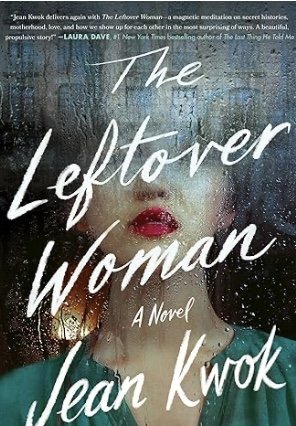
The Leftover Woman by Jean Kwok (HarperCollins) ~Janet Brown

A leftover woman, as a Chinese saying goes, is one that nobody wants, “leftover, like scraps on a table.” Jean Kwok presents two women from different continents, each one feeling like a leftover for different reasons.

Jasmine has come to New York from China after paying a group of snakeheads to smuggle her into the U.S. Now, faced with a balloon payment, she’s looking for work that will keep her from the threat of prostitution. She’s also here to find her daughter, a child whom she was told died at birth but whom her husband had given up for adoption to a couple from Manhattan. Jasmine’s willing to do anything to succeed in her quest, even working as a cocktail waitress in a Chinese-owned strip joint. She’s in flight from her rich and powerful husband and has no friends--except for a boy she grew up with in her village who now works in a martial arts school near Chinatown. She ignores him out of an excess of caution, concentrating only on recovering her lost child.

Rebecca is a highly placed editor in a publishing house founded by her father. Dogged by a scandal that almost scuttled her career, she’s frantically trying to regain her professional reputation to the exclusion of the two people she loves--her husband, a professor who’s fluent in Chinese and four other languages, and the daughter they have adopted through an agency in China. Rebecca has turned over her daughter’s life to a Chinese nanny who speaks limited English. Although Lily is unpolished and clumsy, she adores Fiona, the little girl who is under her care.When it becomes obvious that Rebecca, who’s the only one in her household who can’t speak Chinese, is taking second place in her daughter’s affections, she begins to hate the woman who has supplanted her.

The way Jasmine and Rebecca find each other is a dizzying story with twists that come without warning. Although Kwok at first seems to be following in the footsteps of Jackie Collins, she’s much too smart to take that route. Yes, she cloaks this novel in heavy scenes that reek of romance, but she’s done her research and that gives her book a whole other dimension.

In her portrayal of Jasmine, Kwok explores the dilemma of undocumented immigration and the gaping differences between fresh-off-the-boat Chinese and Chinese Americans. In a Chinatown cafe, Jasmine notes the confidence that radiates from women who look like her but who exude a sense of belonging--”their fearlessness, the way they’d seized their genetic peculiarities…and decided to wield them.” “Remember,” one of them tells her later, “appearances are everything.” When Jasmine follows up on an employment tip this women has given her, she discovers “Asians exploiting Asians,” in a club where a Chinese American woman hires women from China who have no other job options. In this place Jasmine and other immigrants satisfy “every cliche of male desire.” There is, Jasmine learns, “no room for subtlety in a strip club.”

Through Rebecca, Kwok glances upon issues of “race, feminism, and identity,” and the way both “women and immigrants need to split themselves into different personas and roles.” As Rebecca, Lily, and Jasmine come to a shocking intersection, questions of economic class arise in a conclusion that’s filled with violence and heartbreak.

The Leftover Woman confronts a multitude of stereotypes, including the ones that cling to genre fiction. Kwok, whose parents brought her to the U.S. from Hong Kong when she was five and who spent a large part of her childhood working in a sweatshop, earned an undergraduate degree from Harvard and an MFA from Columbia. In her fourth novel she draws skillfully from every part of her background to create a book filled with constant surprises and provocative points of view, one that belongs in an academic seminar as much as it does under a beach umbrella.

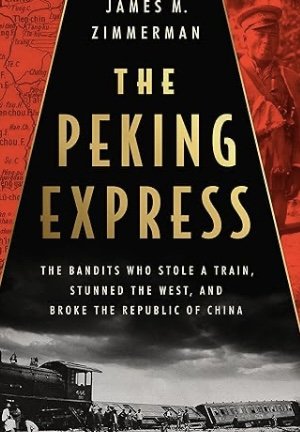
The Peking Express by James M. Zimmerman ( Hachette Publishing Group) ~Janet Brown

Shanghai had a community of 35,000 foreigners in 1923 with many of them eager to travel on the newly launched express train to Peking. “A luxury hotel on wheels,” with its silk sheets and and its five-course banquets, the four-month-old train could make the 892-mile overnight journey in thirty-eight hours and attracted a multinational collection of affluent passengers.

On the morning of May 5, 1923, among those who boarded the train was an Italian attorney who represented the Shanghai Opium Combine, the owner of the Chinese Motors Federal Company who had left Romania penniless years before, a honeymooning couple from Mexico, a number of journalists, a couple of military families with their young children, and the aging sister-in-law of John D. Rockefeller Jr, heir to the Standard Oil Company.

At 2 am on May 6, over 100 passengers were kidnapped by 1000 bandits, who attacked and derailed the train. Although the victims were stripped of all their possessions, that wasn’t the goal of the man who was their leader. 

Sun Mei-yao was a twenty-five-year-old former soldier who had amassed a large company of bandits and planned to use them in an “economic insurgency” against China’s warlords and the corrupt military general who governed the region. Shrewdly he decided that the best way to gain attention and achieve his goal of becoming a general himself, leading a brigade of former bandits, was to take hostages. The Peking Express, filled with wealthy Chinese and important foreign figures, was his ticket to success and he grabbed it.

Marching his captives to his stronghold on Paotzuku Mountain, Sun knew the grueling trek that would take several days was beyond the abilities of the women and children in the party. He gradually released them all--except for the Mexican bride who was from a country where banditry was commonplace and refused to leave her husband. (Eventually Sun lost patience and told a group of negotiators “And take the Mexican lady with you!”)

As released prisoners made their way to safety, they provided the necessary details that would capture the imaginations of newspaper readers all over the world.  When Lucy Aldrich, the Rockefeller relative who was on her second journey around the world, emerged from captivity, her greatest fear was that her family would never let her travel again. She described her ordeal as “most dangerous,” yet “thrilling” and extremely amusing at times,” which probably launched 1000 headlines.

The remaining captives reached the bandits’ fortress and found “a beautiful quiet place with caves and the Temple of the Clouds.” “Our view is like an artist’s map,” one hostage wrote to his family.  However it certainly wasn’t summer camp.

Their treatment was far from idyllic; beatings were not uncommon and three of the strongest men were separated from the others and isolated as bargaining chips on the least accessible part of the mountain. There these men found a group of 23 kidnapped children huddled in misery, like “hopeless hungry little old men.” Sick and near starvation, the group of boys and one girl were like a subscription service; their parents sent money each month to keep them alive. (The 47 children whose parents stopped sending ransom were thrown over the side of a cliff.)

Although foreign governments chose not to directly intervene in freeing the hostages because it was a matter for China to resolve, they sent doctors and supplies to the mountain and instituted an improvised postal system. Letters from the captives and replies from their families, 50-100 letters a day, were carried by visitors and the bandits, along with newspapers and cameras. 

The hostages realized their only strength came from standing together, which kept Sun from using executions as a negotiation tactic. When they were finally released after five excruciating weeks, they made sure that the Chinese who had become part of their group were freed with them. Later all of the Chinese were brought to safety along with the imprisoned children.

Sun Mei-yao got what he wanted for a very brief time. When international attention veered away from the newly appointed brigadier general, he was beheaded, much to the rage of the men he had held hostage. The conditions of their release had been based on Sun’s safety and the violation of that infuriated his former prisoners, many of whom had come to respect him. So had Mao Tse-tung, who “admired Sun Mei-yao’s ability to mobilize the people.”

What came to be known as the Licheng Incident was perhaps the first use of international media to engineer worldwide public opinion. That it ended with much less bloodshed than the recent highjacking of a train in Pakistan is a sad commentary on current politics. 

Later the Peking Express would become the Shanghai Express in a 1932 movie starring Marlene Dietrich and Anna May Wong. The screenwriter? None other than Harry Hervey, the pulp novelist and author of Where Strange Gods Call (Asia by the Book, April 2024).

The site of their captivity is now part of the Baodugo National Forest Park where a “rickety cable car” takes hikers to the foot of Paotzuku Mountain. If they can manage the ascent, they can sit where Peking Express hostages once waited to be released.

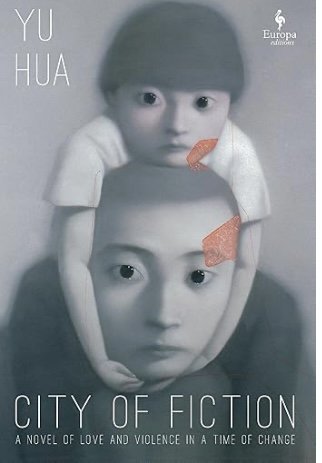
City of Fiction by Yu Hua, translated by Todd Foley (Europa) ~Janet Brown 

Strangers are unusual in the town of Xizhen so everyone knows about the tall Northerner who has shown up for no apparent reason. The man arrives carrying an infant so young that he has to pay women who are nursing their babies to give milk to his motherless child. Although it’s difficult for the townsfolk to understand his dialect, his love for his daughter and his friendly demeanor wins them over, especially when he reveals a talent for carpentry that he offers for free. 

Li Xiangfu and his little daughter become an integral part of Xizhen, although his origins are still a mystery. He takes on the task of teaching, telling his students to “sit upright and walk straight,” words that he embodies in his own life. His daughter becomes the most beautiful girl in town, with people saying she’s as “lovely as Xishi,” the first of China’s legendary Four Beauties.

Nobody knows that Li Xiangfu had once fallen in love and married a woman whose dialect was identical to the people of Xizhen. She had run away with part of his fortune, leaving him with their newborn child, and he has devoted his life to finding the woman he still loves. Settling in Xizhen only because the town his wife said was her own seemed to be a place nobody has ever heard of, Li Xiangfu hopes that someday she might appear in this town where everyone speaks her language.

Life is idyllic in this prosperous farming region until the political instability that takes place after the fall of the Qing Dynasty leads to terrorism. Bandits roam unchecked, stripping crops and wealth from people who have never learned how to fight. With unspeakable cruelty, they murder and pillage, taking hostages who may yield substantial ransoms--or die slow and terrible deaths. After the leading citizen of Xizhen is captured, Li Xiangfu is the one who volunteers to buy his friend’s freedom.

What begins as a story of love and devotion turns into stories of stomach-turning torture, graphically described, with an abrupt ending that brings no feelings of hope or redemption. Much as Yu Hua did in Brothers (Asia by the Book, January 2010), he has written City of Fiction in what feels as if it should be in two separate volumes. The first has sweetness while the second has none at all. Even the beautiful daughter, the guiding hope of Li Xuangfu’s life, disappears from the second half of the narrative, safely ensconced in a Shanghai boarding school.

Beginning with fascinating descriptions of village ceremonies and wildly humorous episodes of magic realism, Yu Hua’s immediate plunge into sadism and grueling battle scenes is viciously jarring. Even when he brings his novel into a circular structure that gives the story of Li Xuangfu’s faithless wife and retells the events that began this novel in a way that offers another dimension, this brings no brightness to the book’s conclusion.

Still it’s impossible to stop reading City of Fiction, even as it swerves into brutality that is rarely leavened with any sort of mercy.  Yu Hua has brilliantly recreated life in China during the beginning of the last century, stunning readers with how much has changed in the past hundred years.

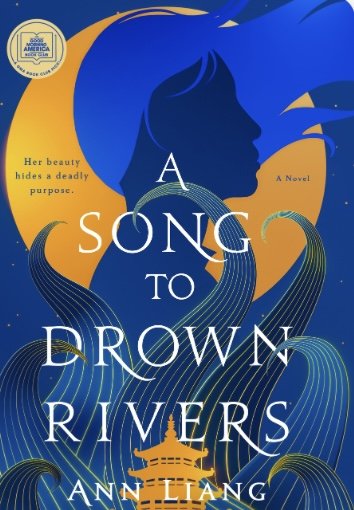
A Song to Drown Rivers by Ann Liang (St. Martin's Press) ~Janet Brown

“Beauty is not so different from destruction.” Xishi has been shielded from what her beauty could inflict upon her since she was very young. Each time she leaves the house, her mother veils her face to ward off the attention that comes from being the most beautiful girl in the village. 

But beauty has its uses and in a region where two kings vie for power, the weaker monarch needs a weapon to defeat the man who has taken over his kingdom. Sending Fanli, his trusted political and military advisor, to find the loveliest girl in the area, he’s certain that great beauty will cause the downfall of his enemy. 

Fanli is a man who seems impervious to female charms but he knows how to assess them. He chooses Xishi to accomplish what the King of Yue has planned--to marry the King of Wu and charm that ruler into doing exactly what she wishes, leading her husband to unwittingly lower his defences and lose his kingdom.

Xishi is a peasant girl without refinement or sophistication so before she begins this project, she needs extensive training under the watchful gaze of Fanli. She falls in love with him but is bound to accomplish her goal. She hates the King of Wu almost as much as his rival does because she had watched Wu soldiers kill her sister. Revenge propels her away from the man she loves and into the treacherous life of a royal court. 

The King of Wu is seduced by her beauty and fulfills every wish she voices, wishes that weaken his kingdom, provide a gateway for the Yue invasion, and ensure that Xishi might eventually regain a life of freedom. But politics is a dangerous game and beauty can lead to destruction as well as cause it.

Ann Liang wrote A Song to Drown Rivers when she was twenty-one, basing it upon the legend of China’s Four Beauties, of whom Xishi was the first. Although the novel is being marketed as fantasy, it’s actually a carefully researched work of historical fiction. Its first sentence is crafted from the Chinese saying that great beauty causes the fish to sink, the geese to fall from the sky, eclipsing the moon and shaming the flowers. It recreates a turbulent chapter in Chinese history, when the state of Wu came into power and threatened neighboring kingdoms. The story of how a beautiful girl was used as a pawn by the King of Yue to eradicate this threat is told in the Spring and Autumn Annals which supposedly were collected and compiled by Confucius.

Often retold legends become cumbersome and ungainly, with language that weighs down the story. Luckily that isn’t the case with this version of Xishi’s life. Although Liang carefully describes the opulence and luxury of the royal lives and the intricacy of political plots, she never turns her heroine into “someone barely even human, a creature of myth.” She gives Xishi a spirit that resonates and enthralls through the centuries, telling her story in a fluid, fast-paced style that never flags or falters, while giving it the delicate grace of a fairy tale. 

Although she has written four novels for young adults, this is Ann Liang’s debut foray into adult fiction. Let’s hope it won’t be her last.

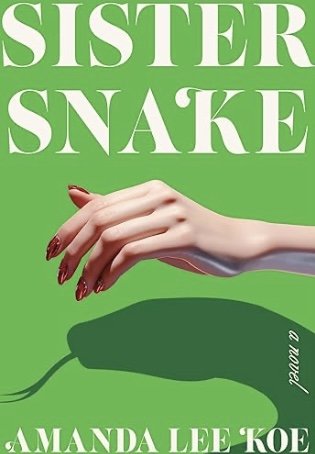
Sister Snake by Amanda Lee Koe (HarperCollins) ~Janet Brown

When Emerald goes broke while living a wild life in New York, her request for help is refused by her wealthy sister, Bai Suzhen. Still, after Emerald’s venture into the world of escort services goes dangerously awry, Suzhen flies from Singapore to rescue Emerald and bring her to the safety of the island republic.

Since Emerald is as unconventional as Su is prudent, Singapore’s sterility isn’t where she belongs. Swiftly she uncovers the hidden side of the Lion City, hanging out with lesbians and eating at street stalls, while horrifying Su’s husband, a native-born Singaporean with political ambitions.

Sister Snake might seem as if Crazy Rich Asians has collided with the 21st century version of Sex in the City if it wasn’t for its opening sentence. “Before they had legs, they had tails.” 

Dipping deep into the Chinese Legend of the White Snake and her green counterpart,  Amanda Lee Koe has brought the story of shape-shifters into the modern world. Su and Emerald left the West Lake of Hangzhou as beautiful women, transformed from snakes after seizing the lotus seeds of immortality and meditating for eight hundred years upon self-cultivation, an art that allows them to take on a human form. Sworn sisters since they first met, when the green viper saved the life of the white krait, Su’s desire to become human only took place because of Emerald’s love of risk. Once they become women, immortal, beautiful, and able to move from reptilian to human form at will, Su’s pragmatic and goal-driven nature continues to collide with Emerald’s restless hedonism. “Moderation was too human for her,” while Su believes this is the key to success. Throughout the centuries, the sisters alternately co-exist and clash. Emerald’s feral nature always lurks at her surface, while Su represses her own, to the point that she undergoes plastic surgery to put the beginning of wrinkles into her perfect and unaging face.

A trophy wife in Singapore who brought her own wealth to her marriage, Su is horrified to discover she’s pregnant, a fact that she confirms when she comes to rescue Emerald. Frightened that the life within her may be a snake instead of a human fetus, she gets rid of the person who might reveal her pregnancy, Emerald’s best friend, whom she murders with the instinctive and deadly skills of her inborn nature.

Suddenly the shape-shifters change their human emotional states, with Emerald forming deep and compassionate links with human friends while Su’s releases her innate savagery. Although separated by their new transformations, they are still sisters and they are, under their glamorous exteriors, still viper and krait.

When the story of the White Snake first came into being in the Tang Dynasty, it was, Koe says, intended as “a cautionary morality tale.” In her retelling, she was guided by the vision of “a hot snake queen with an existential crisis,” which she turned into a pair. Throughout Sister Snake, Koe gives glimpses of who these women have been in their reptilian lives, gradually enlarging and deepening these views of the snake sisters before their human lives threaten to drive them apart. The ending that closes this novel is startling, satisfying, and a lovely surprise, taking the story from a guise of romance and fantasy into something that’s completely fresh and new.

With Sister Snake, Amanda Lee Koe joins a new wave of novelists from Singapore, taking her place beside Rachel Heng’s The Great Reclamation (Asia by the Book, January 2022) and Kirsten Chen’s Counterfeit (Asia by the Book, June 2022). These powerful voices give vibrancy to fiction, with novels that take conventional forms and give them unexpected twists.

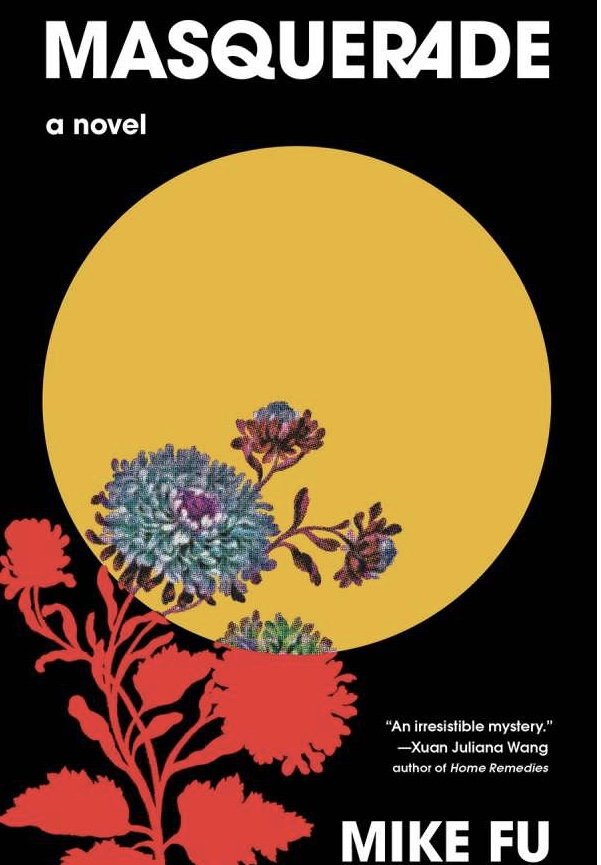
Masquerade by Mike Fu (Tin House)

Anyone who has made a round-trip flight across the Pacific knows the price exacted by these hours on a plane. The traveler often loses control of ordinary life at the end of these journeys, sleeping and waking at times far from one’s normal schedule, feeling ravenous hunger at four in the morning, finding the world at large has taken on an unfamiliar, almost hallucinatory, cast. “A legal drug,” Pico Iyer has called jet lag and when mixed with illegal ones or even alcohol, it removes even more controls.

Meadow Liu is well acquainted with jet lag. He’s been flying back and forth between the U.S. and Shanghai once or twice a year since he was ten years old. Even so he’s always felt that “he’s lost a piece of himself on these journeys” and on this latest one he has the feeling that not only is he “intensely disconnected” from everything he knows, he’s become “31 going on 13”.

He has many reasons to feel this way. His entire life has become a liminal space. He was given a job as bartender in a hip Brooklyn hangout after he abandoned his academic career. He was forced to move from his apartment and is now plant-sitting for Selma, an artist who is so perfect she seems like a “splendid illusion.” He was recently ghosted by a man who seemed to be the perfect boyfriend until he vanished without a word of explanation. To cope with his floating existence, Meadow drinks a lot and takes every drug that comes his way.

To complicate things even more, while searching for his passport several hours before his flight, he comes across an old book on Selma’s shelves. Drawn to it because the author and he have the same name, he’s intrigued that the story takes place in Shanghai, where he himself is going. Tossing it into his carry-on, he forgets about it in the flurry of living with his parents as their temporary guest and making contact with Selma who is here to launch an art show.

When he dips into the novel that he borrowed, he’s surprised that he and the narrator seem to be living parallel lives, with each of them attending decadent Shanghai parties. Things become stranger when he returns to Brooklyn. The book disappears and resurfaces at odd intervals. A man who shows up at closing time in Meadow’s workplace warns him to “pay attention to symbols,” an admonition that he later finds is also given to the narrator of the peculiar book.  Before this warning is given, Meadow finds a white switchblade that’s been left behind on one of the bar’s tables. The same knife is given to the narrator in the novel.

Selma has mysteriously vanished from Shanghai so Meadow is unable to ask her about the eerie coincidences that he’s found in the book that she owns. Meanwhile his life becomes increasingly bizarre, with a bedroom mirror almost liquefying as he stands before it one sleepless night. He’s followed by strangers as he makes his way through New York. Awakened by pounding on the apartment door one night, he looks out through the peephole and sees Selma standing there, only to have her disappear from view. Confronted with someone who looks disturbingly like him, Meadow follows his double who leads him to an off-off-Broadway theater. A poster near the theater’s entrance has photos of the actors. One of them is the man who ghosted Meadow.

And as his life becomes increasingly unhinged, Meadow finds it’s being replicated, page by page,  in the novel written by the man who shares his name.

Is this being scripted and manipulated by Selma, a woman who has always been enigmatic or is Meadow immersed in a form of psychosis that he’s nourished with cocktails, drugs, and jet lag? Is this a puzzle he’s meant to solve or is it a temporary state, a “translucent jelly,” that will eventually fade away?

Mike Fu is a translator based in Japan who in 2019 translated Sanmao’s classic travelogue, Stories of the Sahara (Asia by the Book, April 2021)  into English. Masquerade is his first novel, one into which he seems to have poured everything he’s ever observed and experienced. A smart writer and a skillful observer, Fu’s gift of creating atmosphere along with his well-turned phrases (“thunder purred with the malice of a sleeping cat”) make this book a compelling one—with an annoying ending.  As the narrator of the novel within this novel concludes, “If any trace of doubt remains--then write this story anew.” Every reader of Masquerade is given a chance to create their own explanation, their own end to the story.~Janet Brown

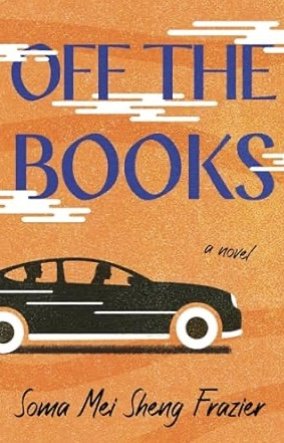
Off the Books by Soma Mei Sheng Frazier (Henry Holt)

Every girl should have a grandfather like Mei’s. When she graduates from Dartmouth and faces a tight job market, it’s Laoye who buys her a sedan and persuades her to forgo the easy money of working for a rideshare company. He’s the one who taught her to drive as soon as she was old enough to sit behind the wheel of a go-kart and he’s the one who sets her up with a woman who always needs a ride. So do her customer’s many female relatives, all of them with peculiar schedules and all of them turning out to be sex workers.

But then Laoye is no ordinary grandfather. He’s a devoted pothead with unconventional acquaintances who patronize his granddaughter’s ride service. Mei’s latest client is different--a conventional-looking handsome young Chinese guy with a Bulgari watch and the elegance of a GQ model. 

Henry Lee hires Mei to drive him from San Francisco to Syracuse, all expenses paid. It would be the ideal gig except for one glitch. Her passenger carries a giant suitcase that he takes out of her field of vision at every rest stop and that he allows nobody else to touch. 

Mei stifles her curiosity and respects her customer’s privacy until the day he steps away from his burden to take a phone call, leaving his baggage halfway out of the car. When Mei pushes it securely onto the back seat, she feels something move inside it.

Is her passenger transporting smuggled wildlife? Is this something that could put an end to her livelihood and maybe even land her in jail as an accessory? Mei keeps her questions to herself until that night, when she hears voices coming from the hotel room next door--Henry and another person, both speaking Chinese.

At this point what seems to be turning into a standard romantic comedy takes a sharp twist into global politics and stays there. The person in the suitcase is a terrified child who was taken out of China after her mother was imprisoned by the government. Her father is a professor who teaches at a university in upstate New York. His little daughter, traumatized, has begged for the safety of traveling in a gigantic suitcase. She and both of her parents are Uyghur, the oppressed minority of Northern China. 

If Laoye trusts Henry Lee, then Mei has no choice but to do the same. On the drive across the country, she, her customer, and Anna, the child who has chosen the safety of a suitcase, form a kind of family, with just enough potential danger and sexual tension to keep things interesting--but not interesting enough. 

Since many of the readers who pick up Off the Books may have no knowledge of what’s going on in Xinjiang, an autonomous territory of Northwest China where the Muslim Uyghurs are being forced to assimilate into mainstream Chinese culture, they have a lot of catching up to do. Soma Mei Sheng Frazier has done her homework but the information she ties into her novel eventually takes over and sinks the whole thing.

If you disdain the Crazy Rich Asians series for its frivolity and wish that romance novels would dabble in geo-political issues, this is the book you should take with you when you go to the beach. Otherwise pick up Tahir Hamut’s Waiting to be Arrested at Night (Asia by the Book, August 2024) along with the smart romance novel, The Ministry of Time by Kaliane Bradley (Asia by the Book, November 2023) and save yourself a bad case of literary indigestion.~Janet Brown

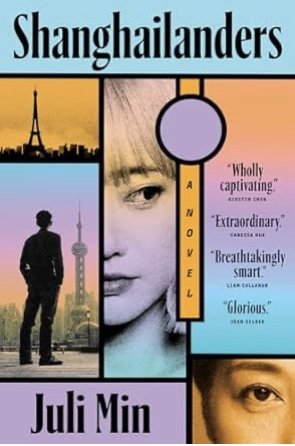
Shanghailanders by Juli Min (Spiegel and Grau)

Happy families are all alike, according to Tolstoy, but unhappy families are the ones who get all the attention. Starting with Cain and Abel and moving through millennia to the British Royal Family as portrayed by Netflix in The Crown, dysfunctional parents and their children feed the imaginations of novelists and fill the shelves of libraries. 

But not every unhappy family is captured in fiction with the skill that Juli Min gives to the Yang family in her debut novel. Shanghailanders. Taking the threadbare formula of successful husband, unhappy wife, and three beautiful daughters, Min reveals these cliched figures cleverly, in a series of interlinked short stories that move backward in time, from 2040 to 2014. 

While giving scant descriptions of Shanghai, Min provides a startling view of that city’s wealth, along with a capsule history of how swiftly this came into being. A man who was orphaned before he was in his teens and who grew up in a small, crowded room sees an opportunity when he’s still at a university. He borrows money from friends and buys several apartments. By the time he graduates, Shanghai’s rapid change has made real estate the arena where fortunes are made and Leo is a wealthy man.

His three daughters are in good schools, with the two oldest in the U.S. His wife is an artist, Japanese by birth but with most of her life shaped by living in Paris. In addition to the home in Shanghai, the family has a country place, a house in Vancouver, a village house in Zhejiang, an apartment in Paris, and an estate in Bordeaux. 

And yet as the years fly backwards, unhappiness settles in like a rot. Leo’s wife plans to leave him but her plans are set aside when she learns one of her daughters needs an abortion. His oldest daughter is a kleptomaniac who has made cruelty her second-favorite hobby. His youngest, at sixteen, has discovered a flair for sex work. His mother-on-law, teetering on the edge of dementia and living in a palatial assisted-living facility in France, has recently been diagnosed with an STD. Leo “loved them, all of them,” but he has lost interest. Slipping into another life is a thought he occasionally entertains, but—”how tiring.”

Wrapping her novel in snatches of time, Min mercilessly dissects this family, through the eyes of people who work for them and through the moments that bring yet another crack in their perfection. When she finally takes her readers to where this family began, at Leo’s wedding, where he sees his bride as “the loveliest, most reckless person he knew,” what pervades this event is “Spirit, grief, memory, and that, too, edited and faded over time.” 

Min has created a joyless world, with characters who spend their  lives “dancing around the truth.” The elegance of her sentences, the precision of her descriptions, the way she gives life to even those characters who exist in passing moments, all make Shanghailanders soar far above its soap opera possibilities, giving it the glitter and intricacy of a masterfully cut diamond set in bright platinum.~Janet Brown

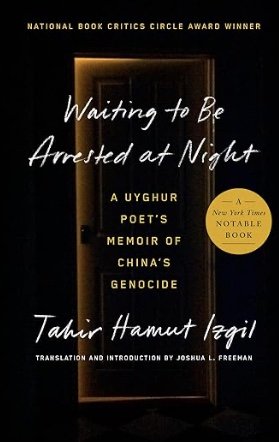
Waiting to be Arrested at Night by Tahir Hamut Izgil, translated by Joshua L. Freeman (Penguin Press)

“No wall can stop the wind,” a Uyghur proverb says and Tahir Hamut Izgil knows this is true. In 1996, he is imprisoned for three years when Chinese authorities stop him as he leaves his home in Xinjiang to study in Turkey. Accused of “taking illegal and confidential materials out of the country,” this young poet has to rebuild his life when he‘s released just before the turn of the century.

He marries and makes a comfortable and secure living for his wife and two daughters as a film director for movies, television shows, and commercials. But his true vocation lies in writing poetry. Over the next twelve years, he nurtures this gift within a network of Uyghur writers.

Uyghur people have lived in the Xinjiang Uyghur Autonomous Region for millennia, perhaps before the beginning of the Christian Era. Followers of Islam with presumably Turkish origins, most of them live in the capital city of Urumqi, as does Izgil. In recent years, the Chinese government has accused them of plotting separatism and when a spurt of violence erupts in Urumqi in 2009, the clampdown upon this ethnic group is swift and draconian. 

Mass arrests become routine, with Uyghurs accused of “fabricated crimes” and whisked away to re-education centers. Izgil is taken into police custody, extensively interrogated, and put under surveillance. 

In 2011, the government bans traditional Arabic greetings and orders people to change their names from those that have Islamic origins. The Chinese flag is raised over mosques. Radios are confiscated and banned from sale. Inspections of mobile phones routinely end in the arrest of the people who own them.

Izgil and his wife are called into police headquarters for fingerprinting, an ordeal that lasts three hours and includes taking blood samples, ‘voice prints,” and facial images. When asked about his religious faith, Izgil says he has none. When they’re finally released, Izgil’s wife, who has resisted any thought of immigration, says “We have to leave the country.”

They give away their copies of the Quran, they purge their phones and computers of anything that might be compromising, and they embark on a torturous, convoluted path that will lead them from their homeland. After a Uyghur academic is given life imprisonment under accusations of separatism, Izgil keeps warm clothing and thick footwear by his bedside in case the police come to take him away in the middle of the night.

“I wish China would just conquer the world,” one of Izgil’s friends says bitterly, “Then we would all be the same…not alone in our suffering.” Another says in a poem, “We came from nowhere else and we will not leave for anywhere.” Not long after Izgil and his family emigrate to the United States, this man is sentenced to 16 years in prison.

Once they are safely in another country, Izgil calls his parents but not even this message of reassurance goes unpunished. Soon after this, his mother’s phone and ID card are both confiscated. 

As they make another home in a strange place, “we burn with guilt,” Izgil admits, “Our bodies might still be here but our souls are still back home.”

Although this memoir is eloquent and illuminating, its narrative is told under a different timescape, twisting with personal history, conversations that are scrupulously detailed, and a wealth of poems. Reading it gives not just another perspective but a whole new form of psychology, one that was constructed to survive a world that could well have been invented by Kafka, one that readers are privileged to experience at a comfortable distance.~Janet Brown

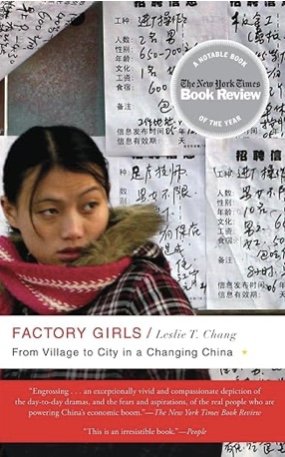
Factory Girls by Leslie T. Chang (Random House)

In 1978 a Taiwan manufacturer established the Taiwan Handbag Factory in an isolated corner of Guangdong Province. It was the only foreign factory to have come to the small town of Dongguan, a place without railway connections or roads. It hired local labor but soon needed to augment that supply with migrant labor from rural China. Two years later Deng Xaoping established the first of China’s Special Economic Zones in Shenzhen, fifty miles from Dongguan. 

By the 1990s, Dongguan had become a manufacturing hub, with factories for electronics and computer parts standing beside the ones that made toys, clothing and shoes. It became famous for its “factories and prostitution,” a city “built for machines, not people.” Instead of streets, it boasted ten-lane highways.

In 2004, Leslie T. Chang, a bilingual reporter for the Wall Street Journal, came to Dongguan. Her goal was to report on migrant labor in that city, a tsunami of workers who had been streaming to its factories for two decades. She stayed in Dongguan for 1-2 weeks every month for two years.

A young woman herself, who is fluent in Chinese, Chang found it easy to gain the confidence of young women who worked in the factories, who at that time made up 70% of the labor force and one-third of the migratory flow. Homeless until marriage, by virtue of their gender these girls were never considered permanent parts of their family households. When parents realized their daughters could become financial assets in factory towns, they encouraged the girls to take that leap.

Chang follows the lives of two girls, Min who left home at 16 and Chunming who came to Dongguan when she was just a year older. Through them she chronicles the progress that could be made by girls who have left their villages.

Although social pressure may have sent these girls to work in factories, what keeps them there is freedom and mobility. If they dislike their workplace, they change jobs, going to “talent markets,” places where job fairs meet speed dating. Rapid-fire interviews are conducted to find workers who are “female, pretty, and single,” the younger and the taller the better. Lies and subterfuge are common, girls who have lost their identity cards and procured another go by a new name for as long as that’s necessary. Men are less desirable job candidates in this fast-paced employment arena and are usually confined to maintenance positions, while young women find their way into office jobs.

Within a year, Chunming goes from making 300 yuan a month to 1500. Min, after having her identity card, mobile phone, and her money stolen from her, goes from living on the streets to “building a new life from scratch,” getting a job in a Hong Kong-owned handbag factory where her salary is high enough to make her the dominant figure in her rural family.

Factory girls are the leaders of a social revolution. The money they bring to their parents give them a position of power. At the Lunar New Year, they are the ones who present envelopes of money to their elders and household decisions rest with them. As they gain positions of status in the workplace, they often outrank the men they date and use that power to their advantage. Chunming’s stock phrase when finding a man didn’t measure up to her standards is “Let’s just be friends, then,” which she often pronounces in a matter of minutes.

Pragmatic and ambitious, these girls set personal goals that dominate their time away from their jobs. Chunming keeps a diary and studies Ben Franklin’s Thirteen Rules of Morality. When direct sales come to China, promising a route to prosperity, speaking skills are a path to success and young women flock to classes that give them that ability. English is so in demand that the Taiwan-owned Yue Yuen plant that manufactured Nike, Adidas, and Reebok, offers English classes onsite at their gated facility, a place that also has a kindergarten, a movie theater, and a hospital.

Girls who had come from small farms find they need polish to achieve success and attend “academies” that tell them how to dress, eat, smile, pour tea, use the telephone, and when it was necessary, how to drink. (“Do you know how to make cocktails?” one of Chunming’s friends asks Chang.)

Chang wrote Factory Girls twenty years ago. It prompts a deep curiosity about what became of these upwardly-mobile, ambitious young women and if their effect on society continues to hold its power. A sequel is screaming to be written, if only to continue the stories of those indomitable girls, Min and Chunming. ~Janet Brown

Other Rivers by Peter Hessler (Penguin Press)

Of all the books I’ve read about the Covid years, whether they are fiction or memoirs, there’s only one I would ever reread. This is one that was written in 2020, Wuhan Diary by the sixty-five-year-old author, Fang Fang (Asia By the Book, December 2020). First published online from January to March of 2020, then translated into more than twenty languages, including English, and published by HarperCollins, this journal showed the day-by-day progression of the virus and the means by which it was suppressed, described in deeply human terms. For me, nothing else has measured up to Fang Fang’s reportage, for which she has been almost erased. She is no longer published in China and her name can no longer appear in that country’s press, nor can she be interviewed by any outlet. Despite this silencing, she remains hopeful, telling another writer, “I believe it won’t be like this forever.”

In his latest book, Other Rivers, Peter Hessler fails to reach the standard set by Fang Fang, although he was also living in China at the time she published her writing. A man who first came to China in 1996, Hessler has lived and worked in that country for over ten years. In the autumn of 2019, he returned with his wife (Leslie Chang, author of Factory Girls, who has matched her husband’s duration in China) and their nine-year-old twin daughters. 

Hired by Sichuan University in Chengdu, Hessler is greeted with a sardonic observation. Noting that he came to work in Cairo just as the 2011 Arab Spring with its subsequent massacres began and then returned to the US when Trump win the 2016 election, a writer at a dinner party predicts that with Hessler’s return to China, “something bad is probably going to happen.” Within three months, Covid erupts in Wuhan.

As a journalist, Hessler had a stunning opportunity to bring this time to life and at times he does that. His account of his daughters’ introduction to Chengdu Experimental Primary Elementary School where they are the only foreign students and the only ones who have no knowledge of the Chinese language, is fascinating, although given less attention than it might have received. The interruption that Covid imposes is perhaps partially to blame but the girls have a full year in the school after that. At the end of the book, Hessler admits his children’s time in a Chinese public school was the most challenging part of our time in Chengdu,” something a reader would never guess from his accounts of that “challenge.”

To be fair, he has a few challenges of his own, ones that are prompted by what seems a lot like naivete. Since English language classics are available in Chengdu, there are a wide assortment of books from which to choose, so it seems peculiar that Animal Farm is one of the two texts chosen for his class on English Composition. Instead of glossing over Orwell’s political satire, Hessler teaches it in tandem with 1984, a recipe for disaster.

In his nonfiction class, he decides to turn its center-point to journalism, sending his students out into the city to observe and report. When one of his students does a profile on her VPN dealer, Hessler identifies this as “edgy research,” but then has her read it out loud in front of the class. “I wasn’t sure if Yidi’s subject matter was too sensitive,” he says, “...by the time she was halfway finished, I was convinced that I had put her at risk.” Considering his “over ten years” in China, this seems negligent to the point of stupidity.

Later, when Wuhan is no longer under lockdown, Hessler visits and interviews Fang Fang, although this is forbidden. But why worry? By the time this is published, he’s back in the US. At the end of March, 2021, his request for a contract renewal is denied by Sichuan University and he and his family return to the peace of rural Colorado.

A writer without a selectivity index, Hessler has no ability to focus. Everything he has ever seen or experienced he tosses in a gigantic salad, recounted in a random fashion that is painfully staccato. His return to the city and the students that he depicted in his first book, River Town, is thrown into his time in Chengdu, no doubt in an effort to increase the page count in Other Rivers. Although he achieves over 400 pages, at least half of them could have been cut to make this a better book, presenting an inevitable question. Where was his editor? ~Janet Brown

Lords of the Rim by Sterling Seagrave (Corgi Books, out of print)

If you want to grasp the vertiginous changes that have swirled into being since the final decade of  the last century, Lords of the Rim could have been a fine place to start. A political analysis of the power and influence of the Overseas Chinese, heavily balanced upon the past history of China with fleeting glimpses of the present, author and historian Sterling Seagrave launches this with statistics that were doubtless cutting-edge in the early 1990s but are threadbare now. An empire of 55 million Chinese who live and work in the countries of the Pacific Rim with a GNP of $450 billion and liquid assets “as much as $2 trillion” are an economic force in the development of China. This is the underpinning of this book but readers are tossed into a dubious frame of mind when confronted with these statistics thirty years after Seagrave put them on his pages. How can these still be valid after the Asian financial meltdown of 1997, the handover of Hong Kong and its subsequent political upheavals, the booming world of high tech that has made smartphones a necessity all over the world, and the effects of SARS and Covid-19? 

Because his thesis is a shaky one at this point  in time, Lords of the Rim is only worth reading now if it’s approached as a work of history. Since Asian history is Seagrave’s area of expertise, and his bibliography at the back of this book shows a vast amount of research, this might be enough to justify reading a book in 2024 that was published in 1995. Unfortunately, it’s not.

Beginning his narrative long before the birth of Christ, Seagrave swiftly moves through Chinese dynasties to show why the North and the South of China have traditionally been in opposition, with the North holding the rulers and the South being a hotbed of entrepreneurs. With merchants being on a low rung of the Confucian hierarchy, it was an easy matter to expel them from the reaches of power, banishing them to live below the Yangtze. Southern China became a sort of prison colony, far from official regulations and near the sea. Maritime trade was a logical step for the exiled merchants.  They found routes to Southeast Asia that became lucrative and later brought them to Arabia and parts of Africa. Long before the advent of the Silk Road, southerners had become wealthy from spices and silks and as dynastic upheavals racked the North, the South became a refuge and an opportunity for the merchant class of China, not a punishment.

Although they weren’t scholars, these businessmen were far from illiterate--and their choice of reading material wasn’t the Analects of Confucius. It was Sun Tzu’s Art of War. Learning that “business is warfare,” they adapted Sun Tzu’ s classic instruction manual to serve as “The Art of Wealth,” with gratifying results.

As their voyages became an integral part of the Southern Chinese economy, they established trading centers in the countries with which they did business, and since these new expatriates had no interest in local politics and no desire to colonize, they met little opposition from their host countries. But through business, the Chinese residents gained secure toeholds as pawnbrokers, making loans to the locals with property as the collateral. As dynasties rose and fell, with accompanying turmoil, the overseas outposts became attractive places to live; by the 17th Century, there were sizable communities of Chinese living in Japan, the islands of Indonesia, the Malay peninsula, and Siam. When the merchant pirate Coxinga, half Chinese, half Japanese, chased the Dutch from Taiwan, that island became another alluring alternative to dynastic uproar and gradually the Overseas Chinese became an “invisible empire.”

Seagrave is masterful in recreating the history of China but that only takes up one-third of his book. He then plunges into the 20th Century history of the Chinese in Singapore, Malaysia, Indonesia, Hong Kong, and Thailand in a kind of intellectual Cliff Notes. Overstuffed with too many names, too many cataclysms, and too many business enterprises, his book becomes a tiresome slog and sinks under an excess of information. Ending with the death of Deng Xiaoping, he hints at a backlash against “commercial corruption” and a threat of “economic collapse.” “Where it will stop, nobody knows,” he concludes.

Sterling Seagrave knew. He lived until 2017. It’s a pity--and quite annoying-- that he didn’t care enough to publish an updated version of Lords of the Rim, with fresh insights provided by a new century.~Janet Brown

Written on Water by Eileen Chang (New York Review of Books)

There are some books that wait for the right moment to be opened, bought with good intentions but sit on a shelf, unread, for months. Last winter I brought home a collection of essays, realized I wasn’t in the mood for any of them, and almost forgot about this purchase. When I picked it up recently, I fell into a conversation with a twenty-something who was born over a hundred years ago, a writer whose fiction had always intimidated me but whose essays were pure enjoyment.

Author of Love in a Fallen City and Lust, Caution, Eileen Chang admits that her novels are “rather diverting but also more unsettling than they should be…I like tragedy and, even better, desolation.” She approaches her characters with an analytical distance that’s scaldingly honest and devoid of tenderness. Although I’ve always been stunned by her talent, I’ve never read her work with pleasure--until I opened Written on Water and was immersed in delight, envy, and agreement. 

Chang had me hooked with her essay,  Peking Opera through Foreign Eyes, where she asserts that ignorance of its subtleties only increases the enjoyment. If the audience isn’t aware of how it should be performed, then it has no niggling criticisms and can simply be delighted by the pageantry and spectacle. As an ignorant and passionate devotee of Chinese opera who has sat on a sidewalk for hours to enjoy outdoor performances of this art-form, thrilling to the “sharp, anxious tattoo of percussion” that punctuate the “kicks and jousts and feints,” I began to love the mind of Eileen Chang. When she went on to say “Chinese people like the law, and they like breaking the law too…by way of trivial violations of the rules,” I remembered the times I saw this happen in Beijing and embarked upon a silent conversation with Chang as I read. And when she discusses “the chamber pot strategem,” when the soul of a dead man is imprisoned in a chamber pot, I knew this was a plot device that could only be created by people who had intimate knowledge of an outdoor privy (or as we called this in Alaska, an outhouse).

At this point I was ensnared by Chang’s wit, frankness, and her unflinching curiosity. She wrote these pieces before she turned 25, after the publication of her first novel, and they’re filled with the viewpoint of someone who’s still in love with discovery. She describes street scenes with the same relish that she does women’s fashions and confesses that her love of city sounds means “I can’t fall asleep until I hear the sound of trams.” She gives a vivid character sketch of her best friend with an intimacy that she denies her fictional subjects and she brings a poignant dimension to the fall of Hong Kong with the memory of “how we scoured the streets in search of ice cream and lip balm” in the midst of “chaos and destruction.”

The bleakness and distance of Chang’s fiction becomes understandable when she writes about her father, a man surrounded by “clouds of opium smoke.” “When he was lonely,” she says, “he liked me.” In a luxurious setting, Chang’s childhood is Dickensian in its privations, which she recounts in the spirit of “There’s very little to remember so nothing is forgotten.” She’s far too ironic--and much too cerebral-- to lapse into drama.

Chang skillfully reveals her love of China, as she writes about its daily life, its art, its music. “I am Chinese,” she says, “so I know how to appreciate noise and clatter…If I were to choose, I could not bear to leave China: I’m “homesick even before I leave home.”…” Ten years after these words were published, she left. In 1955, Chang moved to the U.S. and five years later she took U.S. citizenship. She died alone, in Los Angeles, a death that makes Written on Water all the more precious and deeply sad.~Janet Brown

Coming Home Crazy by Bill Holm (Milkweed Editions)

With ten rooms of books and over 3,500 sections, Powell’s City of Books has filled a city block in Portland, Oregon for the past fifty-three years, and  claims to be the largest new-and-used bookstore in the world. It certainly is one of the most enticing, with its shelves filled with surprises and its cavernous rooms somehow managing to feel cozy. A trip to Powell’s is always a treasure hunt and it’s impossible to stick to a book budget when browsing in that place. 

On a recent expedition, I made it to only two sections--Travel Literature and Asian History--and left with a book bag that strained at its seams. Among my purchases was a book whose title had always intrigued me but that I’d never read, Coming Home Crazy by Bill Holm. 

Anyone who has lived anywhere in Asia, with the possible exception of Singapore, is going to come back to the West feeling a wild disorientation that verges on insanity. Holm cites The Crackup, where Scott Fitzgerald said he knew he was crazy when he couldn’t look at two opposing ideas at the same time. China, Holm says, has the opposite effect, as a place that makes it impossible to ever “see again singly.” People who return from the Middle Kingdom come home with a “bifurcated consciousness.” The antithesis to “every idea in your life and culture looks as sane and reasonable as the idea itself--” and sometimes even more so.

Although this beginning hints at a work of comparisons and contrasts, what follows is a collection of essays that follow a strange sort of alphabetical order, with a scrambled sense of time. After living with a language that can’t be alphabetized, Holm is delighted to point out the random nature of the A to Z classification. By beginning with an essay on AIDS and ending with a piece that explains the Chinese custom of zou houmen, (“going through the back door” to get a desired result), he creates a crazy quilt of unrelated patchwork pieces.

The only way to read this book is to ignore the alphabet. Holm offers suggestions that might give his readers a narrative thread but his choices are as idiosyncratic as his structure. After floundering in attempts to find a beginning, middle, and end, readers may find themselves wishing that Holms had simply published the journals that these pieces seemed to have emerged from.

Nevertheless, within the chaotic tumble of anecdotes and impressions there’s some very good writing and a Picassoesque portrait of what one city in China, Xi’an, felt like to a displaced Midwesterner from 1986-1987. 

As a “waiguoren,” a Western foreigner, Holm was an object of curiosity, one that was inexplicable and fascinating. Reluctant to learn Chinese because it would strip him of his adult authority and take him back into childhood, he salutes his Chinese students in their study of English because they “exhibit a kind of courage” that he lacks himself. Swiftly he falls in love with the idea of teaching people who value books and are delighted to encounter English literature--”Whitman, Thoreau, Yeats…It was all candy, all delight.”

Holm is less than delighted with the frugal and Spartan comforts of his life in China but  he finds an essential dimension in how the people find “celebration in their daily lives.” The ritual of making dumplings is one he explains step-by-step, from buying pork and vegetables in the market, to chopping, stuffing, and shaping in the company of friends in a home kitchen. Eating them is “a mountain, a dinner party, close to gluttony” and a sacrament of pure pleasure.

Pleasure is the hallmark of Holm’s essays. According to him, Nixon wasn’t the one who opened China to the West. Walt Disney did. Sunday evening was when people clustered around TV sets to watch Mickey, Minnie, Donald, and the gang cavort in an hour of cartoons.

And under a government of rigid control with a bloody history that would re-erupt on June 4 in 1989, Chinese people, Holm claims, are “anarchically free” so long as they avoid actions that are overt. The small regulations of daily living are freely and happily ignored in a society that he sees as operatic, “the Asian Italy.”

It would be interesting to go to Xi’an in 2024, decades after Holm spent his year there, to see how many of his observations still ring true. Carried as an anti-guidebook, his collection of impressions and opinions could launch explorations that may prompt surprise, delight, and a whole new attack of “coming home crazy.”~Janet Brown