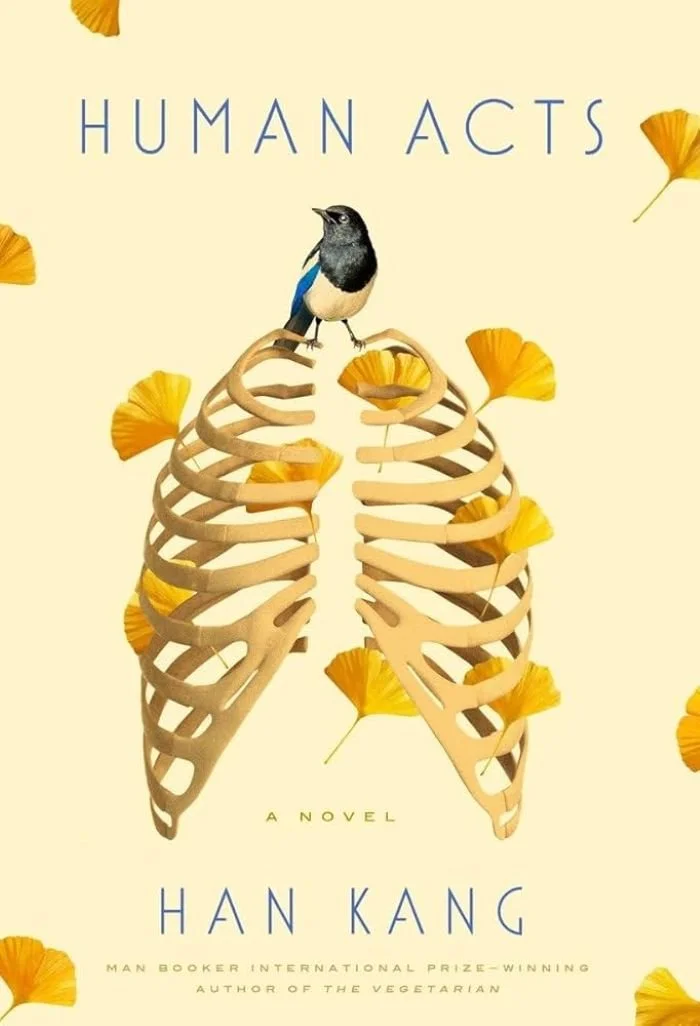
Human Acts by Han Kang, translated by Deborah Smith (Hogarth) ~Ernie Hoyt

In May of 1980, I was still a junior in high school. Ronald Reagan was elected President of the United States, MADD (Mothers Against Drunk Drivers) was established, the second full length Star Wars film The Empire Strikes Back was released, and on the 18th was the eruption of Mount St. Helens. I was looking forward to my summer vacation which I would be spending in Japan. 

Little did my teenage mind know what was happening halfway across the world. I did not follow current events, politics, or world news at the time. Looking back, I’m shocked by what happened on May 18, 1980 in a town called Gwangju in South Korea. 

Han Kang, author of The Vegetarian (Asia by the Book, September 2024), We Do Not Part (Asia by the Book, October 2024), Greek Lessons (Asia by the Book, October 2025), and The White Book (Asia by the Book, July 2025), has also written a book about the Gwangju Uprising titled Human Acts

Before reading the story, translator Deborah Smith, provides an introduction to the Gwangju Uprising. President Park Chung-hi who had ruled the country since 1961 was assassinated. He was assassinated by the director of his own security services. 

Park had “succumbed to the classic authoritarian temptation to institute increasingly repressive measures, including scrapping the old constitution and having a new one drawn up making his ruling a de facto dictatorship”. Unfortunately, Park’s assassination was “no victory for democracy”. 

Stepping into the void was Park’s right-hand man - Chun Doo-hwan. After he came into power, he implemented martial law on the entire country. He had opposition leaders arrested, closed universities, banned all political activities, and silenced the press. What is most disturbing is that today’s America seems to be reflecting South Korea’s past. 

Human Acts opens a few days after the South Korean army opened fire on unarmed citizens. The President had falsely claimed that the rebels in Gwangju are communists who are in league with North Korea. As students demonstrated against martial law, they were shot, beaten and tortured by the South Korean military. 

The book is written in chronological order starting with the Gwangju Uprising, also known as the Gwangju Democratization Movement and May 18 Democratization Movement. It follows a boy named Dong-ho, a middle-school student, during the incident and the people surrounding him. 

The first chapter of the book introduces Dong-ho and the people surrounding him. In subsequent chapters, the narrator is one of the people that either worked with or was related to Dong-ho in some way. He has been helping people keeping a ledger of the dead bodies that were killed in the uprising. His motivation was to find his friend Jeong-day who died at the massacre. 

The following chapter is told through the eyes of Dong-ho’s friend, Jeong-day. The story then jumps ahead to 1985 and is told in the first person by Eun-sok, a girl who helped Dong-ho collect dead bodies. She is now working as an editor for a publishing company. She has a clash with the police for keeping silent about the whereabouts of an author who the authorities are looking for. His play reminds her of Dong-ho who was killed by the South Korean Army. 

There are others who all have their story to tell - Kim Jin-soo, who was one of the survivors of the uprising. Seon-ju who was sexually abused during the uprising. Dong-ho’s mother and finally the author herself, who was six years old at the time of the Gwangju Uprising. 

This is not an easy book to stomach when you take into consideration that it was inspired by a true incident that took place less than fifty years ago. The story will stay with you long after you have finished reading it. It may interest you in learning more about how and why it happened.

When I did my own bit of research to find out what had happened to the man who instigated this crime - Chun Doo-hwan. In the 1996, August 27 issue of the Korean Times, an article wrote that the Seoul Distric Court sentenced him to Death. Later that same year, the Seoul High Court changed it to life imprisonment and a fine of 220 billion won. He was officially convicted of leading an insurrection, conspiracy to commit insurrection, taking part in an insurrection, illegal troop movement orders, dereliction of duty during martial law, murder of superior officers, attempted murder of superior officers, murder of subordinate troops, leading a rebellion, conspiracy to commit rebellion, taking part in a rebellion, and murder for the purpose of rebellion, as well as assorted crimes relating to bribery.

What I find most disturbing is that the current President of the United States is using some of the same tactics as Chun Doo-hwan such as spreading misinformation, firing anybody opposed to his views, trying to suppress the press, ordering the military to use force against American citizens. If there is something to be learned from Kang’s book Human Acts and the facts behind the Gwangju Uprising, then there should be no mistake that the man is to be ousted from office so the country will remain a democracy.

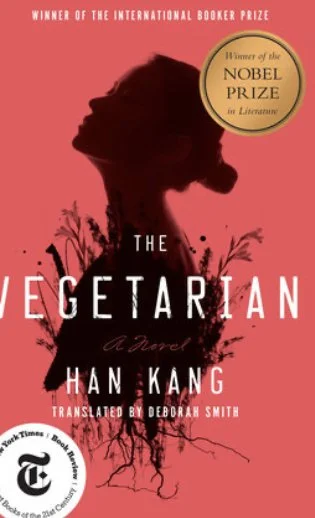
The Vegetarian by Han Kang, translated by Deborah Smith (Hogarth Press)~Janet Brown

When Yeong-hye’s husband finds her standing transfixed in front of their open refrigerator during the middle of the night, she tells him only “I had a dream.” Since he chose her as his wife simply because she is unremarkable in every way, he gives this moment very little thought. Then he comes home from work to find her removing every bit of meat in the refrigerator and throwing it into garbage bags. The waste infuriates him, especially when he discovers the kitchen contains no eggs or milk, in addition to meat, and never will again. Yeong-hye, formerly a compliant wife who grew up a carnivore, has become a vegetarian who prepares only plant-based meals and turns away from her husband’s  touch because he reeks of meat. When she embarrasses him at a company dinner, he enlists the help of her parents in bringing her back to reason.

Now emaciated, Yeong-hye refuses all of her favorite dishes at a family dinner and a brutal scene with her father results in her attempt at suicide. Hospitalization does nothing to change her new eating habits and her quiet obstinacy leads to domestic upheavals. Her husband leaves her, her brother-in-law uses her in a shocking art project that destroys his marriage, and her sister finds her own life seems confining as Yeong-hye clings to the existence she has chosen on her own terms.

The novel is told from the points of view as seen by these three people. Just a few internal moments reveal what Yeong-hye has on her mind and these revelations are savage and enigmatic. Otherwise readers see only the obedient wife who inexplicably changes, the sister-in-law who becomes a passive sexual instrument with her body covered in painted flowers, the insane younger sibling whose older sister struggles with guilt because she failed to rescue Yeong-hye from a childhood of brutal physical abuse.

The Vegetarian veers from being disgusting and horrifying into scenes that are profoundly sad and astonishingly beautiful. Han Kang was haunted for years by a statement from another Korean writer, Yi Sang, who said “I believe that humans should be plants.” Pondering “questions about human violence and the (im)possibility of innocence,” she wrote a short story about a woman who became a plant. Then she created Yeong-hye.

Winner of the Nobel Prize for literature, Kang is an author who never writes the same book twice. We Do Not Part (Asia by the Book, October 2024), The White Book  (Asia by the Book, July 2025), Greek Lessons (Asia by the Book, August 2025) all fearlessly explore different facets of the human condition but each in ways that deviate from the others, similar only in her use of different voices to propel her narratives and her underpinning of modern Korean history. Her novels are emotionally difficult, told in unflinching yet poetic language. After encountering and finishing one of them, the other books all insist on being read, perhaps not in rapid succession but beckoning with an inexorable allure. Han Kang’s work becomes a benign addiction, one that’s fed by her prolific talent and her sharp dissection of what it is to be human in this period of history.

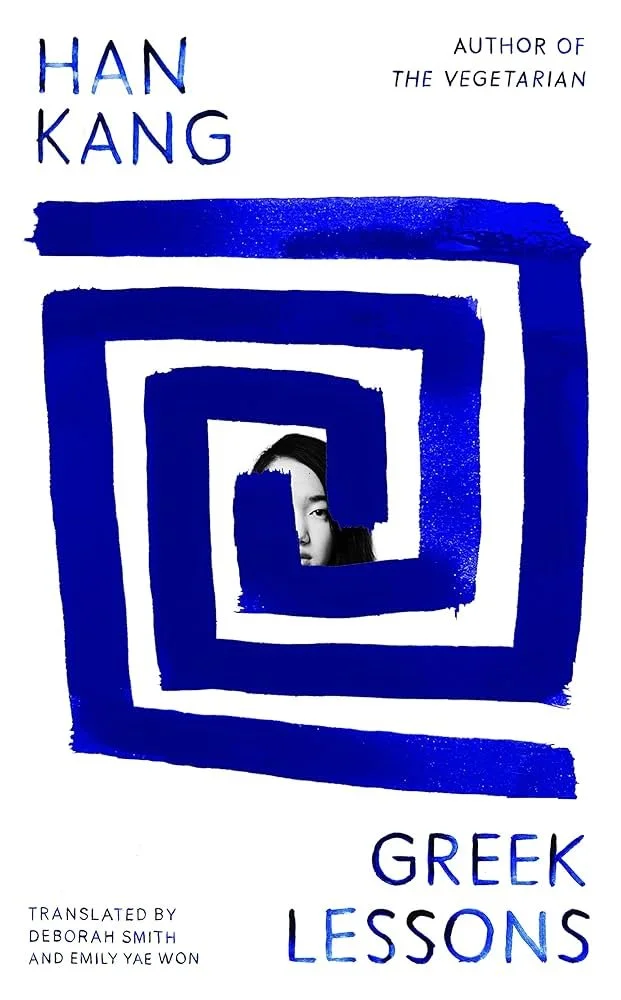
Greek Lessons by Han Kang, translated by Deborah Smith and E. Yaewon (Penguin) ~Ernie Hoyt

Han Kang is a South Korean writer who debuted with her novel The Vegetarian in 2007. She is also the winner of the 2024 Nobel Prize for Literature. Greek Lessons is her seventh novel which was originally published in the Korean language by Munhakdongne in 2011. The English edition was translated by Deborah Smith and E. Yaewon was published in 2023.

The book centers on two main characters. A university lecturer who is nearly blind and a woman who has lost the ability of speech. The lecturer teaches Ancient Greek and the woman is one of the few students enrolled in his class.  

All the chapters of the book are written in the first person. Sometimes it’s the lecturer and sometimes it is the woman who cannot speak. The author doesn’t give a hint to whose point of view is spoken and the reader must infer from the context to determine if it is the lecturer or the woman who cannot speak.

We learn that the woman was also a teacher until the spring of the previous year. One day she was at the front of the class writing something on the blackboard but then froze for about a minute or so. One of her students asked if she was okay. She tried to smile back at the student but “her eyelids spasmed for a while”. “She muttered to herself from somewhere deeper than her tongue and throat: It’s come back!”. 

When she was a young girl, her mother always told her how bright she was. She was able to learn Hangul (Korean script) when she was only four years old. When she started primary school, she used to write new words at the back of her diary “with neither purpose nor context, merely a list of words that had made a deep impression on her”. 

However, “the words she’d jotted down in the back of her diary wriggled about of their own volition to form unfamiliar sentences”. The words would shoot at her in the middle of the night, waking her up a number of times. For her, “the most agonizing thing was how horrifyingly distinct the words sounded when she opened her mouth and pushed them out one by one”. 

It was when she was sixteen when “the language that had pricked and confined her…abruptly disappeared”. Now here she was - a middle-aged woman who once again could not find the words to speak. 

As for the lecturer, he lived in a town called Suruyi in the southern part of South Korea until he was fifteen. One Sunday, his mother informed them that the family would be moving to Germany in two months. He spent the next seventeen years of his life in Germany. It was in Germany when the lecturer learned of his condition. He knew he would be losing his vision sometime in the near future.

The lecturer decided to move back to his home country before losing his sight permanently. He was able to get a job teaching Ancient Greek at a local college. He did not admit the severity of his condition to his employers. 

The core of the story is how these two unlikely individuals begin to find solace in each other. One who could not see and one who could not speak. Would their relationship flourish or is it destined to be a disaster? 

Kang’s prose will grip the reader. It is not only a story of loneliness and solitude, but it’s also about love, compassion, and intimacy. It is sure to stir your heart.


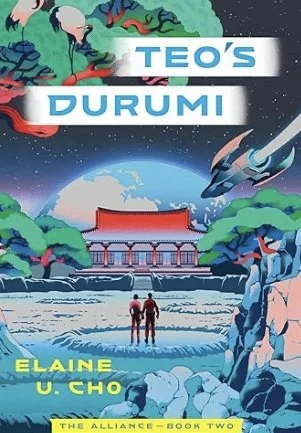
Teo’s Durumi by Elaine U. Cho (Hillman Grad Books) ~Janet Brown

Back in the middle of the last century, there were serials, a clever marketing device that instilled customer loyalty. Magazines, radio stations, and movie theaters all produced stories that ended with cliffhangers, to be continued in the next installment. Still to be found on streaming sites (Game of Thrones anyone?), the gimmick dissolved in other arenas--until Elaine U. Cho resurrected it in Ocean’s Godori, (Asia by the Book, May 2024).

This science fiction adventure ended so abruptly that some readers were infuriated. Clearly they had never gone to a movie matinee where a weekly Saturday serial ended with the invitation to return for  “another episode in this thrilling drama.” For those of us who had, we knew there would be a sequel. Unfortunately we had to wait longer than a week to discover what would happen next.

It’s been over a year since the characters of Ocean’s Godori escaped death by crash-landing their spacecraft on a distant moon. Although Teo’s Darumi, begins at the exact point where its predecessor ended, memories fade and not everyone will have a copy of the first installment in their bookcases for quick reference.

Luckily Elaine U. Cho offers a brief refresher course given by one of the minor characters, providing thumbnail sketches of the multitudes who propel the plots of both books. It would have been helpful to have included the glossary of Korean vocabulary that came at the end of Ocean’s Godori, adding the new words that appear in Teo’s Darumi. Still careful readers will find clues to their meanings through context and quick explanations given when the words first show up. 

For those who have come to this sequel without having read its predecessor, Cho has constructed it so cleverly that it works as a stand-alone novel. While those who read the first might miss the focus on Ocean, that prickly daredevil loner, the characters in this new book soon flourish under their newly acquired spotlights and the plot swiftly moves into new dangers and fresh horrors.

Teo, the only survivor of the massacre that killed off the rest of his family’s wealthy dynasty; Sasani, a pariah, shunned for his knowledge of funeral arts, who has found hopes for a new community as the spacecraft’s medical officer; Phoenix, the dashing space raider who’s attracted to Teo’s fortune and Ocean’s skills as a pilot; Ocean who finds a kinship with Sasani, since she is also a pariah of sorts, band together in ways that surprise them all.

Cho has given alarming depths to Corvus, one of the most hideous villains in any galaxy, giving him accessories that can suck the souls and memories from his victims, an activity to which he has become addicted, with dreams of interplanetary domination. As a counterpoint, she gives her main characters whopping helpings of romance, so much of it that only the grisly violence of the final battle can submerge the affairs of the heart. 

The violence goes on for fifty horrendous pages in which nobody is sure that goodness will triumph--squeamish readers, be warned. Since Cho has given new dimensions to Ocean and her colleagues, their bloody struggles to survive are close to unbearable and will be absolutely impossible to abandon.

Once again, room is left for another installment but these new conclusions will leave readers satisfied. Too bad. As a person who grew up in the mid-20th century, I miss that cliffhanger.


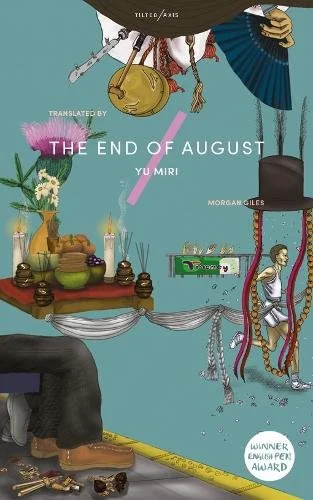
The End of August by Yu Miri, tranlated by Morgan Giles (Tilted Axis Press) ~Ernie Hoyt

Yu Miri is a Zainichi Korean novelist. Zainichi Koreans are ethnic Koreans who immigrated to Japan before 1945 and are citizens or permanent residents of Japan, or who are children of those immigrants. Her native language is Japanese but she is a citizen of South Korea. She writes her books in Japanese. 

She is the author of Tokyo Ueno Station (Asia by the Book, May 2021). The End of August is her latest novel. It was originally published by Shinchosha in 2007 in the Japanese language as 八月の果て (Hachigatsu no Hate). The English edition, translated by Morgan Giles, was published in 2023. 

The End of August is a semi-biographical family epic. The tome is over seven hundred pages and focuses on several generations of Yu Miri’s family. The story takes place in Japanese-occupied Korea in the mid-1920’s. The reader should be warned that they should study Yu Miri’s family tree, provided at the beginning of the book,  before taking on the immense task of reading this saga.

Here is a short summary of Yu Miri’s family, starting with her great grandfather, Lee Young-Ha. He was married to Park Hee-Hyang and had five children with her. They had four sons and one daughter. The eldest son was Lee Woo-Seon, followed by their daughter, Lee So-Won. Lee Woo-Cheol was the second son. His two younger brothers were Lee Woo-Gun and Lee Su-Yong. 

Lee Yong-Ha also had a mistress named Mi-Ryeong. They had a daughter named So-Jin, a girl who would never meet her father. The only thing she would know about him is that he gave her her name.

Lee Woo-Cheol is married to Chee In-Hye and has four children with her. Their daughter’s names are Mi-Ok, Shin-Ja, and Ja-Ok. They named their son Shin-Tae and like his father before him, Lee Woo-Cheol has a son with his mistress, Kim Me-Yeong, who the name’s Shin-Cheol. 

Chee In-Hye is Lee Woo-Cheol’s first wife. After she leaves him, Woo-Cheol marries An Jeong-Hye and has four children with her. They have three daughters and a son. Their daughter’s names are Shin-Ho, Shin-Myeong, and Shin-Hee. Their son is named Shin-Hwa. Shin-Hee marries a Japanese citizen named Yu, against her parent’s wishes. Shin-Hee and her husband are the parents of Yu Miri. 

As the country becomes more unstable, Lee Woo-Cheol runs away to Japan. His brother becomes the leader of a resistance movement against the Japanese forces. Their stories are both hopeful and tragic. After running away to Japan, Lee Woo-Cheol marries a Japanese woman named Nemoto Fusako and has a son with her who he names Shin-Il. Fusako only discovers that Woo-Cheol was married and has children when his second wife, Jeong-Hee appears at their door with children in tow causing more family turmoil.

As interesting and entertaining as the story is, the book has many flaws as well. My first and foremost complaint is the Morgan Giles translation. Although the book was originally written in Japanese, the characters often speak in Korean and most of the Korean words and phrases are not translated and the translator does not provide a glossary forcing the reader to look up the words and phrases on their own or they must infer meaning from the context of what’s being said. 

The writing style is also quite difficult to follow especially when Lee Woo-Cheol or Yu Miri are running. The sentences are mostly fragmented and interspersed with “inhale-exhale” making it very difficult to understand what the character is thinking. 

On the positive side, the book sheds light on the atrocity and experiences of the “comfort women” - young women, sometimes as young as thirteen, who were tricked and made to serve as sexual slaves for the Japanese army. It also sheds light on the treatment of Zainichi Koreans who are still oppressed even today. 

A remarkable book but a very difficult read. Be sure to invest a lot of time if you plan to challenge yourself to the task of reading it.


The White Book by Han Kang, translated by Deborah Smith (Hogarth) ~Janet Brown

White is an enigma. Is it a color or is it an absence of color? This makes it an appropriate preoccupation for this enigmatic little book, which at first reveals no gender for its narrator, no name for the city in which it is set, and no plot. Instead it begins with a list of things that are white and a few spoken words that are repeated throughout The White Book: “Don’t die. For God’s sake don’t die.”

White is the color of purity and the color of death. Death is the prevailing theme for the narrator. Her mother at the age of twenty-two gave birth to her first child, alone.  She dressed the baby girl in a white gown she had made while racked with labor pains and wrapped the newborn in ribbons of cloth cut from a white quilt to serve as swaddling bands. The baby, born two months early, her “face as white as a crescent-moon rice cake,” lived for only a couple of hours. That night her father buried her on a mountainside. Her “gown became her shroud. Her swaddling bands became a coffin.” Her death made way for the narrator’s own life and this fact haunts the white view of a book that the author describes as “a kind of essay-cum-prose poem.” “My life means yours is impossible.”

Snowfall obscures the novel’s setting, a “white city” which was so thoroughly destroyed by Hitler, “literally pulverized,” that before it was rebuilt, “the white glow of stone ruins” was all that remained. Walking through it brings the knowledge that every part of the landscape was once dead and was “painstakingly reconstructed.” The wings of a solitary white butterfly loses their  whiteness as they slowly freeze on the outskirts of the city, becoming “close to transparent…something other, no longer wings,” and snow falls “with an equal absence of joy or sorrow.”

The narrator turns into “she” with a view of whiteness that is less apocalyptic. A “white cloud of escaping breath is proof that we are living.” A white pebble found on a beach is seen as what silence would be if “it were condensed into the smallest, most solid object.” “Black writing through white paper” makes her understand that “learning to love life again is a long and complicated process.” She explores the art of “laughing whitely…laughter that is faint, cheerless.”

Han Kung has admitted that The White Book is somewhat autobiographical. She was born after a sister who died before she had taken three hours of breath and that dead infant lives within these pages, as “she,” who sees the beauty and promise that lies within whiteness. Kung wrote this novel while living within this “city of severe winters,” that sprang into new life after all but a tiny fraction was demolished in warfare, when she was given a writer’s residency in Warsaw. 

In sixty-five short pieces, Kang examines grief, guilt, and the life that lies within whiteness. Presented as a novel, its essence is poetry, imagist language clad in thought, showing the perfection of a sugar cube, a glacier…sacred, unsullied by life,” “the impossibility of forever.”

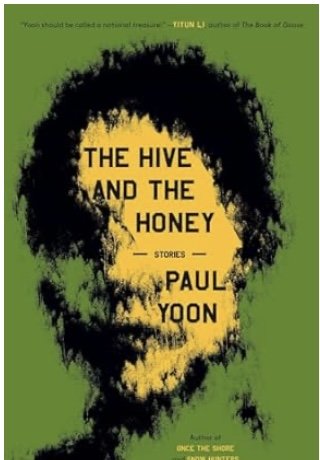
The Hive and the Honey by Paul Yoon (Simon & Schuster) ~Janet Brown

In a world full of displaced people who search for home, Paul Yoon creates one for them in his universe of words. Whether he writes about an imaginary Korean island where war and progress have turned its inhabitants into exiles in Once the Shore (Asia by the Book, November 2023), about orphans in Laos who live in a derelict hospital and carry messages through a maze of landmines in Run Me to Earth (Asia by the Book, December 2020), or a Korean newly released from a POW camp in what was once his country and finds a tentative life in Brazil in Snow Hunters, he evokes heartbreak and hope as he unfolds his characters.

Yoon is a novelist even when he writes short stories, perhaps especially in his latest book, The Hive and the Honey. Each of the seven stories that fill this collection gives full measure to the glimpses of the lives revealed in them. Each feels as if it’s a chapter in a story that will never be fully told, but will remain alive in the imaginations of those who read them.

The stories range from rural New York to the coast of Spain, from 17th Century Japan to a dusty shop in a 20th Century English town, from a Korean mountainside to Siberian prison camps, tracing a pitiless diaspora. In each of them is a boy, all of them in different stages of development, all far from any home they’ve ever known. The worlds they inhabit are brutal and the currency they use to survive is pain and loneliness. Only one of them seems to be on the brink of happiness as he stands in a hayfield with a farm girl, “light on his heels.” The others are adrift in sadness, running, fighting, surviving.

A boxer with a broken nose and hands as “thick as mallets” clings to the hope of finding his Korean birth mother.  A boy who has known only the companionship of Japanese soldiers is turned over to his Korean countrymen whose language he no longer speaks. A Korean couple have the stillness of their lives disrupted when a young Korean boy bursts into their little corner shop, bleeding and confused. A man who has made a tentative sanctuary alone on a deserted mountain is threatened by the appearance of strangers who change him in ways that cling to him like scars. Near a Russian penal colony on an island, a boy is forced by starvation to search for the father who left him years ago while in another lifetime a Russian cossack who is barely out of his teens is steeped in the supernatural as he guards a Korean prison settlement.

All of these stories exist like spiderwebs in the rain, their intricate patterns glowing in an evanescent light. With brilliant words and unforgettable characters, Paul Yoon has created worlds of abstract expressionism, elusive, enthralling, and everlasting. The Hive and the Honey is a book for our time, when those who have homes in the world need to understand what it is to have none.

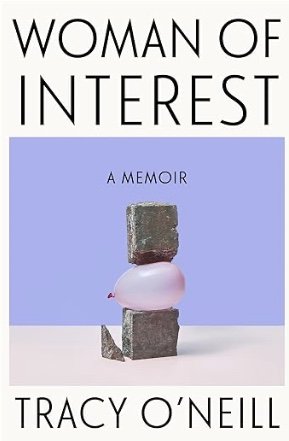
Woman of Interest by Tracy O’Neill

Tracy O’Neill grew up Irish a few miles out of  Boston. A frequent refrain throughout her years at home was “I’m your real mother,” stated by a woman who has been Tracy’s parent almost from birth. Knowing she and her younger brother had both been adopted from Korea has given rise to Tracy’s understandable curiosity about the woman who gave birth to her. This is crowded out by the task of getting two Master’s degrees and a PhD from Columbia, while learning how to live on her own in Brooklyn.

“I read and I wrote,” she says--but then Covid comes to town. Reading and writing in isolation begins to pall and Tracy starts a serious search for her birth mother.

Armed only with scanty facts from the adoption agency who placed her, Tracy resorts to a 21st Century solution, DNA analysis. She spits in a vial six different times. After the sixth try, she’s matched with a girl who’s her third cousin and puts Tracy in contact with that cousin’s father.

“She’s alive,” her uncle tells her. When Covid travel restrictions are lifted, Tracy buys a round-trip ticket to Korea that will give her 22 days with her birth mother and her newly-discovered Korean family. Suddenly she has three blood siblings, a sister and two brothers. All four of them, she’s told, have different fathers.

“Don’t give her anything all,” her uncle says of Tracy’s mother. “Never forget,” another man tells her, “These guys are strangers.”  

Armed with Google Translate, she’s met in Korea by her sister, her cousin, and the aunt who witnessed her birth. She’s also faced with ten days of quarantine that she spends in a bedroom of her aunt’s apartment and she begins a life in translation. Every question, every answer is conveyed in the dubious accuracy of telephone apps--Kakao Talk and Navur Papago, as well as the version offered by Google.

Tracy is back in isolation again, in the home of a cousin and an aunt who are obsessed with feeding her. “You’re too skinny,” they tell her on a phone screen.

This is the way facts emerge, through phones, skeletal and often contradictory. Her uncle in America tells her she’s being lied to because her relatives want “everyone to be happy.” When Tracy is at last able to meet her birth mother, she hires a phone interpreter to make certain the translations aren’t tarnished by family feelings. However the phone interpreter is as resolute in striving for a happy conclusion as the relatives have been.

Embraced by her mother, she fails to feel “the inimitable bond of mothers and children.” “I was nothing but a stone-cold cardboard cutout…in the iron clench of a shuddering old woman.”

When Tracy goes to her mother’s apartment, she is handed a drawstring bag that holds one million won, which is around $8000 U.S dollars. Then she learns she can’t meet her youngest brother because he has never been, nor never will be, told that she exists.

Covid, cultural shock, no common language, and a stay in a foreign country that’s shortened from twenty-two to only seventeen days, ten of which were spent in quarantine--this expedition is doomed from the outset. But Tracy O’Neill is a novelist and she knows how to tell a gripping story. A fan of Raymond Chandler’s Philip Marlowe novels, she cleverly drapes her narrative in noir-style, even coming up with the requisite hard-boiled PI whom she hires at the beginning of her quest. A man who provides no vital information, he remains part of the plot up to the very end, and real or not, he’s an enticing addition. So is the Serbian boyfriend who speaks in broken English. Another plot device? What’s real? Who knows the true usefulness of a common language?

What is true, Tracy concludes, is this. “I twice met a stranger…” The stranger who was her eomma remains an unexplored enigma to the daughter who was given away and to that daughter’s readers. I hate endings,” Tracy says and this story remains shrouded in a haunting mist that’s skillfully reported—or perhaps created— in Woman of Interest. ~Janet Brown 

Dallergut Dream Department Store by Miye Lee, translated by Sandy Joosun Lee (Wildfire)

Miye Lee is a South Korean writer who was born in Busan in 1990. After graduating from university she worked for Samsung Electronics as a semiconductor engineer. Dallergut Dream Department Store is her first novel which was entirely financed by a crowdfunding service in Korea, and was translated by Sandy Joosun Lee. 

Lee says, and most people know, we spend a third of our lives sleeping. “Dreams of wonder and bizarre events, recurring dreams about a particular person, and dreams of places we’ve never been”. 

Dallergut Dream Department Store is a story about a mysterious shopping village you can only go to when you’re asleep. “It’s full of interesting people and places that capture the hearts of the sleeping customers, like a food truck that sells snacks to ensure a good night’s sleep”. 

Penny has always dreamed of working at the Dallergut Dream Department Store. Her application has passed the screening and she has an interview scheduled for the following week. The Dallergut family is well known in Penny’s town. In fact, “the family is the origin of the city”. 

Penny is interviewed by Mr. Dallergut himself. Although she was unsure of herself, Mr. Dallergut asked Penny if she could start tomorrow. The Dallergut Dream Department Store is five-stories high. Each floor sells different genres of dreams. On her first day, Penny meets a veteran employee named Weather who is also the manager of the first floor. She tells Penny to check in with the manager of each floor before she decides on which floor she wants to work in. 

The first floor sells high-end, popular or limited dreams, Penny discovers that the second floor sells generic dreams and is managed by a man named Vigo Myers.  The third floor manager is a woman named Mogberry. On this floor, the staff sells groundbreaking and fun activity dreams. The fourth floor sells nap-exclusive dreams and is managed by Speedo. The top floor, the fifth floor, only sells leftover dreams from the first, second, third, and fourth floors. She also discovers there is no manager for the fifth floor. 

Mr. Dallergut is talking to Weather when Penny returned from her floor tour. They are discussing the need for a new face to help run the front desk on the first floor. Penny overhears them and when Dallergut asks which floor she would like to work on, she immediately says that she would like to work at the front desk. 

And so begins Penny’s adventure of working at her dream job in the Dallergut Dream Department Store, a store that sells dreams of all kinds. But Penny also discovers there is an entirely separate business that the department store deals with - the store’s supply of dreams are created by dreammakers. Penny is a fan of many of them who have names like Kick Slumber, Yasnooz Otra, Wawa Sleepland, Doje, and Babynap Rockabye. They all specialize in the type of dreams they make. There are even dreammakers who make nightmares. 

The dreams are bought on a deferred payment system and the currency used is emotion. However, none of the customers remember that they bought their dreams as when they wake up, they forget that they were even in a store. 

Penny also learns that Mr. Dallergut doesn’t sell dreams to just anybody and everybody. He always has a reason why he does or doesn’t sell a dream to a customer. Mr. Dallergut tells Penny it is only with time and experience to learn all the nuances of selling a dream. 

Lee’s story is a nice escape from reality. If we really could buy our dreams, I’m sure many of us would do so at a moment’s notice - a dream about becoming rich and famous, a dream about meeting a lost love and rekindling a relationship. It makes you think as well, what kind of dream would you buy? Readers will also be happy to know that a sequel has already been published as well. ~Ernie Hoyt


Welcome to the Hyunam-dong Bookshop by Hwang Bo-Reum, translated by Shanna Tan (Bloomsbury)

South Korean writer Hwang Bo-Reum’s Welcome to the Hynam-dong Bookshop is  a book for booklovers and for anybody who has ever had a dream of opening and running their own bookshop. This is her first novel which was originally released in 2023 in her home country. 

The book became an instant bestseller and was translated into several languages the following year, including English. The Japanese translation won the Japan Bookseller’s Award in 2024. 

The main character, Yeongju, did everything she was supposed to do. She went to university, married a nice man, and had a decent paying and well-respected job. She adhered to the principle that if she were to do her best, things would go well for her. 

At her job, she was a contract worker. However, her manager promised her that if she did well before her next evaluation, she would eventually become a permanent employee. She was given an important assignment that she put her blood and guts into, thinking this time, the company will recognize my worth and make me a permanent full-time employee. How shocked she was to find that her manager not only took her name off the project and added an inept co-worker who was then promoted over her. 

So, Yeongju does what only most people dream about doing. She quits her job, she divorces her husband and decides to open a bookshop which was a dream of hers since she was a child. However, she has no experience on how to run a bookshop or how to run a business, but that does not deter her from following her dream. 

She finds a spot in a suburban area of Seoul that she just fell in love with. She thought that if she fills the store with books, people will come. But the reality of the matter was far from what she imagined. After opening the shop, she would ask herself, “if this was her first visit, would she have faith in the staff’s recommendations? How does a bookshop earn trust? What makes a good bookshop?”

For the first few months after opening, Yeongju started writing to do lists, prioritizing what needed to be done first. Before opening the shop, her old life was tearing away at her soul. The only thought in her mind was, “I must open a bookshop”. 

The bookshop has a few early regulars but is still nowhere near to being called successful. Even Yeongju herself says, “I must do better than this”. She starts an Instagram account for the shop and decides to hire a barista so people could enjoy coffee while browsing, perhaps buying a book or two. 

The first employee she hires is Minjun, a young man who also seems to have no direction in life as yet. In the beginning Yeongju tells him that the shop will probably be open for two years or so. She still did not have the confidence that she could run a successful and busy independent bookshop. 

But as the years pass, she begins to think differently from when she began. She now wants her bookshop to be more than just a bookshop, she wants it to be a place where people can come and forget about their everyday, stressful lives, enjoy a cup of coffee and read books they might enjoy. 

As a longtime bookseller myself, I couldn’t help but admire the change in Yeongu’s attitude when starting the shop and how she gains more confidence in believing in herself, her small group of friends, and her employees who make the Hyunamh-dong Bookshop a place I want to go to as well. ~Ernie Hoyt


We Do Not Part by Han Kang, translated by E. Yaewon and Paige Aniyah Morris (Hogarth, Random House, release date 1/21/2025)

Kyungha is a writer who’s haunted by nightmares of black human forms standing in the snow as the tide surges toward them, of massacres that send women and their children down the steep side of a well to escape death, of holding a single flaming match that  could reveal the face of a mass murderer. Engulfed by these phantoms, she struggles to overcome them and to regain her life. 

When a friend summons her to a hospital room, she finds the photographer and filmmaker with whom she’s worked for years, immobilized and crippled by an accident that took place when working in a rural studio. Inseon is from the island of Jeju, where she has lived alone in the company of a caged bird. Pleading with Kyungha to go to her home and give the bird food and water before it’s too late, Inseon persuades her to leave Seoul and travel to Jeju, in spite of an approaching snowstorm that threatens to make the journey impossible. 

Arriving on the last flight before the storm hits, waiting beside a lonely road for the bus that will take her close to Inseon’s house, Kyungha at last begins a walk to safety that instead plummets her into a deep pit. When she emerges, she’s lost her phone and when she enters Inseon’s dark, cold house, she finds the bird is dead.

Suddenly this story slips into the hallucinatory quality of Kyungha’s nightmares. The bird that she buries returns to life. The friend whom she had left in the confinement of a hospital ward suddenly appears in the unheated house and begins to reveal the history that Inseon’s mother lived through and archived, in notebooks, letters, and newspaper articles. The massacres that have haunted Kyungha’s sleep unfold as a tragedy of death and horror, one that was covered up the minute after it took place. Bodies were buried under the runway of Jeju Airport; shot as they waded out to sea where the waves carried off their corpses; dumped into pits where the snow covered and erased them, staying invisible for thirty-four years and remaining forever anonymous.

The dead dominate in this eerie novel. But who is dead? Who’s alive? Perhaps the most vivid character is Inseon’s dead mother, forcing her history upon her daughter and Kyungha, telling her terrible stories in a voice that lives through pieces of saved paper. “Extermination was the goal.”

Extermination is what fills the history and the nightmares, wrapped in the surrealism of snowfall: Snowflakes land on the fronds of palm trees and freeze bright blossoms; snow crystals “swirl wildly as if inside a giant popcorn machine;” snow clouds emerging“like tens of thousands of white-feathered birds flying right along the horizon.” Snow extinguishes the light of a final candle and threatens the life of the one remaining match, held by a woman who may already be a ghost.

We Do Not Part is an unsettling work of art, with each sentence holding a new masterpiece of beautiful and bone-chilling words. It should be read slowly, like poetry, because the narrative is unbearably painful if approached in the way novels are usually consumed. Han Kang combines the supernatural with the inhuman, history with its denial, the living with the dead, as she blurs every boundary line, with the finality of snow.~Janet Brown

Han Kang received the 2024 Nobel Prize for Literature five days after this review was posted.


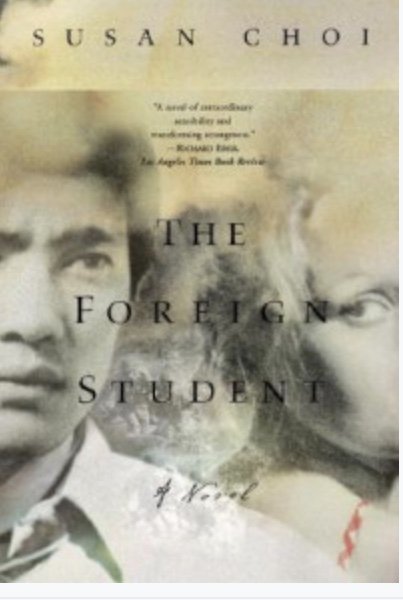
The Foreign Student by Susan Choi (HarperCollins)

It begins like a fairy tale. The lonely traveler walks through the night to a place he’s never been before, where a kind old woman gives him a place to sleep. In the morning a beautiful young woman takes the foreign stranger to his new home and tells him about an older man who will help him as he learns to live and study in a rural paradise.

But, as it is in fairy tales, nothing is as perfect as it first appears to be. Chang has survived years of war, sickness, and starvation that his Southern counterparts have never even thought of. On a Tennessee campus, he’s called Chuck by classmates who regard him with “a subtly unremitting scrutiny, disguised as politeness” and who mistake his “limited English for a limited knowledge of things.” Chang likes that; it gives him “a hidden advantage,” which he uses to his benefit, along with his “infinite patience for listening.” Seen as an object of charity, he hides secrets which emerge only in his half-remembered nightmares.

The young woman who first helped him has secrets of her own. From the time she was fourteen, she has had a sexual relationship with the older professor whom she advises Chang to take as a mentor. She has inherited her childhood home and is still enmeshed in her childhood liaison with the man who has known her since she was a little girl. Although rumors swirl around her, Katherine has set herself apart in a cocoon of loneliness. 

“You’re the first new thing here in a while,” she tells Chang. As she slowly begins to form a friendship with this stranger, both of them peer at each other through their veils of secrets, each beginning to feel trust without knowing why.

Although a love story teases at the edges of this novel, the story belongs to Chang. Gradually bits of his history are revealed: his early friendship with a rebellious boy who joins the guerrilla movement against the government of South Korea, his English proficiency that gives him a job as a translator for the American presence in his country, his abandonment, survival, and betrayal. Scenes of torture lie in counterpoint to the tentative peace that he and Katherine find together, darkening Chang’s dreams and tarnishing the possibility of his finding happiness.

Susan Choi brilliantly unfolds Chang’s world as he leaves the safety of the Southern campus and goes to Chicago, a metropolis where he’s “surrounded and invisible,” where there are “so many ways he could slip into life.” After a summer of living in the city’s Japantown, Chang can “no longer imagine the lack of imagination he’d arrived with.” As he encounters new dreams, he begins to face his nightmares and dares to believe he might deserve a life, one filled with love and without charitable condescension

As he and Katherine slowly release “the wariness they both turned toward the world,” they find new ways of living within it, bringing hope and joy to a novel that has been shrouded in the immobility of pain. Choi’s recreation of history, her skillful creation of characters who may never have appeared in fiction before, and her ability to paint unforgettable landscapes with precise and evocative words make her debut novel stunning and unforgettable.~Janet Brown


Recitation by Bae Suah, translated by Deborah Smith (Deep Vellum)

There are some books you read and can’t put down. Once you come to the last page, you’re saddened by the fact that the story has ended because you want more. Then there are books you read, reread, and try to read but the more you read, the angrier you get as there’s no plot or point to the story. 

Bae Suah’s Recitation falls in the latter category. Perhaps there is something lost in translation from the original Korean. Suah is a South Korean writer and translator who made her literary debut in 1993 with A Dark Room in 1988. Bae had no formal training in writing nor did she have a literary mentor to help her and it shows. She started writing as a hobby but left her full-time job after getting her first story published. 

Recitation starts off with a woman named Kyung-hee talking to some people she met at a train station. We never know who she is talking to or why but she tells them she had the idea of visiting the houses she’s left behind. We do learn that the people listening to her were from the same city as Kyung-hee. She tells them in her hometown she was a theater actor specializing in recitation. 

The people who first talk to Kyung-hee meet her at the train station. They offer to accompany her to her hotel or wherever she was staying, but she tells them she doesn’t have a reservation anywhere, that she is waiting for a man who is going to let her use his living room for a few days. 

She explains to the people who talk to her that she is a “part of a community of wanderers who let out their homes free of charge”. She continues by saying, “If someone comes to visit whichever city I’m living in, I give them somewhere to stay, and then when I go traveling, other people in other cities will let me use their living rooms, veranda, guest room, attic, or even in the off chance that they have one, a barn”. 

The people become intrigued with Kyung-hee’s story. They listen to her as she tells why she started traveling, the people she’s met, the experiences she had. This may sound like the beginning of an interesting tale but it becomes one long boring monologue. You discover that Kyung-hee doesn’t really have anything to say, or rather she speaks a lot but doesn’t say anything that makes any sense. 

Anyone who is not familiar with Bae’s writing may become frustrated as they try to decide who is actually speaking. Bae switches from Kyung-hee to other characters, to the unnamed people who first started listening to her, and then to a daughter Kyung-hee doesn’t claim to know. Not only is the writing confusing, but I found it pretentious as well. In the end, I wonder why I even bothered to read this book at all. If you’re a glutton for literary punishment, you could challenge yourself to read this. As for me, I was just glad that I was able to finish it. ~Ernie Hoyt


Forgotten Country by Catherine Chung (Riverhead Books)

Forgotten Country is Catherine Chung’s debut novel. It is a story about family bonds, secrets and betrayals. It is about a family that drifts apart and comes together. It is a highly emotional roller-coaster that will take you on the ups and downs of life. The book received an Honorable Mention for the 2013 PEN/Hemingway Award.

The story centers around a South Korean family who emigrated to the United States and made a life for themselves in a city in Michigan. The father was fleeing political persecution and brought with him, his wife and two young daughters, Jeehyun and Haejin. The girls were given American names at their school to blend in more with American culture and they became Janie and Hannah. 

Before the family moved and the night before Hannah was born, while Janie’s mother was in the hospital, along with her father, Janie was left alone with her grandmother. It was the first time she was away from her own home without her mother. The room her grandmother put her in was large and scared her. When her grandmother checked in on her, Janie was crying. She cried so hard, she had a fever. Janie still wouldn’t stop crying until her grandmother shook her and said, “Jungshin chalyuh” which meant pull yourself together.

Her grandmother said she was too old to be crying. “You’re an elder sister now, and you have new responsibilities”. The grandmother then tells her about how she also became an elder sister. The day Hannah was born, her grandmother also told her, “In our family, a sister always dies.”.

Now, years later, in the U.S., Hannah has disappeared without a trace. She cut all ties to her family. Her father has told Hannah that he and her mother are planning to move back to South Korea and that Janie needs to find Hannah before they leave.

Janie’s father told her that he has cancer and that a doctor recommended a specialist in his home country who handles his type of cancer. The doctor said there was nothing more he could do. The father and mother plead with Janie to find Hannah before they leave. Thus starts Janie’s journey in which she will learn more about her family and herself. 

Janie does track down Hannah in California. They have an awkward reunion but Janie did her duty and informed her sister that their father was dying of cancer and that their parents sold the house in Michigan and would be landing in Korea right about the time they were having this discussion. 

Their argument and Hannah’s attitude brings out the worst in Janie, who tells her, “Don’t worry, you don’t have to come.” Hannah of course doesn’t believe her but Janie can’t stop herself from saying, “Seriously. They just wanted me to tell you they sold the house and they’re gone. They’re done with you.”. 

Forgotten Country is definitely an emotional roller-coaster, not only for the characters in the book, but for the reader as well. It makes you question what is love and what is loyalty? It makes you think about what you would do if confronted with family secrets and how you would deal with it in this poignant and very strong story about family ties. ~Ernie Hoyt

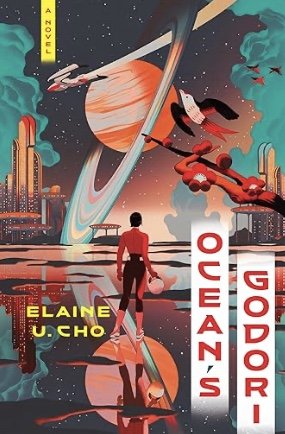
Ocean’s Godori by Elaine U. Cho (Hillman Grad Books)

Ocean Yoon ought to be on the fast track to stardom. She can outrun any other space pilot in the solar system, she’s a graduate of the world’s best flight program, and she’s Korean. 

Korea rules the solar system with its space agency, the Alliance, and Seoul is a glittering metropolis filled with galactic hotshots. Ocean would be one of them except for two fatal obstacles. She was sent to a boarding school on Neptune where she grew up without the cultural influences that would make her truly Korean and she’s developed a mind of her own that doesn’t submit well to authority. Early in her space career she made a decision that’s branded her as a liability on any spaceship. Nobody wants the woman with the grisly nickname, Headshot, who never misses her target—except for a captain with a shaky code of ethics and a ship that needs Ocean’s unmatched speed and skill.

Captain Song pretends that she “could put this ship on auto-pilot and it would do the job,” but when things get rough, she turns to the woman whom she tries to ignore. She has to rely on Ocean, who has gained the respect of the crew in a way that Song has not. Even the newest recruit, a man from a planet where the inhabitants learn to become Masters of the Death Arts, is fascinated by Ocean from the moment he joins the crew. 

When Ocean’s best friend Teo, the son of a man who has made his fortune by devastating the environments of other planets, shows up in an escape pod, wounded and unconscious, mutiny begins to simmer beneath the surface of Song’s crew. It bubbles over when the most notorious raider in space comes aboard and places a wedge between Song and her crew. Phoenix wants Teo’s money and Ocean’s skills and he’s smart enough to exploit the situation to get what he wants.

Elaine U. Cho is adept at creating a multifaceted plot that takes a new twist on every page but her ability to bring life to her characters through smart and snappy dialogue is what powers this novel into new territory. Ocean’s Godori soars far beyond conventional science fiction. Its roots are in the Saturday morning serials that once made radio stations popular, when dialogue and cliffhangers ruled the airwaves. Cho has resurrected that form and made it her own, ending her debut novel with a teasing conversation that sets the stage for the next episode.

“A thief, a hacker, an accountant, and now a pilot. My ultimate party is almost complete.” Because Cho has provided a multitude of characters who almost threaten to topple Ocean’s Godori, Phoenix has quite a few candidates who might complete his party. The question is will Cho be able to sustain this wild pace and devious plot in a follow-up novel? What she’s done in this one sets a high bar. She’s written a space fantasy that will ensnare even those readers who despise science fiction.~Janet Brown


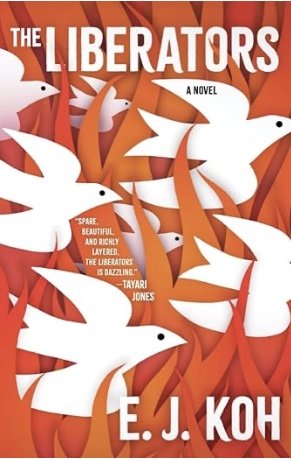
The Liberators by E. J. Koh (Tin House)

“The fog drew rosefinches, like blooms in the low bush, whose cries I mistook for rainfall.” 

Yohan is a man obsessed with words, who can write them in six languages. During his lifetime, he has lived through the Japanese occupation of Korea, survived the horrors of World War Two, and “watched the country divided up as spoils of war.” What puts him into prison is a shadowed mystery with a partial disclosure: “To be a spy was to one day be known.”

Decades later, living in America, his daughter meets a man who draws a tiger on her bare back and tells her “It’s Korea…if the country had no stitches” and was reunified as a single nation. Although he knows “The South doesn’t want to rebuild the North. And the North doesn’t trust the South,” he is devoted to bringing the two divisions back together once more. His dream is rejected by the Korean men who come to his meetings in a local pool hall and when he returns to Korea, he’s imprisoned “for crimes of moral turpitude.”

Although politics is a hopeless quagmire that gobbles up idealism, Yohan’s daughter erases divisions in her own family by nurturing  her North Korean daughter-in-law. When she dresses the mother of her grandchild in the green hanbok that was once worn by her own mother, “the fabric folded smoothly..,the ribbon falling down the front, a new verdant path.”

Like Yohan, E.J. Koh is dominated by words. In her memoir, The Magical Language of Others (Asia by the Book, November 2020), she describes her life, lived in four languages, English, Korean, Japanese, and poetry. “Languages,” she says, “as they open you, can also allow you to close.” 

In her first novel, Koh lets the language of poetry open windows and then she slams them shut. Six characters are partially revealed in The Liberators but none of them are as fully realized as the images that surround them. In a gorgeous section entitled Animal Kingdom, Yohan’s grandson is given a dog, “a bright and curious joy,”  that’s “joined to the boy like a wish.” Later the boy is united with the woman he will marry in “the elaborate braid of our bodies.” Trapped in poetry, he and the other five characters that fill these pages remain “shadows that flew up and shattered across the ceiling.” Each of them is truncated by subtlety, as if they were created to convey Koh’s language rather than the reversal that would have given them life. They are pieces in a jigsaw puzzle, given just enough definition to merge into a whole pattern.

Mixed with Koh’s poetic language is the harshness of political reality in which a country with millennia of history and tradition becomes sacrificed to global economic interests. When Koreans gather together in America to watch the TV coverage of the Olympic ceremony in Seoul, the doves that symbolize world peace perch on the flaming cauldron and are burned alive, “a memory that had to be erased…that had to be forgotten in our soft, closed palms.” 

“Why visit the past, why go digging up its grave?” asks the man who dreams of Korea as a tiger, complete and undivided. Yohan’s daughter answers him by embracing the present in another country, unified with her North Korean daughter-in-law, a conclusion that escapes cliche because Koh has clothed it in poetry.~Janet Brown


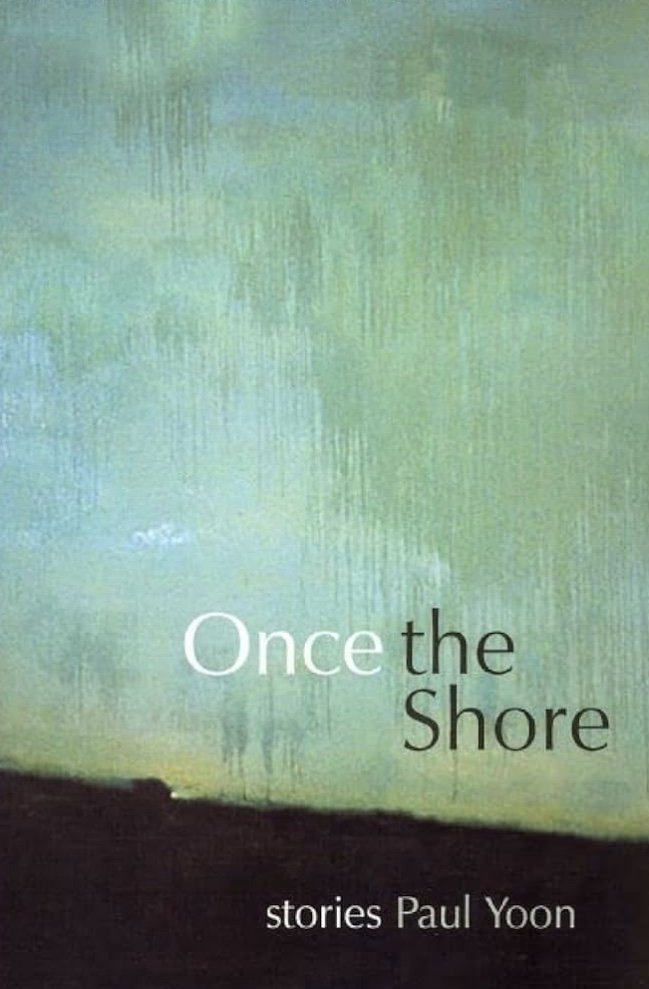
Once the Shore by Paul Yoon (Sarabande Books)

Floating across the landscape of Solla, one of the many islands lying off the coast of Korea in the East China Sea, are eight enigmatic stories. The characters within them are as mysterious and evanescent as rain-drenched spiderwebs, each embodying a different part of the island’s history and each one of them abandoned in mid-moment. The ends of their stories are left for the reader to imagine, based upon the hints that were strewn through each of their narratives. 

An aging American widow comes to a resort on Solla, searching for traces of the man her husband once might have been. An elderly couple in 1947 take their ancient trawler to the site of U.S bomb tests that destroyed twenty Korean fishing boats, one of which held their only son. A woman who owns a shop in a Solla tourist town has her past return to confront and betray her. A sixty-year-old “sea woman” dives into the depths of the ocean as she has every day since she was thirteen, her only friend a boy who lost his arm to a shark and who longs for her to bring him a sea turtle. An American deserter upsets the peace of a Solla mountain village by overstaying his welcome and befriending a young crippled village girl. A farmer sells his land to a developer with “fingers clean as polished silver” and plans to turn it into a hotel that will overlook a golf course, while his young daughter, haunted by a ghost who wears the dress of her dead mother, furiously opposes his decision. An orphan girl who has been employed by an “American hospital” watches cargo trucks deliver men on stretchers, soldiers who have come from Australia, France, Greece, to fill a thousand beds in a place that had once been a vocational school run by the Japanese. A young married couple live in a highrise building among the tourist businesses of Solla City, making their living through tourism in a world of hotels and markets that sell souvenirs.

Through the kaleidoscope of these stories, the history of Solla island is made tangible and the island itself takes on a substance that eludes the lives of the people who pass over it like clouds. Solla, with its caves and forested hills and Tamra Mountain rising above it all, is described so meticulously that it comes as a shock when Yoon admits it has never existed at all. Its alluring beauty can be visited only in these pages.

The eerie shadow-lives of the characters in Once the Shore exist as faded silhouettes against an island whose history is being devoured by war and international businesses. The young couple in the final story exist in a different universe from the old woman who dove for fish. They visit parts of their island as tourists, divorced from what exists beneath the commercial facade. When they go to Tamra Mountain, they hire a guide. Solla no longer belongs to them, unlike the sea woman who once took possession of the ocean every day. Within its depths “the world consisted of light towers, sunlit, and she swam among them,” every day for more than half a century, knowing she is one of the last to have “carried seawater within them.”

The young couple whose lives are consumed by tourism are unaware of how Solla’s “winds, like great birds, came in from the sea” or the majesty of its “trees, slow moving and wide as ships.”  They are unable to see the beauty of its twilight, with the sea’s “silver reflections folding over one another like the linking of fingers.” When they buy a platter of abalone from a sea woman in a tourist market, they have no idea they’re in the company of the island’s fading history.

Through Yoon’s stories, the glory of an imaginary place becomes real and its gradual loss becomes a sharp and bitter grief.~Janet Brown


Nuclear Blues by Bradley K. Martin (Great Leader Books)

Bradley K. Martin worked for decades as a foreign correspondent. He was mainly based in Asia. When he worked for Bloomberg News he was chief North Korea watcher. He gained his reputation on being a North Korea expert after writing the nonfiction bestseller Under the Loving Care of the Fatherly Leader : North Korea and the Kim Dynasty, a comprehensive history of the country under the leadership of  Kim Il-sung and Kim Jong-il.

In Nuclear Blues Bradley has now turned to the world of fiction and has created a unique murder-mystery set in the Hermit Kingdom under the new leadership of Kim Jong-un. Included in his story is a Korean-American journalist-turned- blues musician, suspicious men from the Middle East, and a Christian college in North Korea, credit-default swaps, Russia, nuclear missiles, and a mysterious woman who may or may not be related to the current leader. 

Heck Davis is a photo-journalist but has decided to give up the profession and become a blues musician. He still takes on the occasional story and finds himself at the Korean Demilitarized Zone, also known as the DMZ. It is a strip of land that runs across the Korean peninsula separating the countries of North Korea and South Korea and was established as a buffer zone between the two warring countries.

Davis is on assignment for an Internet-based news agency called AsiaIntel, with three other cameramen visiting the Joint Security Area (JSA) located in Panmunjom. His journalist friend Joe Hammond is also scheduled to show up at the JSA. But because Pyongyang has a strong distaste for foreign journalists, Joe has come to North Korea as a member of an ordinary sightseeing tourist. Davis times his schedule to coincide with the tour group so he can see his friend. 

Davis’ current assignment is to take video for AsiaIntel. His editors want him to “gather military-themed footage from the southern side of the Cold War border relic.” Heck spots his friend Joe but he feels there’s something not quite right about him. “There was something wild in his eyes, something coiled and edgy about his posture.” 

Davis focuses his camera on his friend when Joe crouched, bends forward and rams his head into one of the North Korean guards. As Joe makes a run toward the South Korean side of the J.S.A., he flashes his passport and yells, “U.S. Citizen! U.S. Citizen. ” He looks at Davis and shouts “Sixty-seven twenty” before he’s shot down and killed. Davis also notices three letters scrawled on the palm of his friend’s hand—“CDs”. 

With the death of his friend, Heck Davis’s journalist instincts take over. He is determined to solve the mystery of what happened to Joe. He also needs to know what “Sixty-seven twenty” and “CDs” mean. But first, he must find a way to get back into North Korea. 

Thus begins one of the most original stories involving Kim Jong-un and a host of other characters. The further the story takes you inside North Korea, the more interesting and surreal the plot. Highly implausible but extremely entertaining, this book was impossible for me to put down. It may not be the true essence of North Korea but with Martin’s background as a North Korea watcher, he makes it as real as it can possibly get. You may even want to visit the world’s most isolated country just to see for yourself. ~Ernie Hoyt

The Curse of Kim's Daughters by Park Kyong-ni, translated by Choonwan Knag, Myung-hee Lee, Kay Ho Lee, and S. Keyron McDermott (Homa & Sekey Books)

Park Kyong-ni is one of South Korea’s most prominent writers. Her best known work is her ten-volume epic Land which started as a serial publication in a literary magazine called Modern Literature. The story debuted in the September 1969 issue. It took her twenty-five years to complete.

The theme focuses on ordinary Korean people’s lives spanning from the mid-nineteenth century to the early twentieth century, through Japan’s occupation and up until the division of the country into North and South Korea. It has been made into a television series, a movie, an opera, and has been translated into several different languages, including English. 

The Curse of Kim’s Daughters was first published in 1962 in the Korean language as Kim Yakkuke Ttadeul. The book was translated into English by a four-member team of translators including three Koreans and one American. It was published in 2004 by Homa & Sekey Books, an American publisher that specializes in fine books on Asia, focusing mainly on China and Korea.  The translation was made possible by a grant from the Korean Literature Translation Institute (LTI Korea). 

The Curse of Kim’s Daughters is set in the town of Tongyong, a small fishing village near Tadohae Seashore National Park. It sits halfway between Pusan and Yosu. It is the story of one family’s struggle to live and survive in a rapidly-changing world. The Kim family’s patriarch is Songsu Kim, a man who was orphaned after his mother committed suicide and his father ran away from home after killing a man.

Songsu Kim was raised by his uncle and grew up to inherit the family pharmacy. He later sells the company and invests in a small fishing fleet. He marries a woman named Punshi who was chosen to be his bride by his uncle. Although Punshi gives birth to a son, the boy dies at an early age. Punshi then gives birth to five daughters, Yongsook, Yongbin, Yongnan, Yongok, and Yonghay.

We follow the lives of Songsu Kim, his wife and his daughters as they all deal with their own troubles. There does seem to be a curse set upon the Kim family’s daughters. The eldest becomes a widow, gets pregnant and is accused of killing her own baby after giving birth to it. The second daughter despairs of not being able to find a suitable husband. The third has a mental breakdown and goes insane, while the youngest meets with misfortune while at sea. 

I’m sure there are some aspects of Korean culture that I just cannot understand which may have biased my opinion on praising this novel. I can understand arranged marriages, respecting your parents and your elders, and not shaming one's family but the abuse and neglect fostered upon the daughters of Songsu Kim by their various spouses can only be described as abuse and domestic violence. 

The most heart-wrenching incident involves the third daughter who falls in love with one of the family’s servants. They elope but are caught. The servant is made to leave town and because their daughter is no longer a virgin, the parents force her to marry a rich man’s son who is not only abusive but is an opium addict as well. Whenever the third daughter tries to come back home, her mother forces her to go back to her abusive husband because that is her duty as a woman. 

Although well-written, the story is sad and depressing and doesn’t seem to leave any room for hope. The parents’ attitude towards their own children borders on child abuse. If you want to be depressed and believe that living life is a curse, then perhaps you will be able to enjoy this story. As for me, I believe in the pursuit of happiness and that all relationships should be based on love and trust. ~Ernie Hoyt

Please Look After Mom by Kyung-Sook Shin (Knopf)

None of Mom’s children give her much thought until the day she goes missing in a busy Seoul subway station. One minute she’s clutching her husband’s hand as he’s forcing his way down the stairs and then she’s gone. Before he realizes her absence, he’s already packed into a crowded car, unable to leave. When he returns to the spot where he last saw his wife, she has vanished. 

As they begin to search for her, her children realize they barely remember the date of their mother’s birthday.  Mom had merged her celebrations into those of her husband’s, for the sake of convenience. In fact they don’t know her true age, their father tells them, because she’s older than her birth certificate indicates. They don’t have a recent photograph of her because Mom hated having her picture taken and nobody ever pressed the issue. 

When they think of the 69-year-old woman named Park So-nyo who turned out to be really 71, all they can think of is Mom, whose “house was like a factory,” filled with juices and sauces and pastes and fermented fish made by her own hands. All they remember at first when they think of Mom is how she perpetually worried that her children might go hungry and how she always made sure they were fed.

Their search is for a woman whom they barely know, one whose reported sightings are ghostly, in neighborhoods her children left long before.  As they try to understand the mystery of why she didn’t call any of them or why she hasn’t gone to a police station to ask for help, they begin to turn up fragments of memory—the unspoken knowledge that Mom is unable to read, the ignored signs of her ill health, the way she cared for her family unaided when their father temporarily abandoned his household.

As Mom gradually takes shape while still remaining elusive, each member of her family sees dimensions of her that they have constantly overlooked—her curiosity about one daughter’s trips abroad, her longing to read the books written by a child with whom she constantly battles, her hidden devotion to a brother-in-law who killed himself before her children were born, and her connection to “that man,” who is linked to her in a way that always remained a secret.

Mom slowly unfolds like a budding flower, in a shadowed fashion through the eyes of others. Only at the end of her story does she emerge with her own voice, and by then she’s taken on another shape, an unrecognizable form. 

In the relentlessly urban world of modern-day Korea, Mom is embarrassingly rural, only recognized for what she gives and how she nourishes once she has disappeared. Kyung-Sook Shin has created a delicate allegory, a fable built with spiderwebs, carefully and gracefully constructed. Her opening sentence echoes the stark lack of sentiment that characterizes the beginning of Camus’ The Stranger.  The famous Mother died today. Or was it yesterday,” is matched by “It’s been one week since Mom went missing.” But unlike the narrator of the French classic, Mom’s children find their way into the compassion and tenderness of Shin’s final sentence, voiced to the Pieta, “Please, please look after Mom.”~Janet Brown