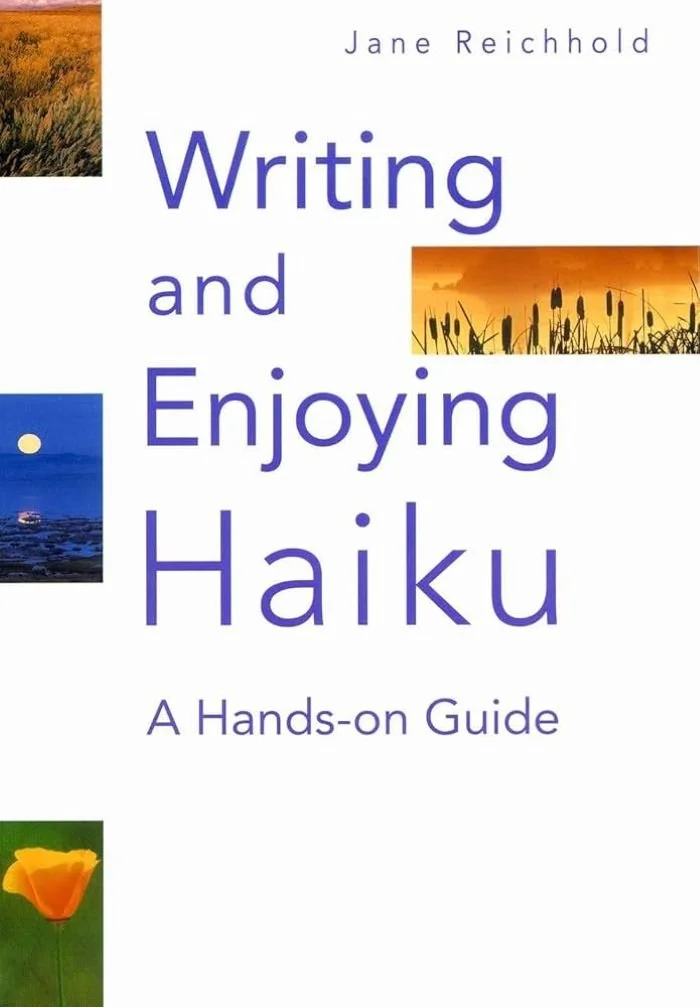
Writing and Enjoying Haiku : A Hands-on Guide by Jane Reichhold (Kodansha) ~Ernie Hoyt
What is haiku? I was exposed to this word when I was an elementary school student living in Japan. I learned a little more about it when I was in high school when one of my classes was covering poetry. What I remember from my class is that haiku is a traditional form of poetry in Japan consisting of three lines containing seventeen syllables in a 5-7-5 pattern.
In my youth, I used to write poetry - mostly limericks or other poems whose first two verses would rhyme. I had never given any thought to writing haiku. Recently, I’ve been watching a television variety show called [プレバット!!] (Prebatto!) and one of the segments is dedicated to haiku. The title of the television show is a shortened form of “pressure battle”. Selected panelists are given a theme or shown a picture and they must write a haiku to describe the subject. A haiku master would then judge each haiku and a winner would be chosen.
I could not understand how the haiku poems were judged by the haiku master. I decided to delve a little deeper into the subject by reading a book about haiku in English. Writing and Enjoying Haiku : A Hand’s-on Guide by Jane Rechhold would be my re-introduction to the genre.
Jane Reichhold is an American author and translator whose specialty is haiku. She is a three-time winner of the Haiku Society of America Merit Book Award and has been a member of the Haiku Society of America, Haiku Poets of Northern California, Haiku Canada, Haiku International (Tokyo, Japan), and the Poetry Society of Japan. She also runs a website called Aha! Poetry (www.ahapoetry.com).
So, what exactly is haiku? It seems to be more than three lines of seventeen syllables in a 5-7-5 pattern. As this book is more about writing haiku, Reichhold says you must first be able to read haiku. She says, “That sounds fairly simple, but like everything else concerned with haiku, levels are buried under levels and archeology seems child’s play in warm sand”.
Haiku is a short form of poetry that originated in Japan. The traditional Japanese haiku consists of three phrases composed of seventeen mora which is a small unit of timing that is equal to or shorter than a syllable. A haiku requires a kireji (cutting word) and a kigo (a word or phrase associated with a particular season).
Reichhold also states that the traditional rules for haiku in Japanese are often difficult to follow in another language. She says if you want to start writing haiku, forget the technicalities of the Japanese language and follow these six basic rules.
Write in three lines that are short, long, short without counting syllables
Make sure the haiku has a fragment and a phrase
Have some element of nature
Use verbs in the present tense
Avoid capital letters or punctuation
Avoid rhymes
It may seem difficult at first but once you understand how to read haiku, writing your own may be the next step. The rules may seem overwhelming at times all you have to do is remember what Reichhold said in her Foreword, “Let go of your preconceived ideas and simply do whatever brings you the most enjoyment.” Keeping that in mind, I might attempt to write my own haiku now.