Inseparable by Yunte Huang (W.W. Norton & Company) ~Janet Brown
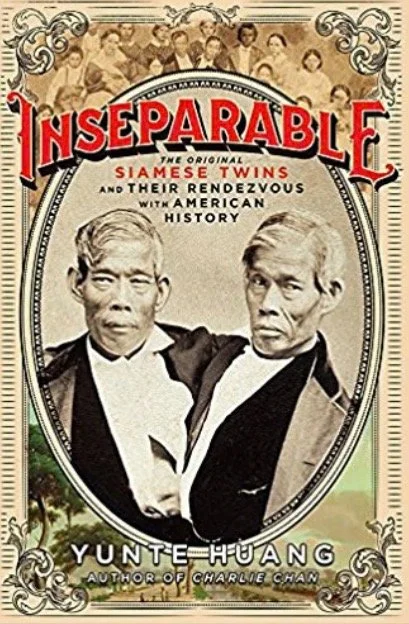
The men who were the inspiration for the coinage of "Siamese twins" as a popular description for conjoined siblings have been the subject of curiosity and intrusive speculation for over two hundred years. They weren't the first babies to ever share a body but thanks to a Yankee businessman, they became the most famous. Their history continues to evoke interest, with at least four books written about them in this century alone.
What is usually overlooked in all the miles of print that focus upon their lives is the extraordinary success the brothers achieved in a country far from where they were born. This is what Yunte Huang has chosen to illuminate in his biography of Chan and Eng, Inseparable.
Born in a Thai fishing village in 1811, the twins immediately excited local curiosity that they turned to their benefit as they grew up. In their teens, they began their entrepreneurial career by selling ducks and preserved eggs in the public market, with their unusual status drawing more than their fair share of customers. When two New Englanders discovered them, the men instantly recognized the twins' potential. But even then, when they were seventeen, Chang and Eng knew how to drive a bargain. They knew their worth. They had already been presented to the King of Thailand and his royal court, where they had received attention and gifts.Before they agreed to leave home, they arranged for their mother to receive $500 and negotiated a five-year contract in which they would receive "ten Spanish" a month with all expenses paid.
By this time, Chang and Eng were fluent and literate in Chinese, the father's native tongue, and in Thai, the language used by their Sino-Thai mother. During the four-month voyage from Thailand to Boston, they learned basic English and when they reached America, they continued to learn three or four English words a day. As their vocabulary became more extensive, the twins began to add comic badinage to their hours on stage and became avid readers, presenting their favorite book, The Letters and Journals of Lord Byron, to a university that had hosted them in a Southern town.
On a thirteen-month tour of England, the twins were given A Dictionary of General Knowledge, a hefty one-volume encyclopedia, that they kept and read throughout their lives. (It was found on their bedside table after their deaths and was obviously well-used.)
Perhaps it was through this gift that Chang and Eng realized they had legal rights. At 21, they declared themselves free from the men who had profited from them, hired a manager, and began to tour independently. In addition to booking stage time and selling tickets to their exhibition, they returned to their roots, selling merchandise to their audiences. By the time they were 28, Chang and Eng had more than $10,000 dollars in savings, which would amount to over $385,000 in 2026 dollars.
Their tour took them to North Carolina where the climate and topography made them feel at home. They hunted, fished, and decided this was where they would settle down. They established a general store, bought 150 acres of farmland, and had a house built to their specification, with big windows in every room to capture the light and a view of the nearby Blue Ridge mountains. Sending their manager to New York as their personal shopper, Chang and Eng revealed a taste for elegance and luxury in their daily lives.
Perhaps it was their status as sophisticated and successful men of the world that made them successful when they began to woo two sisters who would become their wives. It certainly helped them to achieve American citizenship which by law was conferred only to "free white persons." Marrying was more problematic. Miscegenation laws got in the way, as well as newspaper articles that inveighed against women marrying "quadrupeds." Still Chang and Eng stood out in the rural South with their charm, fame, wealth, and good taste. They held a double wedding with the brides coming home to a house that was described as "uncommonly elegant." The sisters were now both Mrs. Bunker, the surname their husbands chose to put on their marriage licences, since in Thailand at the time of their birth, surnames weren't used.
Chang and Eng had developed a way of living together that brought the concept of "alternate mastery" into play. Every week one of them took his turn in making decisions and having a private life, while the other kept silent and "turned his face away," essentially blanking out as a person, an act of disassociation and survival. This practice was observed religiously, even more so when each twin set up his own household in a separate home. (When one of Eng's children died in infancy, he refused to attend the baby’s funeral because it was his week to be the invisible man. This may be why his wife refused to be buried in the family cemetery, next to her husband, her brother-in-law, and her sister.)
By the time the Civil War broke out, Chang and Eng owned 800 acres, two homes, and 32 slaves. Patriotic citizens of the Confederacy, the twins put their money in Confederate bonds. At the end of the war, their wealth plummeted from $34,000 (over $725,000 in 2026 dollars) to just over $9,000, with most of that tied up in acreage.
The twins abhorred P.T. Barnum. They'd worked with him in the past and decided that of all that Barnum exhibited, he himself was the most freakish of all. But they were wiped out. First they submitted themselves to Barnum's flim-flam, then they went out on their own. But times had changed and the twins were old men. They once had prided themselves that they were "never part of a circus," but their final appearance was in a Berlin arena, appearing after the clowns and bareback riders. Humiliated and depleted, they returned home.
By now Chang was an alcoholic, in poor health, while Eng's only vice was being "an addict of late night poker." After suffering a stroke on their final voyage from Europe, Chang became an invalid, while Eng, still healthy, did all he could to keep his brother alive, knowing that without him, he would himself become a "walking shadow." When he awoke one morning to learn that Chang had died, he immediately told his family. "Then I am going too." He died several hours later, killed by failure of the liver that the twins had shared.
When considering the lives of Chang and Eng. men who made a successful place for themselves in a foreign country, refusing to deny themselves as much normalcy as they could muster in their connected bodies, and founding a dynasty of Bunker descendants that number around 1500 today, Chang and Eng are men who deserve to be regarded with marvel. Instead their shared liver is gawked at every day at the Mutter Museum in Philadelphia. If the twins could see that, they probably wouldn't be surprised.