Autumn Light by Pico Iyer (Knopf) ~Janet Brown
A man who has become famous for writing about travel, Pico Iyer has had a solid base since he was 26. when he realized that if he didn't make the choice to live in Japan, that "meant a kind of exile." For over almost fifty years, that country has been his anchor, the place where he met his wife, where they share a home, and where he has found the stillness to write about his life there.
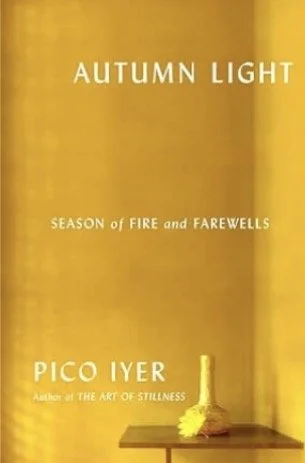
Autumn Light is part of a kind of trilogy that began with The Lady and the Monk (Asia by the Book, November 2025) and ends with A Beginner's Guide to Japan (Asia by the Book, April 2021). While the first book describes how he fell in love, with his wife and her country simultaneously, and the concluding volume tangentially addresses what happens when a dream becomes real, Autumn Light is an intimate look at the end of life, seasonally and inevitably, in a culture "that cherishes things precisely because they cannot last."
Although the cherry blossom season draws local residents and tourists to admire and contemplate, Iyer prefers autumn, "the season of fires and farewells." He's called back home during that season by the death of his father-in-law, and finds his wife is taking care of matters with her customary "emotional efficiency.” Yet, when the two of them are alone, Iyer is given access to her emotional depths, a discovery that leads him to a greater intimacy with the people he loves, the people who have befriended him, and the world he strives to be part of.
Although Japan often describes itself as a country with four seasons, Iyer has learned its year actually contains seventy-two, each one lasting for five days. His own suburban neighborhood is based on an agrarian calendar that is marked by nine harvests and prayers to the goddess of the sun. With time distinguished by periods of planting, blooming, ripening, harvest, and death, this cycle is always in focus and accepted.
Iyer, a man who works from home while his wife leaves for her job every day, has been given a nickname that he's heard from boys on the street. He's called Isoro, a parasite, since he seems to live a life of domestic leisure. There's one place where he feels accepted, if not understood, in a ping-pong club at a local exercise center.
Surrounded by people who are old enough to be his parents, Iyer finds himself "entering Japan through the narrow gateway of ping-pong." As he plays and is soundly trounced by a community of the elderly, he observes and imitates them, feeling as if in this place he can almost "pass as a local while remaining the token foreigner."
At home he travels through grief with his wife. At the ping-pong club he watches his comrades grow older and begin to fall away. Walking through tree-lined streets where the "leaves are scraps of flame" he wonders "how long these days of gold can last."
"Dying," he says, "is the art we have to master." In Autumn Light, both Iyer and Japan give concise and beautiful hints in how to master that art.