Video Night in Kathmandu by Pico Iyer (Vintage Departures) ~Janet Brown
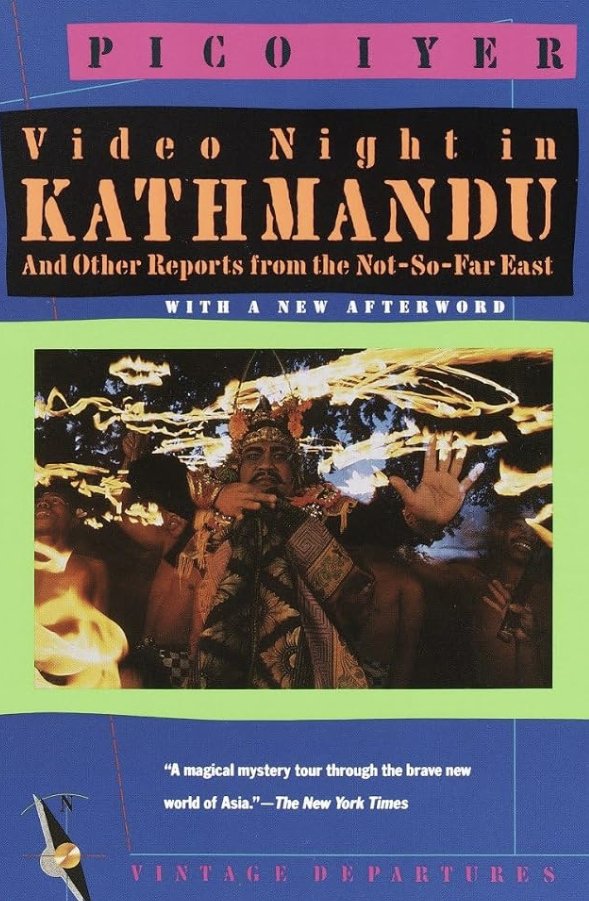
In 1988 a book appeared that changed travel writing forever. Travelogues had dominated this category from its outset, taking readers from Point A to Point Z. That format had been in place from the days of Marco Polo right up through Dervla Murphy, and nobody saw reasons to deviate from it, until Pico Iyer came out with Video Night in Kathmandu.
This book broke right through the fourth wall that had stood implacably between the writer/instructor and reader/student. Iyer brought a subjectivity that was far from unassailable. He gleefully threw out observations and opinions that challenged conventional wisdom and invited opposing points of view. Instead of describing landmarks and monuments, he took the position that travel and travelers were a corruptive, inexorable force that were homogenizing the places they sought out as exotic.
Globalism wasn't a household word in the mid-80s but Iyer found it all over Southeast Asia, skipping blithely over this portion of the continent and finding Rambo in every country he visited. "Rambo," he claims, "was 'Reaganizing’ the world."
But Sylvester Stallone wasn't the only agent of change nor was America the only culprit. In Bali, the town of Kuta felt like an Australian 'holiday camp,' bristling with signs that promised "Aussie Breakfast" and "Bloody Good Tucker." In Ubud, where "the real Bali" was a strong selling point, the leading citizen is a Spanish artist, Antonio Blanco, who presents to Iyer a writer of "real genius," a role model to emulate. This literary god is Sydney Sheldon.
Hong Kong has no such perversions. An "expat city,” it’s a place where, two years before the hand-over, most of those expats are British. Their “voices of elegant irrelevance” identify them as Old Etonians to boot, lured by "a free flat, free holidays, free flights on Cathay Pacific." They pay for this ease by buttressing the truth that "Here work is life. There's no difference between the two." For the British, Hong Kong "is a tolerable halfway house fairly close to the tropics."
A train ride away, China, despite the intrusion of Rambo, remains resolutely untarnished. In 1985, traveling there was considered "an act of folly." Even in Beijing, those who journey from the West are corralled in foreign ghettos where they console themselves with expensive glasses of Coca-Cola. Only in Shenzhen, a city that’s in the rudimentary stages of construction, does Iyer find traces of Western decadence, Froot Loops in a local supermarket and a poster of Brooke Shields ornamenting an ice cream parlor.
In Japan Iyer discovers that America's national pastime has become Japan's national obsession. Baseball has replaced sumo wrestling all over the country. And yet when Iyer begins to investigate this takeover, he finds the Japanese have transformed it into a kind of "ideal social order." Fans exhibit a discipline that's "passion by remote control," within a setting of "unchanging ritual." Players submit to a tyrannical regimen. "Absolutely everything, " Iyer concludes, "was deadly serious" and the importation of American ballplayers was usually a miserable failure.
In an afterword written for the paperback edition, Iyer admits this book became obsolete so swiftly that within a Chinese calendar year he followed it up with a sequel, The Global Soul. Even so, this man, who in his own life (his Hindu upbringing in England, his Oxford education, and his stint of journalism in New York before finding a home in Japan) exemplifies globalism, has taken travel literature away from didacticism and into a whole new form of exploration. Half a century after he wrote it, Video Night in Kathmandu still rings true and still invites rebuttals.