The House on Dream Street by Dana Sachs (Seal Press)

It's easy to fall in love with a country--travelers do it all the time. It's far more difficult to extend that infatuation into a long-term relationship, as Dana Sachs discovers when she moves to Hanoi.

house.jpg

An independent American with a fledgling grasp of Vietnamese, Dana soon discovers that in her new home she has all the authority of a three-year-old child, coupled with the notoriety of Brittany Spears. Soon after her arrival she realizes "I would always stand out in a crowd--bigger, paler, and richer than everyone else." She is told about another American woman who had lived in Hanoi and was so besieged by attention that she retreated to her room and refused to leave until the day that she flew back to the States. Keeping this example in mind, Dana forces herself out into public view, learning to be comfortable within Hanoi's teeming streets and in the home of the family who rent her a room and slowly absorb her into their domestic scene.

She quickly learns key phrases, the most useful being "I don't know how to eat it." This, her Vietnamese friend, Tra, who has lived in America tells her, is a polite way to refuse unwanted food, and it rescues Dana from eating an egg that she thought was hardboiled but turns out to be a baby chick in embryo.

"You should try it. It's delicious," Tra tells Dana later, adding sympathetically that she had a similar experience in the States with mashed potatoes--"All that butter and cream--disgusting! How can people eat that?"

Learning the language helps build Dana's confidence and allows her to become closer to the family in whose house she lives. She enters a different time zone, spending hours sitting with her landlady Huong in a living room whose folding doors when opened exposed the entire room to the street. "It was hard," Dana remarks, "to know where the inside stopped and the outside world began." Sitting on a sofa that was almost on the sidewalk, Dana discovers how a public world can also be deeply personal, and how "relaxing" does not need to "involve some action verb." As they sit together Dana and Huong become friends and Dana becomes part of a small part of Hanoi.

Certain stereotypes persist. Dana continues to see Hanoi through a filter of past war stories, and many men of Hanoi continue to see her as an easy conquest, since she is of course American. A meeting with a man who claimed to have rescued John McCain when the downed pilot was floundering in Hanoi's Western Lake brings Dana to an unexpected affinity with Phai, a motorcycle mechanic, whose gentle kindness provides a restful sanctuary from an endless barrage of things to learn.

It's easy to fall in love with a man who in some ways personifies the country that she loves--it's far less easy, Dana discovers, to extend that infatuation into the same sort of long-term relationship that she has with Vietnam. And yet the attraction becomes a lasting friendship, as Vietnam becomes a second home, while changing over time as much as Dana and Phai do. The vivid and careful chronicling of Vietnam as it enters a new, peaceful, and prosperous century makes this book an important historical document as much as it is an engaging piece of travel literature that deserves to become a classic.
All the Wrong Places: Adrift in the Politics of the Pacific Rim by James Fenton (Atlantic Monthly Press)

"Horrible" is James Fenton's assessment of contemporary journalism, a discipline that prevents reporters from writing as though "they are present at the events they are describing. And not only present--alive, conscious, and with a point of view."

These are also prerequisites for being a poet, which Fenton is, so he is well-prepared to practice what he calls "something that predates journalism," the narrative form that is "reporting in its natural state."

jamesredux.jpg

Rather than the recital of facts that come from the mouths of journalists, Fenton is obsessed with the details that give depth and color to a narrative, and it is his gift for finding small, particular, idiosyncratic features that gives his reportage strength. When he is without these, as he is in the portion of this book that is set in Korea,he ventures into Fire in the Lake territory, about which he says, "the purpose of the book seemed to be to warn you off the subject." When he encounters the right people, as he does in the Philippines when he meets Helen, an American Meryl Streep look-alike who has become so immersed in her chosen home that she speaks English with a Filipino accent, he gets to the bones of his story. And when he writes about a part of the world that has claimed him, as Southeast Asia has, he is opinionated, at times thoroughly obnoxious, and absolutely unbeatable.

A man with a passion for Cambodia, Fenton went to Saigon a week after the Khmer Rouge took Phnom Penh, six days before the Americans left Vietnam. He had been to Vietnam before, where his English had been found wanting by a Viet Cong soldier when he had failed to respond to "How are you?" with the obligatory response "Fine thanks, and you?" He had been to a village on the border between Cambodia and Vietnam that was "a hypermarket of contraband" where every man, woman and child spent their time gambling,like "some allegorical town, say in the Pilgrim's Progress" while they waited for the Khmer Rouge to come and buy weapons. He had traveled through a village that had been destroyed by napalm, where he "noticed a pile of bananas that had been charred right through, although they preserved their original shape...like something discovered and preserved in Pompeii. The bodies had already been cleared away."

In Saigon as the city prepares for its fall, Fenton watches the appearance of the giant helicopters that complete the American evacuation as they darken the sky for hours, their noise "a fearful incentive to panic." The looting of the embassy begins as the last helicopters were landing on the roof and when Fenton enters the building he is greeted by "suspicious looks, so I began to do a little looting myself in order to show that I was entering into the spirit of the thing." When the liberating forces entered Saigon, their first view was of people laden with booty, which Fenton remarks, must have confirmed their belief in urban degeneracy.

Flagging down a tank with an NLF flag as it approaches the Presidential Palace, Fenton is hauled aboard and told to keep his head down. As the tank enters the palace gate and the immortality of history, its hitch-hiking poet observes "an extraordinary number of dragonflies in the air."

With the advent of peace the streets of Saigon became filled with the abandoned uniforms of the Saigon Army, "piles of clothes, boots, and weapons...so complete it looked as though their former occupant had simply melted into his boots;" stalls of looted goods whose chief customers, Fenton says, were the NLF, as well as the French residents of the city and journalists; billowing parachutes of various colors that sheltered impromptu cafes and "made the city utterly beautiful;" and the wives of military officers who took to the streets in protest when their husbands were sent away to reeducation camps where, rumor claimed, thousands had been killed.

If God is in the details, then James Fenton's writing must certainly qualify as some kind of sacred text. Read it and weep and pray that he may someday do this again.

Mosquito by Roma Tearne (HarperCollinsAustralia)

In the most terrible times of history, fairy tales are born. Princes marry fair damsels despite all obstacles in stories that are told and retold during times of plague, starvation, and never-ending war. When daily living is hopelessly, helplessly, and routinely endangered, stories emerge that keep the human spirit alive, and survive to become enduring literature, as the works of both the Brothers Grimm and Pramoedya Ananta Toer have done. In this same tradition comes a breathtaking and beautiful first novel from Sri Lankan artist and writer, Roma Tearne.

Theo, a middle-aged writer and widower, returns to his native Sri Lanka after decades of British life, during a time when civil war is driving others away from this country. He explains his return as a search for sunlight, but in truth Theo leaves safety for danger because he believes that he has nothing left to lose. He is a man without emotion, frozen by grief, searching for words.

mosquito.jpg

Nalini is a girl who has learned to live a silent life. After watching her father burn to death on the street, leaving only black dust for his daughter to touch, Nalini has found that lines drawn on paper are more comforting than words. She draws and paints unceasingly and when Theo, as a local celebrity, comes to speak at her school, Nalini discovers that he is someone whose image she wants to put on paper.

Caught first by her tenacity, then her talent, and then her beauty, Theo begins to look for Nalini's presence in his life. Commissioning her to paint his portrait, he is amazed by the new life and youthful eagerness that Nalini gives to his painted image. Slowly an affinity develops between the seventeen-year-old artist and the forty-five-year-old writer, one that is carefully observed and understood by Theo's manservant, Sugi.

As he watches the silent girl, whose "unhappiness had blotted out her light," and the grief-stricken middle-aged man, both take on renewed life when they are together, Sugi is frightened by what he sees and they refuse to acknowledge. "They are both such children," Sugi realizes, "The girl is too young, and he is too innocent." In a country where the sounds of the night can presage death,Sugi knows that Theo and Nalini hear only what will enhance the new world that lies between them, and that it is up to him to protect them--if he can.

Surrounding the enchantment that envelops this unlikely couple are people slaughtered in road ambushes, child soldiers who kill without pity, and corpses who have died from torture and are found hanging from trees. Falling in love in a landscape of unspeakable beauty, in a country where peace is an illusive luxury, "a place spiralling into madness," Theo and Nalini are brutally and terribly separated when,inevitably, what Sugi fears comes to pass.

Fairy tales endure, not because of their happy endings, or because of their triumphs of good over evil, or their messages that true love will conquer all. The strength of a fairy tale is found in the exaltation of the strength of the human spirit and the agony that it can withstand. What a fairy tale provides is the realization that it is possible to be damaged and then healed, homeless and then secure, and that the power of story can keep hope alive. Perhaps more than ever, people need the message found in a fairy tale. In Mosquito Roma Tearne brings that message to a world that seems to be going back to a dreadful future.

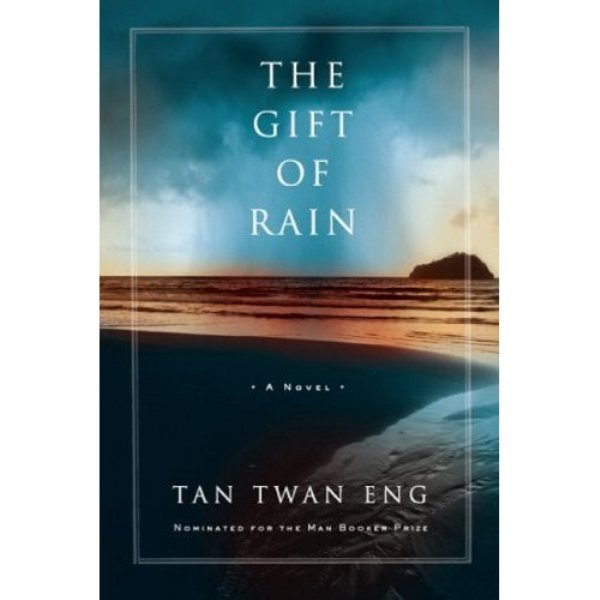
The Gift of Rain by Tan Twan Eng (Weinsten Books)

Philip Hutton, half Chinese, half British, is caught between two powerful cultures and two dynamic families while feeling as though he belongs to neither. Told by a fortuneteller that he "was born with the gift of rain," the element that exists in the space between sky and earth and carries with it both life and destruction, he knows that is his own natural state--caught in the middle without a place that is truly welcoming--until a Japanese stranger enters his life.

giftofrain.jpg

Endo-san is a master of the martial art of aikijutsu, and Philip becomes his student. The harmony and balance of the practice, with its discipline over both body and mind, begins to provide a bridge between the divergent halves of Philip's life,while the friendship and guidance of Endo-san give him the attention that he has never known that he has missed. Slowly the resolution between the mental and the physical that he has learned in aikjutsu begins to permeate other parts of Philip's life, and the disparate elements of his mingled heritage start to cohere for him. Then the war begins, the Japanese invade Malaysia, the British abandon the country, and the world as Philip knows it falls into pieces. With the realization that his family is endangered and that his closest friend is an integral part of the invading forces, Philip begins to make choices that brand him as a traitor, lead to the death of people he loves, and haunt him for the rest of his life.

If it simply offered a passport to a time that has disappeared and a glimpse of the horror and the heroism that are spawned by war, The Gift of Rain does this so well that it would still be an unforgettable piece of fiction. Yet that is only part of what this book does. The Malaysian island of Penang, a piece of the world that both Philip's British and Chinese families are rooted to, is given a central place in this novel and is described in such powerful, evocative detail that it claims the heart of the reader as completely as it does Philip's. From the mouthwatering array of food on its streets, to the amazing diversity of its neighborhoods, to the magnificence of its prewar houses, to the sound of rain dripping from its trees, it is generously and wonderfully given form throughout the book.

So are the complexities of love in its many guises, the mystery of looking at someone never seen before with complete recognition, the question of past lives, and the torment of free will with its attendant curse of choice. Memory and loss, age and acceptance, duty and longing, these threads in the fabric of Philip Hutton's life are examined with such intelligence and grace that they transform this novel without ever threatening to overwhelm its story. This is the mark of a writer to watch; this is The Gift of Rain.

The Latehomecomer by Kao Kalia Yang (Coffee House Press)

"What are you?" was a question frequently posed to Kao Kalia Yang when she was learning to talk. The answer, she quickly learned, wasn't "a name or a gender, it was a people."

"I am Hmong," she would reply.

latehomecomer.jpg

Born in a Thai refugee camp, a child of two people who had met after fleeing to the Laos jungle when the Pathet Lao had deposed that country's monarchy, Kao and her family are in search of a home, as Hmong people have throughout history. From China to Laos, from fighting with Americans in Laos' "secret war" that accompanied the war in Vietnam to becoming the hunted prey of the victors that they had opposed, the Hmong once again found themselves on the move, carrying their history and culture within the minds of their people to a new country that would hold them and their shared identity.

For Kao and her family, the repository of history and culture is their grandmother, who is a shaman and a traditional healer. While in the refugee camps, Thai soldiers who guard the Hmong recognize her powers and come to her to cure their ailments, allowing her to go away from the confines of the camps and gather the plants that she uses in her remedies. She knows how to approach unseen worlds to call home the wandering spirits of living people who have been jarred too harshly by life. She is the one who holds ancient stories of the Hmong in her memory and teaches them to Kao and her sister.

After the family is sent to America, power within it shifts to those who are quickest to master English--except for the grandmother, who keeps her influence and her position as matriarch. In a strange country surrounded by a foreign language that she will never learn, she carries the knowledge of who her family is, and where they have come from.

When Kao becomes mysteriously ill, it is her grandmother's gift that saves her. "Grow beautiful in America," her grandmother tells her, and Kao obeys. As a student at the University of Minnesota, she begins to collect her grandmother's stories, while realizing that she will be the one who will carry the story of her grandmother's life--and death--to tell Hmong children who are born and grow up in America. She will be the one to carry her grandmother's own story, as well as the ones of people Kao never knew who lived and died in Asia, within her blood and bones.

It is not only Hmong children who benefit from this memoir. "I wanted the world to know how it was to be Hmong long ago, how it was to be Hmong in America, and how it was to die Hmong in America, because I knew our lives would not happen again." Through showing the world the life of her grandmother, Kao has revealed the life and history of a people, and all who read this book are richer for having received the gift of what she has written.

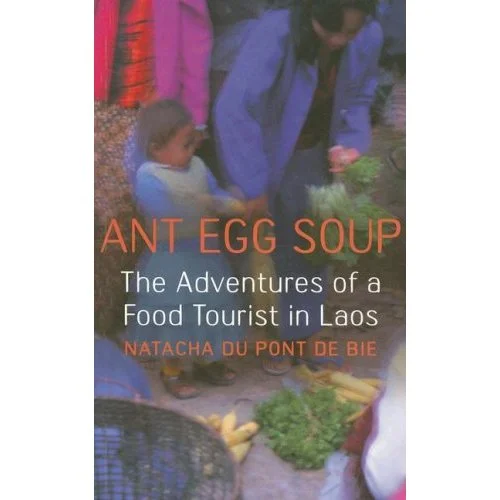
Ant Egg Soup by Natacha Du Pont De Bie (Sceptre Books)

If you believe that one of the main reasons to travel is to find new things to eat and if your favorite souvenirs are recipes from the countries you explore, then Natacha Du Pont De Bie is going to be your new best friend. She's the kind of woman who goes to a country simply because she's intrigued by its food, "a tourist with an inquisitive nature and an empty stomach."

Discovering that there was only one book in print written in English about the cuisine of Laos, she tracked it down, found the man who published it, Alan Davidson,and learned that he as the former British Ambassador to Laos had been given a collection of royal recipes by the Crown Prince, shortly before the monarchy was dissolved by the Pathet Lao. That was enough to send Natacha to Laos, and in 2000 off she went with her copy of Traditional Recipes of Laos, determined to meet people who would show her how different contemporary Lao cooking was from that which had been set before the King.

largeant.jpg

Arriving in Vientiane just in time for lunch, she throws herself on the mercy of the man who stamps her passport in the airport and is immediately taken to eat raw laap. This may not be the most conventional introduction to Lao food for the beginner but Natacha loves it, telling both the reasons why and how to make it in kitchens far from Laos.

There are far too few books about traveling and eating in Laos, and for that reason alone this book stands out. But to recommend it on those grounds alone would be unfair to Natacha. She's a traveler who wants to go everywhere, eat everything, talk with her mouth full, peer over shoulders in every kitchen--and then tell stories about it all. She's not averse to drinking too much Beer Lao, or even more disastrously lao-lao, but is up the next morning to see what's for breakfast (coffee, bananas, rice balls, baguettes, honey, chili sauce, sticky rice and home-made papaya jam greet her during her first Lao hangover.)

She's the kind of woman who's never met a market she didn't like, and her journey through Laos is studded with descriptions of markets and how to cook the food that's sold there. And she's clever enough to go with people who can show her food that won't be found outside of Laos' national borders--like a sliver of wood called sa-khan that's put in stews and tastes "faintly metallic with a mere trace of clove" which,she says,"made the inside of my mouth tingle and zing" and gives plain water the flavor of lemon. Ant eggs have a mild, nutty flavor that prompts her to call them the "caviar of Laos" and she tells how to cook them, if you can find them frozen or canned. Or better yet, just follow in Natacha's footsteps and eat them in Salavan on the edge of the Bolaven Plateau. I certainly plan to--and I'll probably be there in the company of my battered and travel-worn copy of Ant Egg Soup.

The Girl from the Coast by Pramoedya Ananta Toer (Hyperion Books)

She was small and beautiful and only fourteen when she was taken from her seaside village in Java. Carried in the unfamiliar luxury of a carriage, wearing gold and clothes more elaborate than she had ever known before, she was given in marriage to an aristocrat in the city, a man powerful enough that he had no need to rouse himself from his afternoon nap to witness his new bride's arrival. So young that she had not yet begun her monthly cycles, married to a dagger that had represented her husband during the wedding ceremony, the girl was still a child, a fisherman's daughter who had been happy while living among wind, waves and boats and unaware that she was poor until the day that she was enveloped in wealth.

girl.jpg

Bathed in perfume-scented water, adorned with rouge and kohl, in a house where her handmaiden is her only companion and her husband is a stern, soft-handed stranger, the girl becomes a stranger to herself, without a name and without an occupation. Her face is no longer her own, and her life is so truncated that she has no appetite for the food that is plentiful and delicious. Her freedom goes no farther than the garden wall that encloses the house she lives in, and she has lost the ability to give, since nothing that has been presented to her is truly hers. She is taught to recite the Koran by rote without understanding the words she recites, she learns to bake cakes, embroider, turn white cloth into batik. Her hands lose their roughness and her skin turns pale; her wishes are immediately granted by her servants but the girl knows the only real power rests with her husband. She understands that her presence in his house has no more significance than a chair or a mattress; she too is her husband's property. Her life, she realizes, will change only when she becomes a mother, and it does, in ways that she could never have imagined.

Her story has the magic of a fairytale and the power and resonance of a fable, yet it is true. It is one of the world's great writers' tribute to his grandmother, and to the strength and resilience of women who own nothing but their own characters. Imprisoned for his political beliefs for more than seventeen years, Pramoedya Ananta Toer wrote over thirty books and would have accomplished even more, were it not that some were destroyed by the Indonesian military. Among the books that were lost were the two volumes that would have turned this book into a trilogy tracing the history of Toer's family.

Standing alone, this is still a masterpiece. Through the story of an unnamed girl, Toer intertwines true facts with magic realism and offers up a whole world--of large injustices and small triumphs, of the value provided by closely knit communities and the loneliness that can come with affluence, and of the power of stories to keep spirits alive. This is a splendid introduction to a breathtaking body of work as well as a book that would have gained Toer acclaim if it had been the only one that he ever wrote.

The Fragile Edge by Julia Whitty (Houghton Mifflin)


In a world where any of us can go anywhere for the price of a plane ticket, there is one frontier that is for the most part unexplored and uninhabited by human beings. It is a place filled with blazing colors, and sounds that seem to come from our deepest dreams, and intricate social structures. Only a handful of people have ever ventured to it--one of them, fortunately for those who love to read, is Julia Whitty, who has been to the depths of the Pacific Ocean and describes what she found there in words so vivid that no photographs are necessary.

The world of water is a world without our language and one that exists largely outside of our senses, Whitty explains. Underwater, humans have no words. "We smell nothing underwater (although the sea is filled with scents), taste only the metallic tang of compressed air, see poorly, and are reduced to nondirectional hearing; in effect we're disabled." What people experience in the depths of the sea "tends to be felt, rather than accurately remembered."

The coral reefs of the South Pacific atolls provide the aquatic communities that Whitty shows her readers. The water is filled with dusky damselfish, "small strangely pugnacious gray fish," who serve as guardians of the coral by aggressively protecting their gardens of algae that grow upon the reefs. Tiny fish minister to larger ones in "cleaning stations," eating fragments of food found between predatory teeth or debriding the flesh of wounded fish, who wait in queues for the cleaner's attentions. Human divers who approach the cleaners "quietly, holding out some battered part" can also receive their services, which Whitty describes as "nibbles as tender as kisses." Plants that measure the tiniest fraction of an inch, glistening with bioluminescence, illuminate the fish that eat them and turn waves into "incandescent waterfalls of radiance."

This is a world where a moray eel can become a diver's familiar escort, where baby reef sharks are so appealing that people who know better are tempted beyond their strength to cuddle them like infants, and where the song of a distant humpback whale, Whitty says, is "less a sound than an itchy vibration in my bones and teeth." While "humans live by light," the ocean world is one that is ruled by sound, emitting a perpetual low hum that scientists believe could be the sound of storm energy that is converted to seismic waves, becoming "the conversation between the sea and the sky."

Bangkok Blondes by The Bangkok Women's Writers Group (Bangkok Book House)

Sporting heavily bleached hair extensions that were once silky, black strands on a Thai girl's head, learning how to rid an apartment of its resident ghost, finding a future husband at a market stall, eating lunch on Christmas Day with murderers and drug dealers--welcome to the world of the Bangkok Blondes.

bblondes.jpg

They're not exclusively blondes, these articulate women who live in Bangkok, and they are definitely not the chick-lit purveyors that the title and cover of this anthology might imply. They are writers who give a multi-faceted and unstereotypical view of a city that they all know well.

For decades, books about Bangkok have been dominated by the perspective of the Barstool Buddhists, those old Bangkok hands who, to a man, have suffered at the soft and gentle hands of Thai girls and have lived to tell, and retell, the tale. (Notable exceptions to this school of writing are Colin Cotterill and Jim Eckardt, authors who have gone beyond the bar scene with praiseworthy literary results.) For a woman's take on Thailand's capital city, readers could choose either Carol Hollinger's classic Mai Pen Rai (Means Never Mind) or Karen Connelly's classic Touch the Dragon (published in the U.S. as Dream of a Thousand Lives). And that was all she wrote--until the Bangkok Women's Writers Group came along.

A collection of personal essays and fiction with a smattering of poetry, Bangkok Blondes provides an honest, idiosyncratic view of the eastern hemisphere's City of Angels. Jess Tansutat, the volume's sole Thai contributor says in her outstanding essay, The Butterfly Game, "For me, the "city of angels" seems to have just too many angels." She handles the difficulty of dating in Bangkok with objectivity, wisdom, and humor, and then the book moves on--no whining, no sniveling--to other facets of Bangkok life.

Pursuing fitness, braving the language barrier in a hair salon, working as an extra on a television commercial, making it past cultural hurdles with Thai boyfriends are stories that are fun to read but aren't unexpected topics. Examining Thai culture while driving in a city that has taken the traffic jam to an art form, playing the Bangkok version of Russian Roulette by riding side-saddle on the back of a motorcycle taxi, living with a statue of the Buddha that's taken on a disconcerting life of its own, undergoing colonic therapy, braving the wild confusion of Romanized Thai and English that has been thoroughly reinvented: these are all things that could only be written by people with open minds and hearts who have willingly submitted to another culture, and that make this collection one to seek out and read.

The pure joy of a book like Bangkok Blondes is discovering new voices. The frustration of it is longing for more from particular voices--Martha Scherzer, Chloe Trindall, Jess Tansutat, Zoe Popham are all writers who should be working on their very own books. But this is only one opinion. Every reader of Bangkok Blondes will discover her own favorite writer--like a box of good chocolates, this book has a wide variety of choices and something for every taste.

Sacred Games by Vikram Chandra (HarperCollins)

Nobody knows why Ganesh Gaitonde, a man who controls at least half of the underworld in Bombay, would choose to give himself up to a lowly police inspector like Sartaj Singh--least of all Sartaj himself. Nobody knows why Gaitonde has sequestered himself in a concrete building that resembles a cube, why he tells Sartaj the story of his criminal beginnings while the police lay siege to the bunker, and why the body of a woman lies beside Gaitonde's corpse when Sartaj reaches the heart of the stronghold. And nobody knows why agents from India's foreign intelligence agency, RAW, take charge of the post-mortem scene and order Sartaj to ferret out the details that will explain the inexplicable.

sacredgames.jpg

Sartaj, a man who was once chosen by a women's magazine as one of "The City's Best-Looking Bachelors," is in the throes of a full-blown midlife crisis, "past forty, a divorced police inspector with middling professional prospects…just pedaling along, doing his job." He's lost his youthful belief that he could "hold the whole city in his heart." When he begins to investigate the life and death of one of the most powerful men in India, his own life starts to expand as he uncovers other people's secrets.

Bombay is a city filled with people who have moved there to recreate themselves, and secrets are perhaps its most valuable currency, upon which power rests. Everyone—the beautiful movie star whose photographs fuel magazine sales, the woman who was Gaitonde's best friend for years without ever meeting him face-to-face, Sartaj's professional mentor who has known him since childhood, Sartaj's mother—has an untold history that forms the base of their visible lives.

As Sartaj explores the mysteries that surround the death of Gaitonde, he is led deep into the heart of Bombay, into his own heart, and into a world beyond, where corruption and greed can lead to annihilation. The mythic life of Gaitonde becomes smaller and more human, while other forces stretch beyond India's borders, and the terror of 9/11 presages the end of the Kaliyug period.

While Sartaj's investigation takes shape, so does the city that he lives in. Vikram Chandra has a Dickensian skill for bringing life to a multitude of characters who at first seem to be a random cluster, but who fit together like a jigsaw puzzle. When all of their stories fall into place, piece by piece Bombay is brought into being—its dark corners, its blaze of vitality, "the jammed jumble of cars, and the thickets of slums, and the long loops of rails, and the swarms of people, and the radio music in the bazaars." This book is far more than a subcontintental version of The Godfather, or the middle-aged love story of Sartaj, a wounded romantic who learns that "to be rescued from one’s foolishness was the greatest tenderness." It’s a portrait of Bombay, of Mumbai, and to read it is to "hold the whole city" in your hands and perhaps in your heart.

Smile When You're Lying by Chuck Thompson (Holt Paperback)

smile.jpg

I love to travel, I love to eat, and I love reading magazines. Staring at the passing landscape from a comfortable train seat and contemplating my next meal, with a small stack of glossy magazines close at hand, is what I hope awaits me after death if I behave myself in this life. Obviously I must be an indefatigable fan of those magazines that are devoted to food or travel, right?

Wrong. Heaven knows I’ve tried to read them. I’ve even bought a few, seduced by their glorious photographs, but every time I’ve gotten past the images, my eyes glaze over, my brain becomes paralyzed from the non-stop barrage of adjectives, and I begin to long for something else to read-- perhaps the back of a cereal box or the label on a bottle of aspirin.

If this sounds a trifle harsh, let me assure you it is mild compared to the blazingly funny critique of travel writing offered by Chuck Thompson, a man who has made his living for years writing for and about "the world’s second-largest commercial enterprise." He’s also a writer who has left most of his best stories unwritten, to be told only in the presence of alcohol and in the company of good friends—until now.

A boy from Juneau, Alaska, Thompson grew up surrounded by the tourist industry and its over-used superlatives. It doesn’t take too many encounters with phrases like "spectacular glaciers" and "the charm of the Gold Rush" or one or two cruise ships filled with souvenir-buyers to turn any lad into a cynic and a traveler who knows that whatever is being touted should probably be ignored, whether it’s described by a glossy brochure or Lonely Planet.

Chuck Thompson is all that and a fine writer too. He opens his book with what promises to be just another story about a Bangkok blowjob bar that is going to substitute one set of clichés for a cluster that is equally time-worn but oh so edgy, and then makes it completely original and entirely his own with his closing sentence. And right from that beginning, when they are whisked away from the perils of reading a watered-down William Vollmann, readers know that they are in for a good time—because the author certainly is.

Thompson is a force to be argued with, and there are going to be many moments when his readers long to do that. Freed from the advertorial school of magazine writing, he never loses an opportunity to voice an opinion or to describe an encounter that’s just a wee bit on the seamy side and guaranteed to make the most politically correct choke on their decaf soymilk lattes while laughing. "It’s a shame," he admits, "but the fact stands that potential sodomy is more entertaining than clement weather, reliable public services, and obedient citizenry." Yup, that it is, when it’s a story told by someone who knows how to tell it, as is the one about writing a letter for an aging lady of dubious virtue on an idyllic Thai island or another that explains why a Japanese friend was nicknamed "Firehose."

Although it’s quite possible that he may not live to write a follow-up, because if Paul Theroux hasn’t put out a contract on him, certainly Lonely Planet will, Chuck Thompson has created a whole new spectrum of travel writing and a book that you can give to everyone on your holiday gift list—or at least for all who already have been endowed with a sense of humor.

Travels in the East by Donald Richie (Stone Bridge Press)

If you are an independent traveler who relishes solitude yet occasionally wishes for another person's voice and vision, you need to pop this tiny volume into your luggage. Donald Richie's newest book is the perfect accompaniment to any journey, whether it's still in the planning stages, is already on the open road, or will never go beyond the expanses of a cozy armchair.

travels.jpg

A man who left the United States to live most of his life in Japan, Richie is well aware of the privileges and limitations that come with spending short periods of time in other countries. Travel, he points out, "is freedom from captivity." Yet when travelers are in places where they cannot speak the language, it also can turn them into "no one at all."

This liability of being no one brings its own form of liberation. Without the demands of customary human interaction, travelers can become cameras, having no responsibilities except to absorb, consider, and record everything they have come to see. And that is where the challenge lies--suddenly the world is transformed into a blur of beauty and amazement. Describing it turns into a vocabulary test. Travel journals, despite the best of intentions, run the risk of becoming repositories for those desperate sentences that are usually found on the backs of postcards--unless the writer is Donald Richie.

This man doesn't leave his knowledge and experience at home when he goes exploring, and he never fails to bring originality of perspective and of language to the places that he visits. Pointing out that there is a vast difference between visiting a destination that's so far along the road less traveled that it is rarely ever heard of, and going somewhere so famous that a visitor has a connection with it long before actually being there, Richie revels in experiencing the places he goes to, and then recreating that experience for his readers. For him, viewing the Great Pyramids or the splendors of Cambodia's temples is an adventure as fresh and untarnished as going to Bhutan or Mongolia.

In Egypt, "in the cold shadow of Cheops" on the Geza plateau, he finds a profile from an ancient bas-relief on the face of the camel driver who is his guide, and a direct line is drawn from the present to the past and its men who built pyramids from stones "as big as a Toyota." At Angkor, while trying to understand the extent of the entire area, he realizes it is roughly the same size as inner Washington D.C. Suddenly he imagines the ruins of that modern capital being toured in the same way that Angkor is now, by tourists wandering through it in a daze of awe and ignorance. In India he sees the future of the world, "when further billions are born and have nowhere to go," and then recognizes in the erotic temple carvings of Khajuraho that sheer joy of "this beautiful, irresistible urge" that will soon overcrowd the planet.

As well as examining destinations, Richie takes a close look at the act of travel, and at those who pursue it. "Why," he asks himself while lying on an idyllic Krabi beach, "are tourists so horny?" He decides that for people who are in "a new environment, cut from the past and plunked into an alien present," often without language and the power that it confers, sex helps to reestablish a "sense of self." While his readers may or may not agree with him, he certainly does give everyone something to ponder.

As he does when recounting a conversation in Japan about the art of using lacquer, where he is told by "a portly gentleman" that there is no more lacquer because it can't be made by robots. "They're all around--young robots. They can't read anything but comic books and they perm their hair and they can't think. Robots already--that's what they are." And then, Richie says, "we drink our tea in that agreeable silence left when undoubted truths have been voiced."

May we all have the pleasure of drinking our own tea, or beer, or Scotch in that agreeable silence that comes when traveling with Donald Richie.~Janet Brown

Tokyo Year Zero by David Peace (Knopf)

It is the world after the Apocalypse, bombed, burned-out and ravenous. People starve while lice feast on their skin and in their hair. Lured by the promise of food, young women follow men they have never seen before, and little boys play at being soldiers, joined by little girls who play at being streetwalkers. The smell of death is well known; it's the stench of rotten apricots. Nothing makes sense and no one is who they appear to be. The Victors are the only people who are not locked in a nightmare, and criminals are the rulers of the marketplace. The war is over and this is Tokyo in 1946.

TokyoYearZero.jpg

In this broken city, corpses are not unusual and people are haunted by death. Black scorched concrete and the charred remnants of houses stand as memorials to the thousands of people who died in barrages of firebombs, while the noise of jackhammers working to rebuild what was destroyed punctuates every other activity. For Detective Minami, a Tokyo policeman, the dead from the past are so real to him that only sedatives will allow him to sleep. He’s a man whose life is almost robotic. He works, he brings food to his family, he makes quick visits to a woman who, he says "haunts me."

"I am one of the survivors," he tells himself bitterly and repeatedly, "one of the lucky ones."

The bodies of young women who were raped and strangled are found in a city park, and the police begin the task of discovering their identities and finding their killer. Minami becomes immersed in a hell that is composed of his war memories and of the terrible truths that he is forced to learn by doing his job—finding a murderer whose past he shares.

And we join him there. This is not a novel that leaves the reader unmoved and unscathed. Through Minami, we become inhabited by the world that he roams through. His repeated phrases begin to drive us as crazy as his body lice drive him. His hunger becomes ours and we feel the bile that he persistently vomits rising in our own throats.

David Peace uses the cadence of rock and roll and the onomatopoeic language usually associated with comic strips to carry us deeply into this book, along with words that are so piercing that it often feels as though he is writing in a whole new language. His artistry and his storytelling hold us captive in a landscape that we would prefer not to see, and yet his skill makes it impossible for us to turn away.

Once in every couple of decades, just when fiction seems as though it is really and truly dead, along comes a book that turns upside down and inside out everything that we think we know about storytelling. Like On the Road, Catch 22, or All the Pretty Horses, Tokyo Year Zero redefines what a novel can be, and what a novel can do. Read it.~Janet Brown

Running In the Family by Michael Ondaatje (Vintage Books)

"It was a new winter and I was already dreaming of Asia." With a dozen crisp words, Michael Ondaatje goes to the core of what it is to live in a cold country while yearning to return to a world of color and light. Born in Sri Lanka and irrevocably shaped by it, Ondaatje gives voice to what many people feel and are unable to articulate. With memories, vivid descriptions and poetry, he catches the shimmer and fragrance of a place that he loves and then gives it to those who struggle to do the same, and fail.

ondaatje.jpg

Ondaatje's family is so rooted in Sri Lanka that "everyone was related and had Sinhalese, Tamil, Dutch, British and Burgher blood in them going back many generations." "God alone knows, your Excellency," was the reply given to a British governor who asked one of them his nationality.

These are people whose stories fill an island, whose names are chiseled in the stone of a church built in 1650, whose exploits still linger in houses first inhabited in 1700, and who continue to tell about the remarkable end of an ancestor who was "savaged to pieces by his own horse."

"There are so many ghosts here," Ondaatje says and then brilliantly brings them back to life: his grandmother "who died in the blue arms of a jacaranda tree," his parents who whirled through the 1920s in a dazzling chaos of cocktails, dancing, and gambling, a forebear who kept biological notebooks cataloging "at least fifty-five species of poison" that could be found in this island paradise, including "ground blue peacock stones."

Sri Lanka was the breeding ground for these beautiful, reckless and mythic people; it claimed them and held them in the same way that it claims and holds this book. A country with "eighteen ways of describing the smell of a durian," where a monitor lizard's tongue, cut in half and swallowed whole, will give the child who eats it the gift of brilliant speech, if it doesn't kill him first, Sri Lanka is, Ondaatje says, "a place so rich that I had to select senses" while observing it.

Through his eyes and voice comes the scent of cinnamon, rich on the skin of the wife of the man who peels it for a living, the darkness of a jungle "suddenly alive with disturbed peacocks," the shadowed figures of men standing by the side of a road, "urinating into darkness and mysterious foliage," the warmth and the smell and the feel of "slow air pinned down by rain."

"We own the country we grow up in," he tells us, while offering the one he owns to us, so generously that we can feel it in our skin and so vividly that whatever part of Asia that might inhabit our memories is suddenly alive in every one of our skin cells. Throughout the coldest winter, this book will bring the gift of heat, of flowers that "flourish and die within a month" and are instantly replaced by more, of "the lovely swallowing of thick night air" and the dreams that it carries. It's a gift wholeheartedly given by a man who can evoke a world and make it breathe forever with his wondrous and lovely words.~Janet Brown

The Father of All Things by Tom Bissell (Pantheon)

father_l[1].jpg

Images and memories usually emerge in a tangled coil when Americans remember the Vietnam War. It's a time that refuses to take on the detachment that comes with becoming part of past history, remaining so unexamined and raw that it still haunts two nations. For many in the United States, the demand of "Peace now" that echoed through the 60s remains unfulfilled, and the issues that divided the country then continue to gape, unbridged, decades after the war came to an end.

Tom Bissell's family history, like that of many children born in the 70s, was intertwined with this war. His father was changed by it, his parents' marriage was destroyed by it, and Bissell grew up with Vietnam on his mind, struggling to learn about his father's time there.

Given the chance to travel to Vietnam with his father, Bissell finds that his carefully acquired abstract facts find a kind of uneasy alliance with the visceral recollections that the country pulls from ex-Marine Captain John Bissell. Skillfully blending military history with his father's memories, Bissell provides a picture of Vietnam, both in the past and during the present, that is harrowing, beautiful and at times surprisingly funny. (This is a family vacation after all, as well as an excavation of a soldier's past, and Bissell is an adult child with snake phobia.)

He shows the war from both sides, giving equal respect to U.S. and Vietnamese soldiers, without glossing over the horrors that were forced upon men and changed them forever. John Bissell, a man known to his fellow-soldiers as "Nice Guy," finds himself killing women who are shooting at him with Kalashnikovs in battle. "War is its own country," Bissell reminds us, "and creates its own citizens."

This is a book that offers no easy answers in its discussion of this particular war and the lessons that it carries over to the present day. Bissell's retelling of how the U.S. removed itself from Vietnam is stark, brutal, and essential for America to remember as it contemplates a withdrawal from Iraq. The memories that his father dredges up are pieces of truth that need to be kept in mind as military personnel return home from the Middle East.

"One of the books I read says that World War II taught its generation that the world is dark but essentially just. Vietnam taught its generation that the world is absurd," Tom Bissell tells his father.

"That's horseshit," his father replies in their continuing argumentative discussion that proves to be honest, loving, and illuminating.

The lessons of the Vietnam War have yet to be fully discussed, but these two men provide a fine example of how to begin, how to listen, and how to come to an internal and personal peace.~Janet Brown

Asian Godfathers by Joe Studwell (Atlantic Monthly Press)

You can't judge a book by its cover, or in this case by its title either. Anyone who fails to keep that tired old truism in mind when buying Joe Studwell's latest is in for a very big surprise. This book is not a rollicking romp through the Asian underworld, or the sort of glossy, glitzy true crime extravaganza that poses as investigative journalism. After all, Mr. Studwell writes for the Economist, not for Vanity Fair, and he admits that his title "is more than a little tongue-in-cheek."

Tycoons is the correct term for these "colourful, obscenely rich and interesting people" who dominate the economic turf of Hong Kong, Malaysia, the Philippines, Thailand, and Indonesia. Governments come and go, underworld figures rise and are deposed, but the tycoons continue to flourish. Not even the economic meltdown of the late 90s significantly diminished their fortunes. Instead many of them became even more wealthy during that financial bloodbath.

asiangodfathers.jpg

Immigration and colonialism were the groundwork from which these fortunes came. The large influx of Chinese, Arabs, Persians, and Indians provided a hungry and willing labor force for colonial powers, eventually becoming "economic entrepreneurs," while the local aristocracy were used to govern the native population, becoming "political entrepreneurs." Long after the disappearance of colonialism, these divisions still remain in place.

Mr. Studwell makes it clear that the wealth of the tycoons is based upon monopolies, cartels, and perhaps most of all, a hardworking and frugal labor force who are encouraged, if not forced, to use saving accounts. Banks in Hong Kong and Southeast Asia, with their huge pool of "excessive savers," are ready sources of investment capital and "money makes more money."

Putting much of the blame for the Asian financial crisis upon the tycoons and their freewheeling financial practices, this book bristles with fierce economic facts that will deter many a casual reader. Those who persist will be horrified by the rapidity with which a region's economic structure can be reduced to rubble, and may wonder not if, but when, their own financial security will be devoured by shortsighted greed.

In the midst of all of the history and the economic gloom and the politics that are straightforwardly corrupt, the tycoons, the "godfathers," prevail through the book with the same resilience and charisma that sustain them in life. Chin Sophonpanich, the Thai creator of one of Southeast Asia's leading banks, is remembered by another financial leader as "absolutely charming—he had about six mistresses." Li Ka-shing, number ten on the 2006 Forbes list of the world's richest men, responded to the kidnapping of his son by withdrawing one billion Hong Kong dollars in cash, so huge a sum that the kidnapper couldn't fit it all into his car and had to make two trips to carry it away. An unnamed tycoon, whose son was sent a box of chocolates by a business rival, told his offspring to feed a piece to his dog, and if that wasn't fatal, "try one on his wife."

Although Mr. Studwell concludes with the confession that he used the "godfathers" as a "structural sleight" to convey a larger history, ultimately they take possession of his book with the same ease and expertise that they would absorb any encroachment on their territory. And why not? It all belongs to them.~Janet Brown

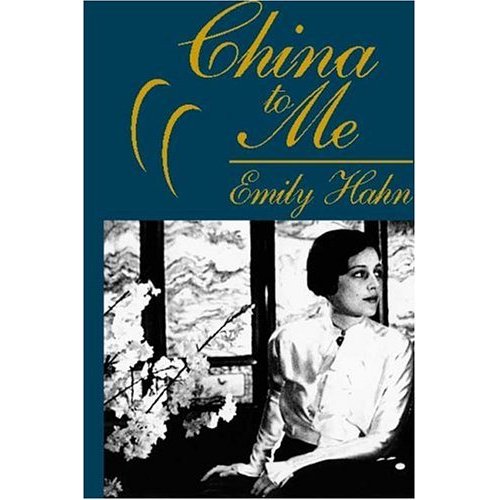
China To Me by Emily Hahn (out of print in the United States)

chinatome.jpg

Emily Hahn was brilliant, beautiful and shameless. Arriving in Shanghai in 1935, she rapidly scandalized the city's community of Westerners by taking up a Chinese lover, an addiction to opium and a gibbon named Mr. Mills, who was her constant escort. (She was once enraged by a dinner party invitation that ended with "Regret we cannot extend the invitation to Mr. Mills.") Later, when Emily announced that she and Charles Boxer, a married British army officer, were going to have a child, an American dowager's huffy response was, "Some women will stop at nothing to bring discredit to our nation."

Although her personal life makes dazzling reading, if that were all there was to Emily Hahn, it would be easy to dismiss her as a precursor to Bridget Jones. Emily, however, was no literary bimbo. She was a talented and professional writer who meticulously reported what she saw and how she lived in China before and during World War II.

Chosen by the Soong sisters to be their official biographer, Emily followed them to Chungking, where Japanese planes rained bombs upon Chiang Kai-shek's government and where Madame Chiang poured her legendary energy into making marmalade. Watching the bombing of the British Embassy while picnicking in the neighboring hills, Emily gives a vividly detailed description of the visual spectacle while confessing, "Sometimes it was too much for our nerves."

When World War II began and Japanese troops seized Hong Kong, Emily was there, with her newborn daughter whose father was now a wounded prisoner of war. It was a time during which she resisted the melodrama that could well have taken over her life. Death, starvation, looting and rape are all in the backdrop of Emily’s story, while never being allowed center stage. As she manages to find food for her baby and for Charles, as she makes her way through the Japanese bureaucracy in a successful attempt to stay out of an internment camp, as she learns how to maneuver in a black market economy, Emily tells her story in the calm, dispassionate tones of a woman who had no energy to spare for flamboyant emotional displays.

Explaining why gold and diamonds are the key to wartime survival, or the stark terror felt after waking up after a night of serious drinking to discover that while in her cups she had slapped the Japanese chief of Foreign Affairs, or the shame of listening to American propaganda broadcasts that extolled the success of bombing raids on Hong Kong which had in truth accomplished nothing at all, Emily gives a clear and rarely seen picture of war, the one that is shared by the noncombatants who struggle to survive.

Emily rather unfairly dismissed China To Me as an "egotistical history" but generations of readers have given it the status of a classic. As resilient as Ms. Hahn herself, this book has bounced in and out of print since it was first published in 1946, and waits now in used bookstores across the world to be rediscovered one more time.~Janet Brown